By The Education Magazine | Updated: March 13, 2026
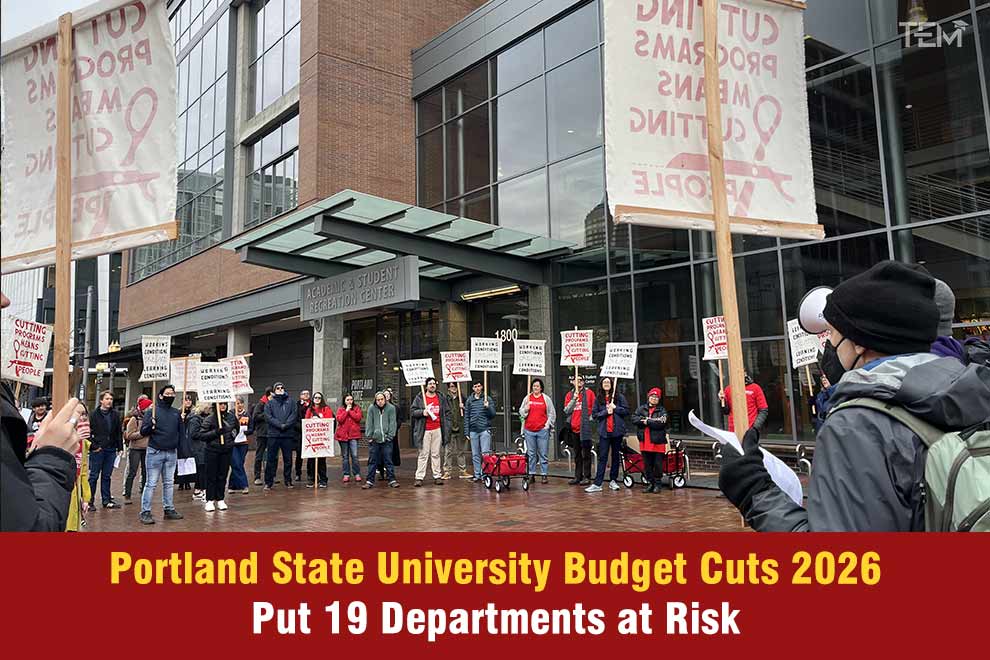
The Portland State University budget cuts took a decisive turn Monday when President Ann Cudd confirmed the university will pursue retrenchment, a rarely used mechanism allowing institutions to eliminate programs and lay off faculty under severe financial distress to close a $35 million structural deficit by the end of the 2026–27 school year.
“I’m taking this step because after reviewing the results of our work, it has become clear that our financial condition is such that departmental reductions or eliminations may be unavoidable,” she said.
A $35 Million Crisis Years in the Making
Oregon’s third-largest public university by enrollment has run back-to-back budget deficits for several years, driven by three compounding pressures:
- A 23 % decline in student headcount since 2019, part of a broader pattern of declining college enrollment reshaping public universities nationwide.
- Escalating infrastructure and operating expenses.
- Stagnant financial support from the state of Oregon.
The board of trustees has also directed Cudd to stop drawing on university reserves to fund operations, a directive that directly triggered Monday’s announcement.
The move also reflects a hard lesson learned. An independent arbitrator ruled in early 2026 that PSU had improperly laid off faculty during the 2024–25 school year without following correct contractual procedures, forcing reinstatements.
Monday’s retrenchment is a deliberate course correction, a procedurally rigorous path that gives the university a stronger legal footing for workforce reductions.
Which Programs Are Under Review?
In a written notice to the PSU chapter of the American Association of University Professors (PSU-AAUP), Cudd identified departments spanning a wide range of disciplines. Three face potential full elimination:
- University Studies: the university’s interdisciplinary general education bachelor’s degree program.
- Conflict Resolution
- Portland Center: a study-abroad program for students from Japanese universities.
Eliminating University Studies would also directly impact six additional departments: English, Physics, Sociology, Women, Gender and Sexuality Studies, the School of Art + Design, and the School of Public Health.
Sixteen departments face potential reduction, including History, Philosophy, Economics, Politics and Global Affairs, World Languages and Literatures, Public Administration, Criminology and Criminal Justice, Educator Licensure, Leadership Learning and Counseling, and the School of Earth, Environment and Society.
The proposed cuts span certificate to doctoral-level offerings, a breadth of reductions that raises questions about PSU’s compliance with federal accreditation standards currently under review by the U.S. Department of Education.
Cudd confirmed that students in affected programs will be able to complete their degrees regardless of what changes occur.
Faculty and Students React
The response from campus has been swift. PSU-AAUP President Bill Knight said the university is “abdicating responsibility” by not approaching the process with more patience.
Unlike Southern Oregon University, which secured emergency state funding, PSU has not requested similar intervention, a choice Knight publicly criticized.
He also warned that PSU could see up to 220 layoffs among full-time faculty and academic staff, though final numbers remain unclear. The faculty union called the administration’s approach “hasty and unimaginative,”
Faculty Senate President Matt Chorpenning was equally direct. “I’ve talked to several colleagues who are pretty certain that they’re not gonna have a job in a year. These kinds of worries drive down morale across campus at a time when it’s already pretty catastrophically low,” he said.
Students are equally shaken. Applied linguistics graduate student Demetra Adams-Kane said the proposal would be “laying off beloved faculty members who have been here for decades and cutting programs that really are the reason why students come to PSU.”
A Warning Sign for Higher Education Nationwide
PSU is not alone. According to the National Center for Education Statistics, undergraduate enrollment has been on a long-term downward trajectory nationally, a trend further complicated by proposed new federal student loan borrowing caps that analysts warn could accelerate enrollment declines at tuition-dependent universities.
Oregon State University missed enrollment projections for the first time in years in fall 2025. Southern Oregon University, which announced it could not cover its payroll by February 2027, recently received a $15 million emergency appropriation from state lawmakers.
PSU’s retrenchment process adds a third major data point to what is becoming a statewide pattern, and the decisions made in Portland this June may well become the template, or the cautionary tale, that guides how underfunded universities restructure in the years ahead.
What Happens Next
Retrenchment at PSU is a drawn-out process that heavily involves campus input, giving the PSU-AAUP union a formal chance to propose alternatives before any decisions are finalized.
How the Portland State University budget cuts ultimately unfold will not be known until university leadership announces its final plan in June 2026. Full details are available on PSU’s official website.
FAQs
- Can tenured professors actually lose their jobs through retrenchment?
Yes. While tenure typically protects faculty from dismissal, retrenchment is one of the few mechanisms that legally overrides that protection. When a university formally declares severe financial hardship, even tenured positions can be eliminated under the terms of the faculty union contract.
- Are other Oregon universities facing similar cuts?
Yes. Every major Oregon public university has announced budget shortfalls in 2026. PSU’s situation is among the most serious, but it is part of a statewide pattern, not an isolated case.