Reported by The Education Magazine | 2 February 2026
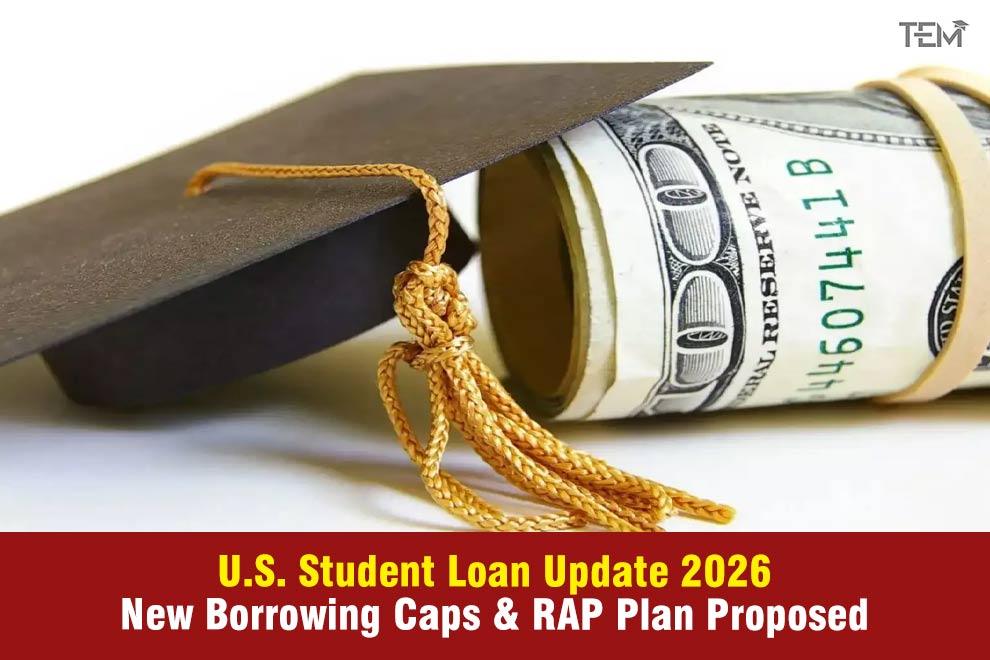
The U.S. Department of Education has proposed a new federal rule aimed at making higher education more affordable and simplifying how student loans are repaid.
The proposal, issued through a Notice of Proposed Rulemaking (NPRM), could reshape borrowing limits, repayment options, and loan management for millions of current and future borrowers. If finalized, the changes are expected to take effect in 2026.
Key Details of the Proposed Rule
The proposed regulation focuses on reducing borrower confusion and limiting excessive debt, especially for graduate and professional degrees.
Under the proposal, the Education Department plans to:
- Reduce the number of federal student loan repayment plans
- Introduce clearer and more predictable repayment structures
- Set new borrowing limits for graduate programs ($20,500/year) and professional programs ($50,000/year).
- Simplify the process for borrowers returning from loan default
Education officials said the changes are intended to align borrowing more closely with educational value and labor market outcomes.
What Is Changing: Old System vs. Proposed Rule
| Area | Current System | Proposed Changes |
| Repayment Options | Multiple income-driven plans with varying rules | Fewer, standardized repayment plans, including the new Repayment Assistance Plan (RAP). |
| Graduate Borrowing | Unlimited access through Grad PLUS loans | New annual caps: $20,500 (Grad) / $50,000 (Professional). |
| Loan Defaults | Complex rehabilitation processes | Two chances for simplified pathways back into repayment |
| Transparency | Inconsistent repayment expectations | Clearer, predictable payments. Includes 100% interest subsidy in RAP to prevent balance growth. |
Education officials say the proposed changes are designed to reduce borrower confusion, curb excessive debt accumulation, and align loan limits more closely with labor market outcomes.
How the Proposed Rule Affects Key Stakeholders
Students and Parents
- Clearer repayment structures with fewer plan options
- Strict limits on graduate and professional degree borrowing.
- Parent PLUS Context: New annual cap of $20,000 per student (with a $65,000 lifetime limit), ending the “borrow up to cost of attendance” model.
- Reduced risk of long-term over-indebtedness
- “Legacy Provision” protection for students enrolled before July 1, 2026, allowing them to keep current limits for up to three years.
Colleges and Universities
- Increased pressure to justify tuition costs, especially for graduate programs
- Possible enrollment shifts in high-cost degrees
- Greater scrutiny of student outcomes linked to borrowing levels
Educators
- Heightened focus on program value and employability outcomes
- Greater alignment between curriculum design and workforce readiness
Policymakers and Loan Servicers
- Streamlined repayment systems may reduce administrative burden
- Simplification could lead to lower default rates and improved compliance
A Global Perspective on Higher Education Affordability
The U.S. approach contrasts sharply with how other regions address the affordability of higher education. Across the European Higher Education Area (EHEA), governments are increasingly tightening centralized tuition controls while expanding publicly funded degree programs to limit student debt exposure.
Countries such as Germany, Norway, and Finland continue to offer low-cost or tuition-free higher education, relying primarily on public investment rather than individual borrowing. In this context, the U.S. proposal represents a middle path, maintaining a loan-based system while introducing stronger guardrails to protect borrowers and limit systemic risk.
For international students weighing U.S. education against alternatives abroad, affordability and clarity on repayment may become increasingly influential factors in decision-making.
What Happens Next
The proposed rule is now open for public comment through the federal rulemaking process. This framework, introduced under the One Big Beautiful Bill Act (OBBBA), seeks to stabilize the federal lending portfolio while addressing the rising costs of advanced degrees.Feedback from students, institutions, advocacy groups, and policymakers will shape the final version before implementation.
If adopted, the new framework is expected to take effect in 2026, potentially redefining how higher education is financed in the United States for years to come.
FAQs
- What is the main purpose of the proposed rule?
The rule aims to make higher education more affordable by simplifying how federal student loans are repaid and limiting excessive borrowing through new annual and aggregate caps under the One Big Beautiful Bill Act (OBBBA).
- Who would be affected by the changes?
The proposed rule would affect new and existing federal student loan borrowers, specifically by enforcing a new $257,500 total lifetime borrowing cap and eliminating Grad PLUS for new programs starting July 2026. Parent borrowers are also affected by new $20,000 annual caps per child.