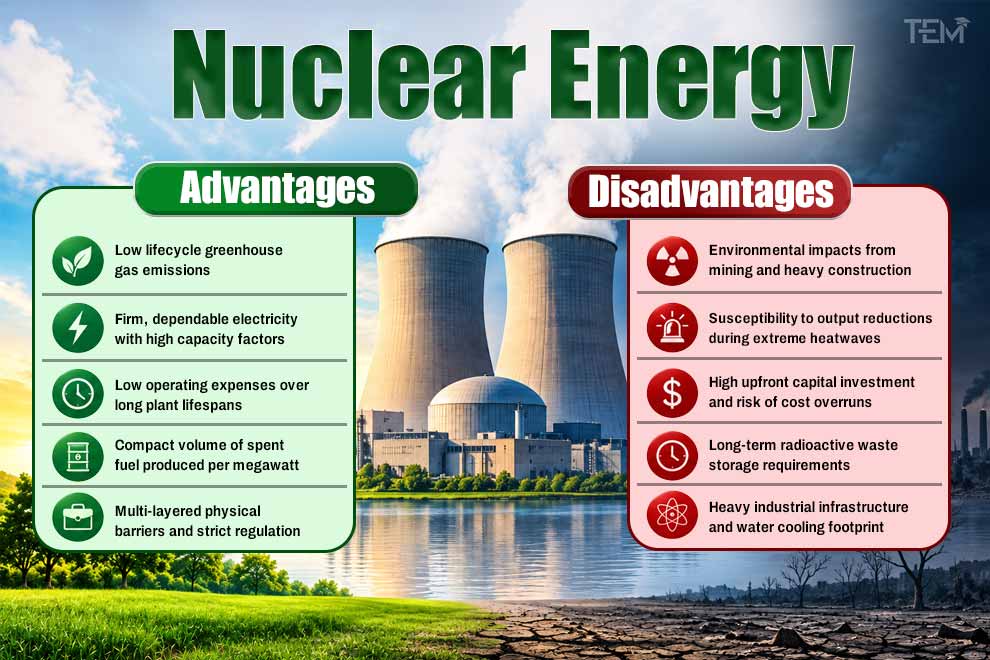
Evaluating nuclear energy advantages and disadvantages requires balancing low carbon emissions against high initial costs and long-term waste management. In 2024, global nuclear reactors generated a record amount of electricity, with major international datasets reporting more than 2,600 TWh. Nuclear power supports electricity reliability in many grids by providing firm, low-carbon generation.
However, severe construction cost overruns and unresolved long-term storage solutions for spent fuel remain persistent drawbacks.
This research report examines the economic, environmental, and technical facts shaping the nuclear industry in 2026 to help readers determine whether nuclear power is worth the trade-off.
Nuclear Energy Advantages and Disadvantages at a Glance
Understanding the balance between advantages and disadvantages requires examining key technical, economic, and environmental factors side by side. The following comparison table provides a direct summary of the main trade-offs in nuclear power generation.
| Evaluation Factor | Primary Advantage | Primary Disadvantage |
| Climate Impact | Low lifecycle greenhouse gas emissions | Environmental impacts from mining and heavy construction |
| Grid Reliability | Firm, dependable electricity with high capacity factors | Susceptibility to output reductions during extreme heatwaves |
| Project Cost | Low operating expenses over long plant lifespans | High upfront capital investment and risk of cost overruns |
| Waste Management | Compact volume of spent fuel produced per megawatt | Long-term radioactive waste storage requirements |
| Operational Safety | Multi-layered physical barriers and strict regulation | Low-probability but high-consequence severe accident risks |
| Land Efficiency | High energy output per unit of land occupied | Heavy industrial infrastructure and water cooling footprint |
Low Lifecycle Carbon Footprint
Nuclear energy generates electricity without burning carbon-based fuels, emitting zero direct greenhouse gases during reactor operations. However, calling nuclear power completely zero-emission across its entire life cycle is technically inaccurate. Minor greenhouse gas emissions occur during secondary phases of the fuel cycle, including uranium mining, milling, conversion, enrichment, fuel fabrication, concrete facility construction, and plant decommissioning.
Lifecycle assessments generally place nuclear power among the lowest-carbon electricity sources, although estimates vary depending on the methodology and assumptions used. International scientific evaluations, such as those by the United Nations Economic Commission for Europe, estimate lifecycle carbon emissions for nuclear power to be comparable to offshore wind power and significantly lower than utility-scale solar photovoltaic systems.
By comparison, fossil fuel facilities release heavy carbon volumes into the atmosphere. Over the past 50 years, commercial nuclear power has prevented approximately 70 gigatonnes of cumulative global carbon emissions. In 2024 alone, global nuclear generation avoided an estimated 2.1 billion tonnes of carbon dioxide that would have otherwise entered the atmosphere from equivalent coal plants.
Provision of Firm Electricity
Electrical grids require a continuous power supply to maintain voltage stability and satisfy baseline demand regardless of weather conditions. Nuclear power supplies firm electricity, meaning its power output can be delivered dependably on demand without reliance on daily weather patterns.
An energy source’s reliability is measured by its capacity factor, which compares actual electricity output over a given time against theoretical maximum generation at continuous full power. The IAEA’s latest PRIS data puts the global nuclear fleet’s 2024 capacity factor at about 84%. In the United States, commercial nuclear power facilities regularly achieve average annual capacity factors exceeding 90%.
Nuclear plants typically achieve high capacity factors because they are designed for sustained electricity generation. However, capacity factor alone does not measure the complete value of a power source; grid flexibility, storage, transmission, operating costs, and demand patterns also matter. Commercial reactors operate continuously for 18 to 24 months before pausing briefly for scheduled refueling and maintenance activities. As electricity demand increases from industrial electrification, artificial intelligence, and data center expansion, technology companies and grid operators are evaluating firm low-carbon generation to support system stability.
High Energy Density
Nuclear fuel possesses extreme energy density compared to traditional fossil fuels and renewable resources. Energy density describes the amount of usable power stored within a given mass or volume of fuel.
A small quantity of nuclear fuel can produce an enormous amount of energy compared with fossil fuels, which is one reason nuclear plants can generate large amounts of electricity from relatively compact sites. For instance, one ton of natural uranium can produce more than 40 gigawatt-hours of electricity, which is equivalent to burning 16,000 tons of coal or 80,000 barrels of crude oil.
This high energy density translates into minimal land requirements. A standard large-scale nuclear power plant occupies a relatively small physical land area compared to the land footprint required for equivalent annual generation from solar or wind utility installations. Because nuclear facilities consume small physical volumes of fuel, logistical demands for fuel shipping and site transportation remain minimal.
Strengthening Energy Security
Nuclear power strengthens national energy security by reducing domestic dependence on imported fossil fuels and protecting economies against global oil and gas price volatility. Because raw uranium fuel accounts for a small fraction of a nuclear plant’s overall operational costs, fluctuations in global uranium commodity prices exert minimal impact on wholesale electricity rates.
From an energy policy perspective, nuclear energy enables domestic fuel supply diversification. Commercial nuclear facilities keep multi-year supplies of enriched uranium fuel directly on site, insulating domestic electricity grids against short-term trade disruptions or regional political crises.
However, complete energy security requires managing front-end fuel cycle supply chains. While raw uranium deposits are geographically distributed across stable export countries like Canada and Australia, uranium conversion and enrichment capacities remain concentrated within a small number of nations worldwide. National strategies aimed at long-term energy security must therefore secure stable domestic or allied enrichment services alongside plant construction.
Long-Term Electricity from Existing Plants
Commercial nuclear reactors require heavy initial investment to build, but offer long operational lifespans once online. Early commercial reactors were originally licensed for 40 years of operation. In some countries, regulators have allowed reactors to operate beyond their original licence periods following safety reviews and major maintenance or refurbishment programs.
This longevity creates a sharp economic distinction between operating existing reactors and constructing new facilities. Once initial construction debt is paid off, existing nuclear plants produce electricity at low marginal operational costs. Refurbishment projects that replace steam generators, electrical cabling, and control systems cost a fraction of building greenfield plants. Extending the operating lives of existing reactors delivers low-cost firm power while supporting long-term decarbonization goals.
High Upfront Investment Requirements
Constructing new large-scale nuclear facilities requires massive upfront capital investment. Capital costs include site preparation, specialized nuclear-grade engineering, structural containment systems, heavy legal licensing, and skilled labor.
Historical nuclear megaprojects have frequently experienced significant cost overruns and construction delays, increasing financing risk for investors. High initial capital commitments create heavy financial risk because interest charges accumulate continuously throughout long construction phases before the facility generates any revenue.
Recent nuclear construction projects in Western countries highlight these financial hurdles:
- Vogtle Units 3 & 4 (United States): U.S. Department of Energy Plant Vogtle Overview. Projected initially at $14 billion, final project costs exceeded $30 billion before the units entered service in 2023 and 2024.
- Hinkley Point C (United Kingdom): Hinkley Point C official project updates. Originally targeted for generation in 2025, Unit 1 is now scheduled for 2030, with a further year possible under the downside scenario. EDF’s estimated completion cost has also risen substantially from the original forecast.
- Flamanville 3 (France): Construction began in 2007 with an initial cost estimate of €3.3 billion. The final project cost estimate rose to €13.2 billion, excluding certain financing costs, before the reactor entered service.
Lazard’s 2025 LCOE estimates show a wide cost range across technologies, but LCOE alone does not capture every system-level cost, including transmission, storage, reliability, financing structure, or the value of existing assets. These high capital requirements make private investors hesitant to finance new builds without government loan guarantees, power purchase contracts, or direct state subsidies.
Financial Risks from Long Construction Timelines
The financial exposure of new nuclear projects increases significantly due to extended construction lead times. Some recent large reactor projects in Western countries have taken roughly a decade or longer from major construction activity to commercial operation, although timelines vary substantially by project and country.
These lengthy development periods expose investors to shifting macroeconomic conditions. Over a decade of construction, interest rate increases can raise financing costs substantially. Regional electricity demand can shift due to efficiency gains, while competing technologies like solar, wind, and battery storage continue to record cost drops.
In addition, evolving regulatory safety rules mid-construction often force design modifications and retrofits. Delaying project completion postpones incoming electricity revenue while interest on heavy construction loans compounds, creating financial strain for project owners.
Long-Term Management of Radioactive Waste
Nuclear fission creates high-level radioactive waste in the form of spent nuclear fuel. Spent nuclear fuel remains highly radioactive and requires isolation and management over very long periods, with the hazard declining substantially over time.
Nuclear power plants store spent fuel in deep, water-filled concrete pools on site for three to five years to lower temperatures and block radiation emissions. After initial cooling in pools, workers transfer the fuel assemblies into steel and concrete dry storage casks. Dry casks withstand natural disasters, extreme heat, and physical impacts without leaking radiation.
While dry casks provide stable temporary storage, permanent management requires deep geological repositories. Deep geological disposal places radioactive material roughly 500 meters underground inside stable rock formations using engineered multi-layer barriers. Finland’s ONKALO project is widely regarded as the world’s most advanced deep geological repository for spent nuclear fuel, but final disposal operations have not yet begun. Political opposition and regulatory delays in many other countries leave spent waste stored at temporary surface facilities.
Rare Accidents with High-Consequence Risks
Safety analysis in the nuclear industry evaluates risk by multiplying the probability of an accident by the severity of its potential consequences. Major commercial nuclear accidents occur with extremely low statistical frequency. However, when a severe accident leads to significant radioactive releases, the environmental, economic, and social impacts are severe.
Three major historical incidents illustrate these consequences:
- Three Mile Island (1979): A partial core meltdown in Pennsylvania was contained by the reactor structure, releasing negligible radiation without direct public health impacts.
- Chornobyl (1986): An uncontained Soviet reactor explosion released widespread radiation across Europe, directly causing acute radiation deaths and requiring long-term exclusion zones.
- Fukushima Daiichi (2011): A major earthquake and tsunami disabled backup cooling systems, triggering partial meltdowns that required regional evacuations and ongoing site remediation.
Modern plant designs incorporate physical containment domes, passive cooling systems that operate without electrical power, and redundant backup mechanisms. Statistically, nuclear power records lower mortality rates per terawatt-hour than fossil fuels, primarily because fossil fuels create continuous air pollution that harms public health. Nevertheless, the potential for regional land contamination during a major release remains a distinct public concern.
Environmental Impacts Beyond Carbon
Although nuclear energy operates with low direct carbon emissions, uranium extraction and plant operations create localized environmental footprints. A thorough environmental evaluation requires looking at land disturbance, resource consumption, thermal discharges, and plant decommissioning.
Uranium mining alters local landscapes and creates radioactive mill tailings that require careful containment to prevent soil and groundwater contamination. Fuel conversion and enrichment facilities consume electricity and chemical reagents during industrial processing.
In addition, nuclear power plants require large volumes of water for cooling systems. Once-through cooling systems draw water from nearby rivers, lakes, or coastal waters. Heat absorbed during steam condensation gets discharged back into local water bodies as warm water. Unchecked thermal discharge lowers dissolved oxygen levels in water, impacting fish and local aquatic ecosystems.
Climate-Related Infrastructure and Operating Challenges
A changing climate presents physical operating challenges for existing nuclear power plants. Commercial reactors rely on cold water sources to condense steam turbine systems and manage heat exchangers. Extreme heatwaves, prolonged summer droughts, and elevated river intake temperatures increasingly constrain nuclear operations.
Environmental protection laws strictly limit the maximum water temperature nuclear plants can release back into rivers to protect aquatic life. When summer heatwaves warm intake rivers to near legal ceilings, power plants must reduce electrical output or shut down completely. This is not a theoretical concern: EDF reported multiple French reactors adjusting output or temporarily shutting down during high-temperature episodes in June and July 2026. Severe droughts also lower river water levels, reducing available cooling water volumes. These climate constraints reduce power output during hot periods when electricity demand surges for air conditioning.
Institutional and Workforce Requirements
Operating commercial nuclear energy infrastructure safely requires specialized, enduring public institutions and technical organizations. Unlike standard commercial operations, nuclear power programs demand rigorous regulatory oversight, specialized engineering talent, and a deep organizational safety culture.
A national nuclear power program requires developing and maintaining key resources:
- An independent nuclear safety regulatory authority capable of enforcing strict safety standards.
- A highly skilled workforce of nuclear engineers, physicists, safety inspectors, and technicians.
- Physical security systems and international safeguard frameworks to track radioactive materials.
- Long-term policy commitments that remain stable across changing political administrations.
Countries that paused new nuclear construction in recent decades face specialized workforce shortages and supply chain atrophy. Rebuilding technical expertise, re-establishing manufacturing supply chains, and training nuclear engineers require years of dedicated investment before new projects can proceed efficiently.
Nuclear Energy vs. Renewable Energy: Different Strengths
Debates about clean energy often pit nuclear power directly against renewable sources like solar and wind energy. However, energy systems analysis shows that these technologies possess contrasting operational strengths that can complement grid stability.
| Energy System Metric | Commercial Nuclear Power | Variable Renewable Energy (Solar & Wind) |
| Power Generation Profile | Firm, continuous electricity output | Variable output depending on sun and wind availability |
| Land Use Footprint | Compact physical land footprint | Larger land surface area requirement |
| Fuel Cycle Requirements | Consumes enriched uranium fuel | Zero ongoing fuel requirements |
| Project Construction Lead Time | Extended development lead times (8 to 14 years) | Often shorter project timelines, although permitting, transmission, and grid connection can extend deployment |
| Asset Operational Lifetime | Extended operating life (60 to 80 years) | Moderate operational life (25 to 30 years) |
The practical question for energy planners is not which technology wins, but how different clean energy sources can work together. Variable renewables supply low-cost electricity when sunlight and wind are abundant. Firm nuclear generation supplies steady power, maintaining grid stability and powering essential industries when solar and wind generation drop.
So, Is Nuclear Energy Good or Bad?
Evaluating nuclear energy advantages and disadvantages shows that nuclear power is neither universally good nor bad. It offers clear strengths alongside distinct operational trade-offs. Its strongest advantages include low lifecycle carbon emissions, continuous firm generation, high capacity factors, and minimal land usage. Its main drawbacks remain high capital costs, construction delay risks, long-term radioactive waste management needs, and rare accident risks.
Whether nuclear power is an effective choice depends on national energy priorities and regional conditions. Key deciding factors include:
- Available financing models and capital costs.
- Geographic conditions and access to reliable cooling water.
- Existing grid infrastructure and industrial manufacturing capabilities.
- National carbon-reduction goals and energy-security strategy.
Nations with high power demand, limited land area, and strong state financing may consider nuclear power an important part of their low-carbon electricity strategy. Regions with abundant land, strong solar potential, and growing battery storage capacity may instead prioritize accelerated renewable expansion.
FAQ
- What are the main advantages of nuclear energy?
The main advantages are low lifecycle carbon emissions, reliable electricity generation, high energy density, and long operating lives. These characteristics make nuclear power useful for countries seeking firm low-carbon electricity.
- What are the main disadvantages of nuclear energy?
The main disadvantages are high upfront capital costs, long construction timelines, complex radioactive waste management, and potential severe accident risks. These factors create financial exposure and require long-term institutional oversight.
- Is nuclear energy environmentally friendly?
Nuclear energy has a low lifecycle greenhouse-gas footprint, but it is not impact-free. It produces low carbon emissions during operation, but uranium mining, spent fuel management, and cooling water usage create local environmental impacts.
- Is nuclear energy expensive?
Constructing new large-scale nuclear power plants is expensive due to high capital requirements and interest charges during construction. However, operating existing plants whose initial construction debt is fully paid off provides stable, low-cost electricity.