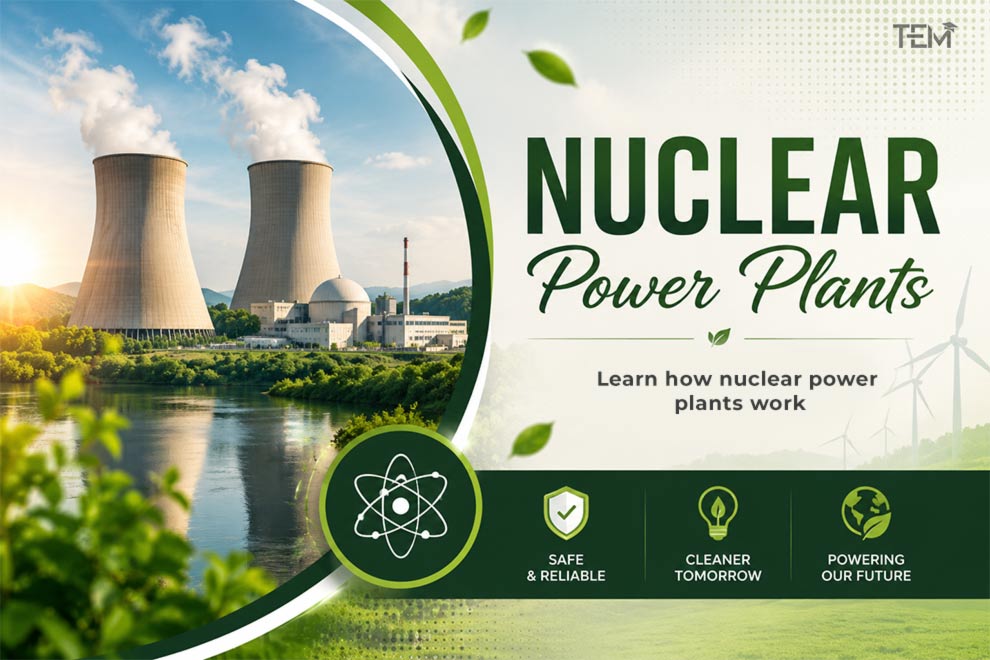
A nuclear power plant looks like a massive industrial complex, but its primary job is simple: produce heat, turn that heat into steam, use the steam to spin a turbine, and convert that motion into electricity. The complexity lies in controlling the nuclear reaction and moving that thermal energy safely through engineered systems.
Nuclear power is an important source of low-emissions electricity in more than 30 countries, representing the second-largest global source of low-emissions power after hydropower. In 2026, the nuclear industry is seeing new reactor grid connections, construction starts, Small Modular Reactor (SMR) development, and refurbishment projects across several countries.
This guide explains how a nuclear power plant operates, what components sit inside it, how a plant differs from an individual reactor, how safety systems function, and what developments are actively shaping the industry in 2026.
What Is a Nuclear Power Plant?
A nuclear power plant is a thermal energy facility that uses heat from nuclear fission to generate electricity. The heat produces high-pressure steam, the steam drives a turbine, and the turbine powers an electrical generator.
Every structural component, including the reactor vessel, cooling circuits, and containment structure, exists to keep that heat-to-electricity process operating safely and reliably. Key concepts covered throughout this guide include nuclear fission, the reactor core, fuel assemblies, control rods, coolants, steam generators, turbines, condensers, and the power grid.
How Does a Nuclear Power Plant Work?
The electricity generation process follows a sequence of straightforward physical steps:
- Nuclear Fission Produces Heat: Inside the reactor core, uranium fuel atoms split apart in a controlled chain reaction, releasing significant heat energy.
- Coolant Absorbs Thermal Energy: Water, or in specialized designs a gas or liquid metal, circulates through the core to carry heat away.
- Steam Forms: The heated coolant either boils directly into steam or transfers its heat to a secondary water circuit through a steam generator.
- Steam Drives the Turbine: High-pressure steam rushes through turbine blades, spinning them at high velocity.
- The Generator Creates Electricity: The spinning turbine turns a generator shaft, converting mechanical motion into electrical current.
- Electricity Enters the Grid: Step-up transformers adjust the voltage so electricity can travel safely through regional transmission lines.
- Steam Condenses and Recirculates: After passing through the turbine, steam is cooled back into water inside a condenser and pumped back to start the loop again.
What Is Inside a Nuclear Power Plant?
A nuclear power plant consists of a cluster of specialized buildings and integrated systems:
- Reactor Building: Heavy structure housing the reactor vessel and primary cooling circuits.
- Reactor Core: The central area holding fuel assemblies where fission reactions occur.
- Fuel Assemblies: Bundles of metal tubes packed with ceramic uranium fuel pellets.
- Control Rods: Neutron-absorbing rods raised or lowered to adjust or stop the fission reaction.
- Cooling System: Pumps and piping that circulate coolant to carry heat away from the core.
- Steam Generator: Heat exchanger used in pressurized systems to make clean steam in a secondary loop.
- Turbine Hall: Building containing the large steam turbine and electrical generator.
- Generator: Machine converting turbine rotation into electrical energy.
- Condenser: Cooling unit that turns spent exhaust steam back into liquid water.
- Cooling Tower: Structure that releases residual waste heat into the atmosphere at many facility sites.
- Containment Structure: Heavy steel-reinforced concrete shell that seals in the reactor and prevents radiation releases.
How Nuclear Power Plants Convert Heat Into Electricity
Nuclear power plants do not convert uranium directly into electricity. Fission generates heat, and the rest of the facility operates on a standard thermal cycle similar to conventional fossil fuel facilities.
| Plant Type | Primary Heat Source |
| Nuclear | Controlled nuclear fission |
| Coal | Coal combustion |
| Natural Gas | Natural gas combustion |
| Solar PV | Sunlight converted directly into electrical current |
The turbine, generator, and grid connection operate on standard mechanical principles. The primary engineering focus at a nuclear site is safely generating and containing core thermal energy.
Types of Nuclear Power Plants
Commercial nuclear reactors operating today fall into a few primary design families:
Pressurized Water Reactors (PWRs)
PWRs maintain primary core water under extreme pressure to prevent it from boiling. This superheated primary water flows into a steam generator, boiling a separate secondary loop of water into clean steam to drive the turbine. PWRs make up the largest share of operational commercial reactors globally.
Boiling Water Reactors (BWRs)
In a BWR design, water boils directly inside the reactor pressure vessel. The resulting steam moves directly from the reactor vessel to the electricity turbine without a separate steam-generator loop. BWRs represent the second most common reactor type worldwide.
Other Major Reactor Types
- Pressurized Heavy Water Reactors (PHWRs): Use heavy water ($\text{D}_2\text{O}$) as both a coolant and moderator, allowing the use of natural, unenriched uranium. Common in Canada and India under CANDU-style designs.
- Gas-Cooled Reactors: Utilize gases such as carbon dioxide or helium as a coolant alongside a graphite moderator.
- Fast Neutron Reactors: Operate without a moderator to slow neutrons down, extracting more total energy from nuclear fuel.
Nuclear Power Plants vs. Nuclear Reactors: What’s the Difference?
A nuclear reactor is the system in which a controlled nuclear chain reaction produces heat. A nuclear power plant is the larger facility that uses that heat to generate electricity, encompassing the reactor, cooling systems, turbine hall, electrical switchyard, and site infrastructure.
A single nuclear power plant site can house multiple individual reactors. For example, India’s Kaiga station operates four active reactors on one site while adding additional units.
How Are Nuclear Power Plants Kept Safe?
Nuclear safety relies on multiple independent layers of protection rather than a single safeguard. International regulatory standards established by bodies such as the International Atomic Energy Agency (IAEA) and the U.S. Nuclear Regulatory Commission (NRC) require a comprehensive approach known as “defense in depth”:
- Multiple Physical Barriers: Ceramic fuel pellets, sealed cladding tubes, thick steel reactor vessels, and outer reinforced concrete containment buildings keep radioactive material enclosed.
- Control Rod Systems: Neutron-absorbing rods can drop into the core to stop the fission process within seconds.
- Emergency Core Cooling: Dedicated emergency systems deliver cooling fluid to remove heat even when normal operations pause.
- Containment Enclosures: Heavy concrete structures designed to withstand high internal pressure and external impacts.
- Backup Power Systems: On-site diesel generators and battery banks keep cooling equipment active during grid power outages.
What Happens When a Nuclear Plant Shuts Down?
When a reactor shuts down for maintenance, refueling, or retirement, the main fission reaction stops within seconds. Even after shutdown, the fuel continues producing decay heat, so cooling systems must keep operating for an extended period.
Because of this residual heat, plants maintain active cooling for spent fuel, keeping it submerged in cooling pools for years before transferring it to dry storage canisters. Once fuel is safely stored, operators can perform major refurbishments or begin long-term site decommissioning.
Operational continuity and refurbishment updates are tracked closely by international regulators. According to IAEA PRIS data, India’s Tarapur Unit 1 returned to service on January 29, 2026, followed by Tarapur Unit 2 on June 6, 2026, after extended periods of suspended operation.
What Is Changing in Nuclear Power Plants in 2026?
The year 2026 has brought key developments across commercial grid connections, SMR deployment, and new project construction starts:
- China: Commercial power additions continued as new Hualong One reactor units, including Sanao-1 (connected March 12, 2026) and Taipingling-1 (connected February 13, 2026), joined regional electrical grids as part of an active national buildout.
- Canada: According to public project filings from Ontario Power Generation (OPG) and the Canadian Nuclear Safety Commission (CNSC), construction advanced on the Darlington New Nuclear Project in Ontario. The installation of the reactor building’s steel-composite foundation slab in 2026 makes it one of the most advanced commercial SMR construction projects in the G7.
- India: According to NPCIL updates, workers poured first concrete for Kaiga Unit 5 and Unit 6, adding two new 630 MWe net pressurized heavy water reactors.
- South Korea: According to IAEA PRIS data, official construction started on Shin Hanul Unit 4, a 1,400 MW APR1400 reactor project, on May 29, 2026.
Are Small Modular Reactors Changing the Nuclear Power Plant Model?
Traditional nuclear power plants typically feature large, custom-built reactors constructed on-site over many years. Small Modular Reactors (SMRs) introduce a standardized approach using smaller, factory-assembled components that can be installed incrementally.
- Land-Based Commercial Projects: China’s Linglong-1 (ACP100, 100 MWe net) SMR project at Changjiang in Hainan continues pre-commissioning activities toward commercial operation.
- Floating Facilities: Russia continues operating its floating SMR installation at Pevek, providing heat and electricity to remote Arctic communities using small reactors adapted from icebreaker designs.
- Global Development: SMR projects in Canada, South Korea, the UK, and the US continue moving through regulatory licensing and early site preparation.
Global Snapshot: Industry Capacity and Generation Data
Understanding nuclear energy metrics requires distinguishing between installed capacity (a point-in-time measurement) and total annual electricity output:
- Net Installed Capacity: The IAEA’s PRIS database reports 379.7 GW of net installed nuclear capacity across reactors currently in operation.
- Annual Power Generation: Nuclear reactors worldwide generated about 2,635.3 TWh of electricity in 2025, according to the IAEA’s PRIS database.
- Measurement Definitions: Capacity (MW/GW) measures maximum potential electrical output at a given moment, while annual generation (TWh) reflects actual energy delivered to the grid over a complete year.
Advantages and Limitations of Nuclear Power Plants
Advantages
- Low Operational Carbon Footprint: Generates electricity without direct greenhouse gas emissions during operation.
- High Energy Density: Small volumes of fuel produce vast amounts of usable heat energy.
- Reliable Baseload Output: Delivers steady, round-the-clock electrical power regardless of weather conditions.
- High Capacity Factors: Operates near maximum output for high percentages of the year.
- Long Facility Lifespans: Some reactors have received regulatory approval to operate for 60, 80, or more years following safety reviews and upgrades.
Limitations
- High Upfront Capital Costs: Requires significant initial financial investment to construct.
- Extended Construction Timelines: Project development and building typically span several years.
- Radioactive Waste Storage: Requires long-term management protocols for spent nuclear fuel.
- Substantial Cooling Water Demands: Facilities require reliable water access for steam condensation systems.
Nuclear Power Plants and the Future of Electricity
International Energy Agency (IEA) projections indicate that global nuclear generation will continue expanding, driven by several key factors:
- Industrial and Technical Power Needs: Growing demand for round-the-clock power from industrial centers and data facilities.
- Grid Stability: High capacity factor power sources supporting grid balance alongside variable solar and wind generation.
- License Extensions: Regulatory approvals extending operating lives of existing reactors from 40 to 60 or 80 years.
- New Fleet Construction: Expanded building programs concentrated across Asia and select North American sites.
Data Sources and Methodology
This guide uses the International Atomic Energy Agency’s Power Reactor Information System (PRIS) for reactor status, capacity, and electricity-generation data, while International Energy Agency (IEA) reports are used for global energy trends, forecasts, and market outlooks. Project developments are checked against national regulatory authorities and operating utilities, including the Canadian Nuclear Safety Commission (CNSC), Ontario Power Generation (OPG), India’s Atomic Energy Regulatory Board (AERB), and the Nuclear Power Corporation of India Limited (NPCIL). Annual electricity generation metrics reflect the latest complete calendar year (2025) to ensure statistical accuracy.
Conclusion
Nuclear power plants convert nuclear heat into steam and electricity using conventional turbine generators. Understanding this fundamental process makes the broader nuclear landscape clear: why reactor types vary, how redundant safety layers protect the core, and why shutdown operations require ongoing cooling management.
Developments in 2026 show an evolving industry. With new large-scale units coming online in Asia, advanced SMR foundation work progressing in Canada, and major refurbishments extending operational lifetimes in India, nuclear power plants remain a major component of global energy planning.
FAQ
- How many nuclear reactors are operating worldwide?
According to the IAEA’s PRIS database, 417 nuclear reactors are currently in operation across 31 countries. Other industry databases may report slightly different totals because reactor-status classifications can vary.
- What is the difference between a nuclear reactor and a nuclear power plant?
A nuclear reactor is the system in which a controlled nuclear chain reaction produces heat. A nuclear power plant is the complete facility, which includes the reactor, steam circuits, turbine hall, cooling structures, and electrical switchyards.
- What are the main types of nuclear power plants?
Pressurized Water Reactors (PWRs) and Boiling Water Reactors (BWRs) make up the majority of global units, alongside Pressurized Heavy Water Reactors (PHWRs), Gas-Cooled Reactors, and Fast Neutron Reactors.
- How long does a nuclear power plant last?
Commercial reactors are usually licensed initially for 30 to 40 years. Following thorough engineering inspections and safety upgrades, regulators regularly extend operating licenses to 60 or 80 years.