The classroom wall no longer defines where learning happens. Across the UK, UAE, USA, and dozens of other countries, families are choosing online tutoring as the primary academic support for their K-12 children, not just as a backup plan, but as a deliberate upgrade. This article unpacks exactly why, what it looks like in practice, and what every parent and educator should know heading into the next school year.
- $23B+ global online tutoring market size in 2026
- 68% of K-12 parents say online tutoring improved their child’s grades
- 3× faster concept mastery in 1-on-1 sessions vs. group classes
- 40+Countries now served by top-tier online tutoring platforms
1. The Shift Is Already Permanent – But Why?
After years of debate about whether online education could match in-person instruction, the evidence in 2026 has settled the question. Research from multiple longitudinal studies across the UK, Australia, and North America consistently shows that students receiving structured one-to-one online tutoring outperform peers in traditional classroom-only settings, particularly in STEM subjects, literacy, and exam preparation.
Three structural forces are making this shift permanent rather than cyclical:
- Curriculum complexity is rising. GCSE and IGCSE syllabi have grown significantly more demanding over the past decade. Students sitting A-Level Mathematics, Sciences, or Economics today are navigating content that previously appeared at university level. Classroom teachers, managing groups of 28 to 32 students, cannot physically provide the targeted reinforcement every child needs.
- The global mobility of families has changed who needs help. Expat families in the UAE, Hong Kong, Singapore, and Qatar whose children sit British, IB, or American curricula often have very limited access to local tutors who understand those specific syllabi. Online platforms remove that barrier entirely.
- Flexible scheduling is now a necessity, not a luxury. Between after-school activities, parents working longer hours, and students managing increasingly heavy coursework loads, the fixed timetable of a tuition centre does not fit modern family life. Online tutoring, bookable by the hour and accessible from any device, does.
“The best online tutoring platforms in 2026 are not replicating the classroom online, they are doing something the classroom was never designed to do: building a learning environment around a single student’s exact gaps, pace, and goals.”
2. What One-to-One Online Tutoring Actually Looks Like in 2026
Parents who have never booked an online tutor often picture a video call with a PowerPoint running in the background. The reality in 2026 is considerably more sophisticated and more effective.
Live, Interactive Sessions
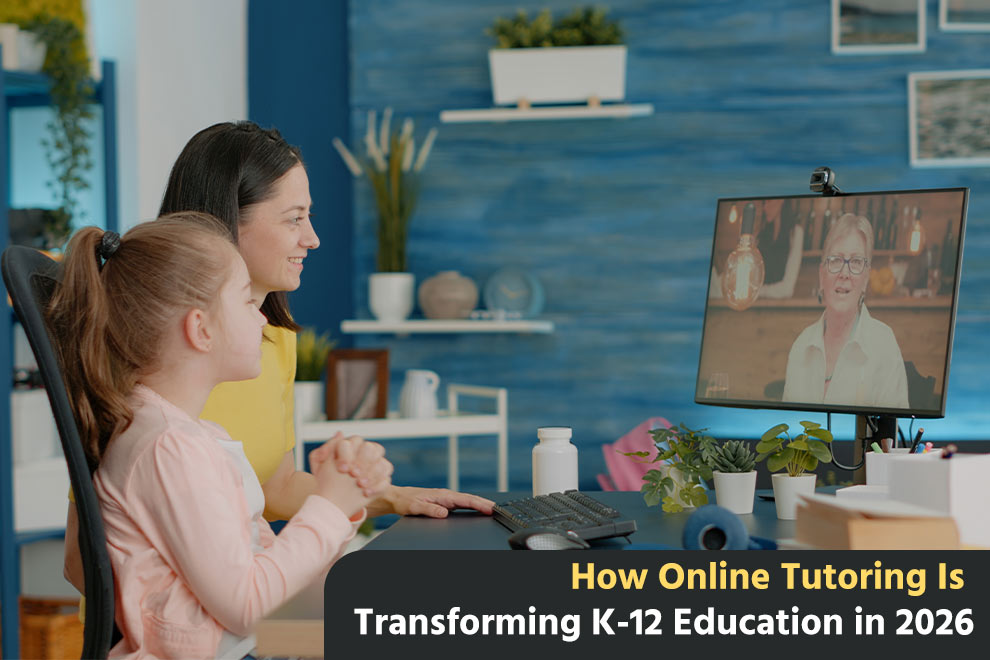
Top tutoring services deliver fully live sessions, not pre-recorded videos, not asynchronous message threads. The student and tutor share a digital whiteboard in real time, annotate problems together, and work through exam-style questions with immediate feedback. This mirrors the dynamic of a private in-home tutor while removing all geographical constraints.
Curriculum-Aligned Expertise
Perhaps the most important development of the past two years is the rise of tutors who are not just subject experts but curriculum specialists. A family whose child sits the Cambridge IGCSE does not need a general science tutor they need someone who knows exactly how IGCSE Physics Paper 4 is marked, where the command-word traps are, and which topics appear every year. Platforms like The Tutors Globe match students to tutors specifically trained in their curriculum, whether GCSE, IGCSE, A-Level, IB, or the American SABIS system, ensuring every session is built around exam-relevant content rather than generic instruction.
Diagnostic-Led Planning
Before the first paid session begins, leading services now run diagnostic assessments. A 30-minute diagnostic pinpoints exactly where a student’s understanding breaks down. Whether that is quadratic equations at GCSE Maths, organic chemistry at A-Level, or text analysis at IGCSE English. The tutor then builds a session plan around those specific gaps rather than starting from page one of the textbook.
3. The Subjects Where Online Tutoring Delivers the Highest Impact
Not all subjects benefit equally from private online instruction. Based on outcomes data and the volume of demand across leading platforms, five subject areas consistently demonstrate the greatest improvement through one-to-one online tutoring.
Mathematics remains one of the most impactful subjects for online tutoring because knowledge gaps tend to build over time.
In Physics, students often struggle with combining abstract scientific concepts with mathematical problem-solving. One-to-one tutoring provides the time and flexibility needed to explore complex ideas in depth.
Chemistry presents a unique challenge due to its combination of extensive memorisation and calculation-based questions.
For English Literature and Language, success depends heavily on individual writing style, analytical thinking, and essay technique.
Similarly, Economics and Business Studies require students to move beyond memorising theory and develop strong evaluation and analytical skills.
For families looking for qualified tutors across all of these subjects, covering GCSE, IGCSE, and A-Level programmes, services like The Tutors Globe’s IGCSE Maths Tutor programme offer curriculum-matched, verified tutors with demonstrable track records of helping students achieve meaningful grade improvements.
4. How to Choose the Right Online Tutoring Platform in 2026
The growth of the industry has created genuine variation in quality. Not every platform offering “qualified tutors” will deliver results. Here is a practical checklist parents and school counsellors can use:
- Verify curriculum alignment, not just subject knowledge. Ask specifically whether the tutor has experience with your child’s exact examination board — Cambridge, Edexcel, AQA, IB, College Board. A Chemistry expert who has never taught Cambridge IGCSE may cover content irrelevant to your child’s exam.
- Insist on a free trial session before any financial commitment. Reputable services will offer this without hesitation. A trial session also reveals whether tutor and student have a productive working dynamic, personality fit genuinely affects outcomes.
- Ask for a session structure, not just topics. Good tutors arrive with a plan. If a platform cannot describe how sessions are structured for exam preparation versus concept building, treat that as a red flag.
- Check the platform’s vetting process. Are tutors degree-qualified? Are references and qualifications checked? Are tutors from recognised universities with demonstrated subject expertise?
- Review pricing transparency. Hidden costs, platform fees, session minimums, cancellation penalties, erode the affordability advantage of online tutoring. Look for services with clear hourly rates and no lock-in contracts.
5. What the Research Says About Long-Term Outcomes
It is worth being clear-eyed about what online tutoring can and cannot achieve. The strongest outcomes occur when three conditions are present simultaneously: sessions are consistent (at least once a week for a minimum of eight to ten weeks), the student is actively engaged rather than passively listening, and the tutor has genuine curriculum expertise rather than broad subject familiarity.
When all three conditions are met, the research is encouraging. A 2025 meta-analysis covering over 14,000 K-12 students across five countries found that students receiving structured private tutoring showed an average improvement of 1.4 to 2.1 grade bands within a single academic term. The effect was largest in STEM subjects and among students who had fallen behind the grade-level benchmark.
Crucially, the improvement was not limited to exam results. Students reported higher confidence in classroom participation, greater willingness to attempt challenging problems independently, and notably reduced academic anxiety. For parents of secondary-age students, this last point carries weight: low-level exam anxiety is one of the most commonly cited barriers to academic performance, and the private, low-stakes environment of a one-to-one session has a measurable effect on it.
6. The AI Question: How Technology Is Enhancing (Not Replacing) Tutors
No discussion of K-12 education in 2026 can ignore artificial intelligence. AI tools are now embedded across the educational landscape from homework helpers to grammar correctors to adaptive quizzing platforms. The natural question for parents is whether this makes human tutors redundant.
The short answer is no and understanding why matters for how you invest in your child’s education.
AI tools excel at content delivery, pattern recognition, and low-stakes practice. They are genuinely useful for drilling vocabulary, running through multiple-choice questions, and giving instant feedback on factual recall. What they cannot do, at least at the level of a skilled human tutor, is notice that a student’s frustration in a chemistry session stems from a gap in their algebra from two years ago, adjust their explanation style mid-sentence when a student’s expression signals confusion, or build the kind of trusted relationship in which a student feels safe saying, “I genuinely do not understand this at all.”
The most effective approach in 2026 treats AI and human tutoring as complementary. Students use AI tools for independent practice and recall, and they use their human tutor for explanation, application, and the metacognitive coaching that lifts performance from passable to excellent.
Looking for a qualified, curriculum-matched tutor for your child’s GCSE, IGCSE, A-Level, or IB subjects? The Tutors Globe provides verified private online tutors from leading universities – serving students across the UK, UAE, USA, Hong Kong, Singapore, and beyond. First session is free. Book a Free Trial at The Tutors Globe
Final Thoughts
The transformation of K-12 education by online tutoring is not a trend still forming. It is an established reality that millions of families are already navigating. The question in 2026 is not whether online tutoring works, but how to access it in a way that is genuinely curriculum-aligned, taught by qualified professionals, and structured around measurable outcomes.
For students sitting high-stakes examinations, whether GCSE, IGCSE, A-Level, or IB. The advantage conferred by consistent, expert, personalised support is well-documented and significant. As the global education landscape continues to shift, the families who take that support seriously will be the ones who see their children walk into exam rooms prepared, confident, and ready.