For years, many parents judged a preschool by how quickly children could write the alphabet or count numbers. If a child came home with worksheets, it often felt like real learning was happening. That mindset is slowly changing. Today, more educators understand that young children learn best when they are curious, active, and involved in what they are doing. This is one reason why play-based learning is becoming a bigger part of every quality preschool in India. Instead of treating play as something children do after learning, it becomes the way they learn in the first place.
What Does Play-Based Learning Actually Mean?
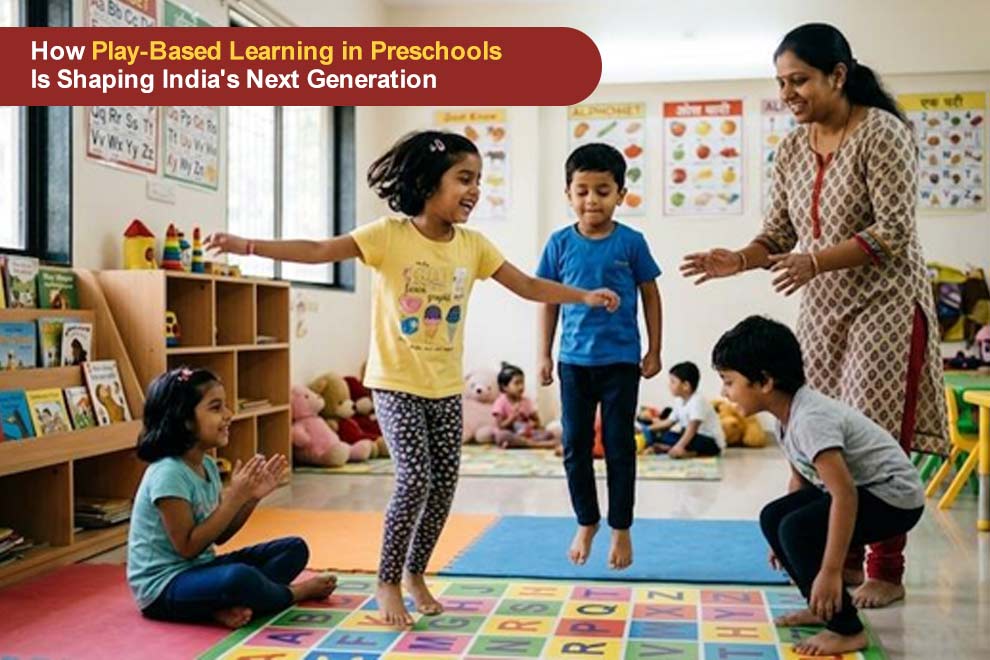
Play-based learning is a teaching approach where children learn through games, storytelling, creative activities, and hands-on experiences instead of relying mainly on memorisation or worksheets. While play may seem informal, every activity is planned with a learning goal, helping children develop thinking, communication, social, and physical skills in a way that feels natural, engaging, and age appropriate.
Why This Matters Now: The NEP 2020 Connection
India’s National Education Policy (NEP) 2020 has played a major role in encouraging this shift. The policy introduced the Foundational Stage for children between the ages of 3 and 8, recognising that these years lay the foundation for future learning.
Instead of expecting young children to spend hours copying letters or memorising facts, NEP 2020 recommends experiential learning through play, stories, art, music, movement, and classroom activities. The focus is on helping children understand concepts through experience rather than repetition. This approach also aims to build curiosity, confidence, communication, and problem-solving skills long before formal academics become the priority.
How Play Builds Real Skills
1. Cognitive Skills
A child trying to finish a puzzle or build a tower with blocks may simply be having fun, but plenty of learning is happening at the same time. These activities encourage children to compare shapes, recognise patterns, count objects, and figure out solutions when something does not work. Instead of memorising numbers or letters from a page, they begin to understand them through experience. Over time, these everyday activities strengthen cognitive skills because children learn by exploring rather than remembering information by heart.
2. Social and Emotional Skills
Playing with other children teaches lessons that cannot be copied from a textbook. During group games, children learn to wait for their turn, share materials, negotiate simple rules, and deal with disagreements. Sometimes they succeed, and sometimes they do not, but every interaction helps them understand emotions a little better. These experiences gradually build confidence, empathy, patience, and the ability to work with others.
3. Language Skills
Children talk far more during pretend play than they often do during structured lessons. A classroom that becomes a hospital, restaurant, or supermarket encourages conversations, questions, and storytelling. As children take on different roles, they naturally use new vocabulary and practise expressing their ideas. Listening to stories, acting them out, and participating in classroom discussions also help prepare them for reading and communication later on.
4. Motor Skills
Young children need plenty of movement throughout the day. Activities like painting, cutting paper, threading beads, and building with blocks improve fine motor control, while running, jumping, balancing, and climbing strengthen larger muscle groups. These physical experiences support coordination and confidence while preparing children for everyday tasks such as writing, drawing, and participating in sports as they grow older.
How Indian Preschools Are Actually Implementing This
1. From Rote Drilling to Activity Corners
Many preschools are moving away from asking children to repeatedly write alphabets or numbers at an early age. Instead, classrooms now include dedicated activity corners filled with blocks, puzzles, sorting trays, matching cards, and construction toys. Children still learn the same concepts, but they understand them by touching, arranging, comparing, and experimenting instead of simply repeating information.
2. Sensory Bins for Early Exploration
Sensory play has become a common feature in many classrooms. Teachers use materials such as sand, rice, water, clay, or textured objects to create activities that encourage exploration. While children scoop, pour, sort, or mix materials, they also develop fine motor control and sensory awareness. Many of these activities quietly introduce concepts like colours, textures, counting, and patterns without turning them into formal lessons.
3. Outdoor and Gross Motor Time as Core Curriculum
Outdoor play is no longer viewed as something children do only after finishing classroom work. Many schools now schedule structured outdoor sessions as part of the daily timetable. Obstacle courses, climbing frames, relay games, balancing activities, and ball games help children improve physical coordination while also learning teamwork, patience, and confidence through movement.
4. Storytelling-Based Literacy
Reading lessons are becoming much more interactive than they were a few years ago. Instead of focusing only on recognising letters and sounds, teachers bring stories to life through picture books, puppets, songs, and dramatic role play. Children begin connecting words with characters, emotions, and real situations, which makes early literacy feel engaging rather than repetitive.
5. Play Built Into the Daily Schedule, Not Around It
One of the biggest changes is how the school day itself is planned. Instead of squeezing play between lessons, many quality preschools now organise the timetable around longer play sessions. Different learning goals are built into these activities, allowing children to develop academic, social, and physical skills together without constantly switching between play and study.
Why Some Preschools Still Lag Behind
1. City vs. Small Town Access
Play-based classrooms are becoming more common in larger cities, but many families living in smaller towns still have fewer options. Traditional teaching methods remain widely used simply because schools with better facilities and specialised early childhood programmes are not always available nearby.
2. Cost
Creating a good play-based environment requires trained teachers, learning materials, activity spaces, books, outdoor equipment, and classroom resources. Naturally, schools that invest in these areas often charge higher fees, making them less affordable for some families.
3. Parents Are Not Always Convinced
Many parents grew up in classrooms where success meant finishing notebooks and memorising lessons. Because of that experience, some still believe children should begin writing and studying as early as possible. When learning mostly looks like play, it can sometimes feel as though not enough academic work is happening, even though children are developing important skills in the process.
4. Not Enough Trained Teachers
A successful play-based classroom depends on much more than colourful toys. Teachers need to understand child development, observe how children learn, and know when to guide an activity without taking over. India is moving in the right direction, but there is still a growing need for more educators who have specialised training in early childhood education.
Closing Thoughts
Play-based learning is changing what early education looks like across India. Rather than asking children to memorise information before they are developmentally ready, it gives them opportunities to explore, experiment, communicate, and solve problems every day. With the support of NEP 2020 and growing awareness among schools and parents, more children can build strong foundations through experiences that feel meaningful and enjoyable. After all, when learning feels natural, children are far more likely to stay curious long after preschool ends.
About the Author: Chitra Khanna is the Content Strategist at KLAY Preschools & Daycare, where she leads content creation focused on early childhood education and parenting. With a background in digital marketing and a passion for empowering families, Chitra develops resources that engage and inform parents, helping them navigate the critical stages of their children’s development. Her creative approach and deep understanding of educational trends ensure that her content is both relevant and impactful. Outside of work, Chitra enjoys exploring new learning methodologies and contributing to discussions on child welfare and growth.
Also Read: Top Game-Based Learning Platforms for Students in 2026: Types & Benefits