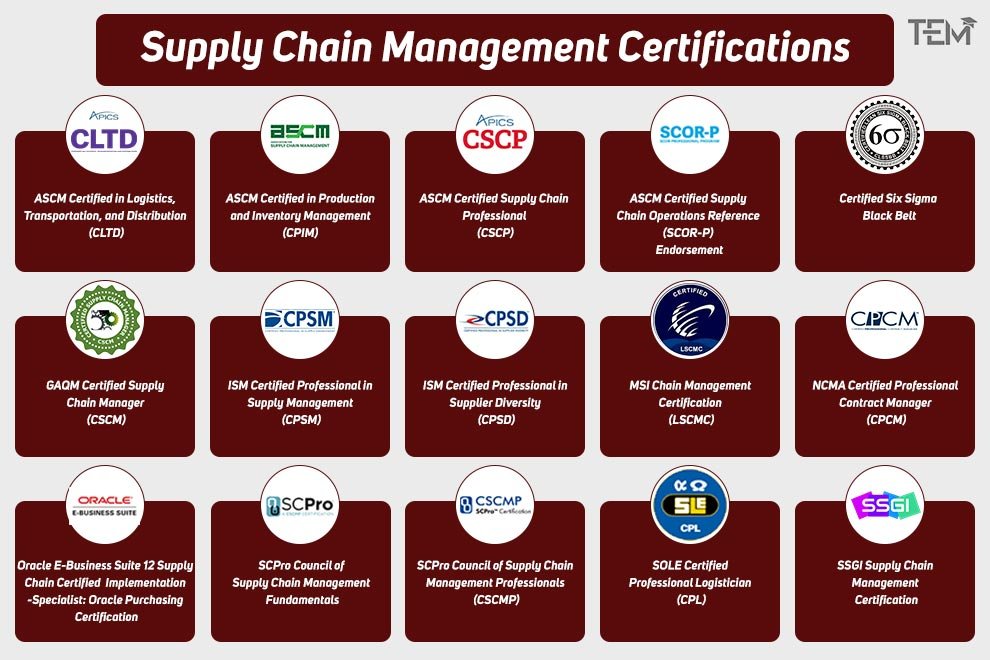
Supply chain practitioners are expected to manage everything from inventory and suppliers to global shipping and customer demand. As businesses adopt new technologies and build more resilient operations, earning the right credentials can help you develop in-demand skills and stand out in a competitive job market.
This guide will break down the top industry-recognized programs, what you will learn, how much they cost, and how they can impact your professional growth. Whether you are an entry-level analyst or a seasoned operations director, you will find the right path for your next career step.
Which Supply Chain Certification Is Best?
The best supply chain certification depends on your career goals. CSCP is ideal for end-to-end supply chain leadership, CPIM suits planning and inventory professionals, CLTD focuses on logistics and distribution, while CPSM is best for procurement and sourcing specialists.
Key Takeaways
- CSCP remains one of the most recognized end-to-end leadership credentials.
- CPIM is ideal for production planning and inventory management.
- CPSM is highly valued in procurement and sourcing.
Choose a qualification based on your target role, not popularity.
Why Earn an Industry-Recognized Credential?
Investing in your professional development through a recognized program offers long-term benefits. Securing a top-tier designation accelerates your progression from operational roles to strategic management, often placing you in a higher compensation bracket than non-certified peers.
Furthermore, qualifications from bodies like ASCM or ISM prove that your knowledge meets rigorous standards. Executive roles demand a comprehensive understanding of risk management and digital transformation. Top logistics programs act as a benchmark recognized worldwide, allowing you to transition into international roles and advance your career seamlessly.
How to Choose the Right Program
If you’re unsure which credential to choose, start by thinking about the type of work you enjoy. Someone focused on procurement may benefit from CPSM, while managers overseeing end-to-end operations often find CSCP a better fit.
You can use this simple decision tree to narrow down your options:
- Beginner ↓ CPIM
- Procurement ↓ CPSM
- Logistics ↓ CLTD
- Senior Manager ↓ CSCP
- Consultant ↓ SCPro
Top Supply Chain Management Certifications
1. CSCP (Certified Supply Chain Professional)
- Overview: Offered by ASCM, the CSCP covers the entire end-to-end operations journey from supplier to customer.
- Unique Insight: Many employers view CSCP as a strong qualification for candidates moving into broad operational leadership.
- Best For: Professionals looking to oversee broad enterprise logistics, Senior Managers, and ERP implementers.
- Skills You’ll Learn: Network design, risk management, vendor relationship management, and continuous improvement.
- Eligibility: 3 years of related business experience OR a bachelor’s degree OR holding an active CPIM, CLTD, or other approved designation.
- Exam Format: 150 multiple-choice questions (3.5 hours).
- Career Opportunities: Operations Director, Global Logistics Director.
- Who Should NOT Choose This: You’re just starting your career and need a strong foundation in planning or inventory management.
2. CPIM (Certified in Planning and Inventory Management)
- Overview: Another premier ASCM program, the CPIM dives deep into the internal workings of an organization.
- Unique Insight: CPIM is especially valuable for specialists working in manufacturing and inventory planning.
- Best For: Planners, buyers, and beginners looking to master internal operations.
- Skills You’ll Learn: Demand planning, master scheduling, MRP, and capacity management.
- Eligibility: No specific degree or experience required.
- Exam Format: One comprehensive exam.
- Career Opportunities: Production Planner, Demand Forecaster, and Inventory Analyst.
- Who Should NOT Choose This: Those looking to specialize exclusively in transportation, warehousing, or external sourcing.
3. CLTD (Certified in Logistics, Transportation, and Distribution)
- Overview: The CLTD zeroes in on the delivery aspect of operations, making it one of the top logistics designations available today.
- Unique Insight: CLTD is highly sought after in the booming e-commerce and warehousing sectors.
- Best For: Logistics managers, fleet managers, and distribution center leaders.
- Skills You’ll Learn: Capacity planning, order management, reverse logistics, and global trade.
- Eligibility: 3 years of experience OR a bachelor’s degree OR an active APICS credential.
- Exam Format: 150 multiple-choice questions (3.5 hours).
- Career Opportunities: Logistics Director, Distribution Center Manager, Transportation Manager.
- Who Should NOT Choose This: Specialists strictly focused on manufacturing, procurement, or internal production schedules.
4. CPSM (Certified Professional in Supply Management)
- Overview: Administered by the Institute for Supply Management (ISM), the CPSM is the definitive qualification for sourcing.
- Unique Insight: CPSM acts as the gold standard for strategic sourcing and vendor negotiation.
- Best For: Procurement specialists, strategic sourcing managers, and commodity buyers.
- Skills You’ll Learn: Contract negotiation, supplier relationship management, spend analysis, and financial acumen.
- Eligibility: 3 years of full-time experience with a degree, or 5 years without a degree.
- Exam Format: Three separate exams.
- Career Opportunities: Procurement Manager, Category Manager, Chief Procurement Officer (CPO).
- Who Should NOT Choose This: Operations managers who need a broad overview of the entire fulfillment lifecycle rather than a deep dive into purchasing.
5. SCPro (Supply Chain Professional)
- Overview: Offered by the Council of Supply Chain Management Professionals (CSCMP), this tiered program tests real-world case study analysis.
- Unique Insight: SCPro stands out by testing your ability to solve complex, real-world case studies rather than just theory.
- Best For: Consultants, mid-to-senior leaders, and problem solvers.
- Skills You’ll Learn: System design, integrated operations mapping, and strategic modeling.
- Eligibility: Varies by tier (Tier 1 requires a bachelor’s degree or 4+ years of experience).
- Exam Format: Multiple-choice (Tier 1), Case Study (Tier 2), Real-world project (Tier 3).
- Career Opportunities: Operations Consultant, Supply Chain Architect.
- Who Should NOT Choose This: Early-career candidates who haven’t yet built practical experience in system design or those looking for the most universally recognized foundational credential.
Program Comparison Table
| Credential | Best For | Difficulty | Degree Required? | Global Recognition | Career Level |
| CSCP | End-to-end leadership | High | No (if experienced) | Excellent | Senior / Exec |
| CPIM | Internal planning | Moderate | No | Excellent | Beginner / Mid |
| CLTD | Transport & distribution | Moderate | No (if experienced) | Very Good | Mid-Level |
| CPSM | Procurement & sourcing | High | No (if experienced) | Excellent | Mid / Senior |
| SCPro | Consulting & design | High | No (if experienced) | Good | Senior / Consult |
Which Path Should You Choose Based on Your Career Stage?
Navigating your professional growth requires timing. Students should focus on foundational courses or the CPIM to grasp internal processes before entering the workforce. For those in their early career, the CPIM is highly recommended to build robust knowledge in demand forecasting.
As you progress to a mid-level practitioner, you should specialize: pursue the CPSM for procurement, or the CLTD for logistics. Managers looking to transition from functional oversight to broader operational leadership will find the CSCP to be the best fit. Finally, executives should look toward advanced programs like SCPro Tier 3 to validate their strategic design capabilities.
Cost & Duration
If you are researching online programs, pricing and time commitment are major factors. Earning these qualifications typically requires a few months of dedicated study.
| Credential | Approximate Cost | Duration | Renewal |
| CSCP | Varies by membership status | 3–6 months | Every 5 years |
| CPIM | Varies by membership status | 3–6 months | Every 5 years |
| CLTD | Varies by membership status | 3–6 months | Every 5 years |
| CPSM | Varies by membership status | 6–12 months | Every 3 years |
| SCPro | Varies by membership status | 3–6 months | Every 2 years |
Note: Avoid relying on exact figures unless regularly updated; we strongly recommend checking the certifying body’s official website because fees change frequently.
Salary Impact
While no credential guarantees a salary increase, many employers view these designations as evidence of specialized knowledge, which can strengthen your profile for promotions or higher-paying roles. Salary growth also depends on your experience, industry, location, and employer, not the credentials alone. Earning a top-tier qualification signals commitment and deep expertise, giving you better negotiation power during performance reviews.
Tips to Prepare for Certification Exams
Earning your designation takes significant effort. To maximize your chances of passing on the first try, follow these proven steps:
- Create a study plan.
- Use official study materials.
- Practice mock exams.
- Join study groups.
- Apply concepts at work.
Essential Skills You Gain
Pursuing an industry-recognized program equips you with highly marketable skills, including demand planning, inventory management, vendor relationship management, logistics, warehouse operations, analytics, risk mitigation, and sustainability tracking.
AI and Digital Supply Chains
The landscape of modern supply chains is shifting rapidly. Earning a credential in 2026 means mastering the digital space. Modern programs heavily emphasize predictive analytics, warehouse automation, digital twins, and operational resilience.
For example, many companies now use AI to forecast customer demand, helping planners reduce inventory shortages and avoid overstocking. Understanding how to leverage these tools is no longer optional for leadership roles.
Typical Leadership Path
A strategic professional designation can smoothly guide you through this progression:
Supply Chain Analyst ↓
Planner ↓
Manager ↓
Senior Manager ↓
Director ↓
VP Operations
Common Mistakes to Avoid
Before committing your time and money, be sure you aren’t falling into these common traps:
- Choosing the most popular credential instead of the most relevant one.
- Ignoring eligibility requirements before paying exam fees.
- Focusing only on cost instead of industry reputation.
- Not checking employer preferences (some companies exclusively sponsor specific programs).
- Expecting the designation alone to secure a promotion without demonstrating on-the-job leadership.
Market Trends in 2026
To stay relevant, modern practitioners must adapt to market trends. Key focus areas include AI-powered planning, nearshoring to mitigate global supply disruptions, sustainability (tracking Scope 3 emissions), and moving entirely to cloud-based ERPs for better data-driven forecasting.
Qualifications are most valuable when paired with practical experience. Employers increasingly look for employees who can apply operational principles to real-world challenges using data, technology, and cross-functional collaboration.
Final Thoughts
The best certification isn’t necessarily the most popular; it’s the one that matches your current role and long-term career goals. Choose a credential that supports your professional growth and continue building practical experience alongside it.
FAQ
- Is CSCP better than CPIM?
CSCP focuses on the entire fulfillment lifecycle, while CPIM specializes in production planning and internal inventory management.
- Which credential is best for beginners?
CPIM and foundational logistics courses are often suitable starting points for early-career candidates.
- Which qualification pays the most?
Leadership-focused programs such as CSCP and CPSM are commonly associated with higher-level roles, though salary depends on experience and industry.
- Are logistics programs worth the investment?
Yes, specialized management designations like the CLTD are highly valued by employers, providing excellent ROI through enhanced job security and career progression.