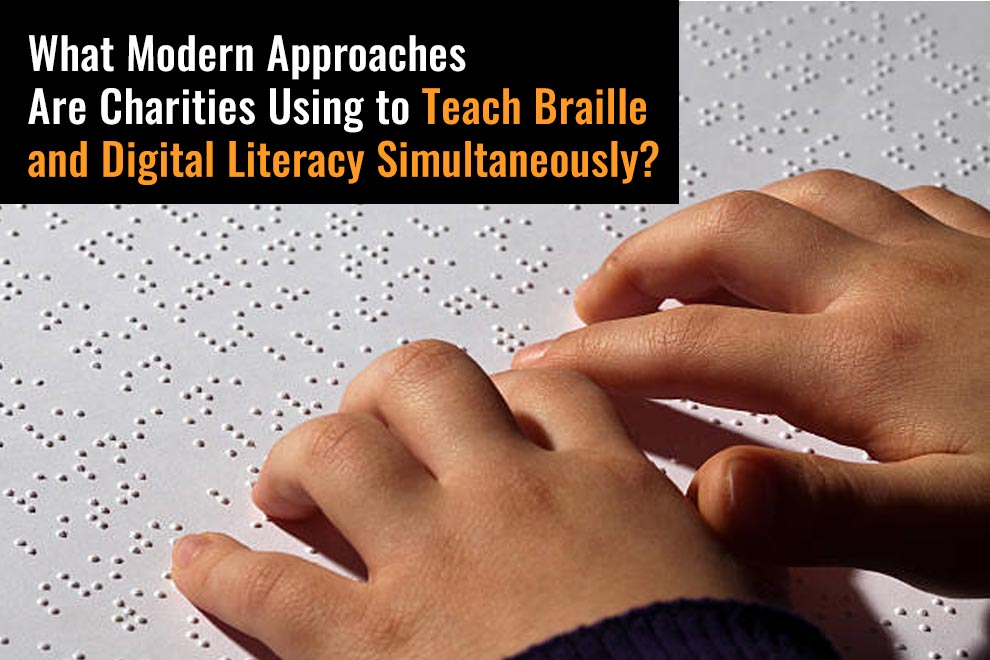
For visually impaired learners, mastering both Braille and digital literacy is essential for educational success, employment readiness, and full participation in modern life. Traditionally taught separately, these two skillsets are now being integrated by forward-thinking charities to create learning models that reflect the real-world needs of blind and visually impaired individuals. With an estimated 285 million people worldwide living with visual impairment—and young learners increasingly reliant on technology—the need for innovative, inclusive education has never been greater. Today’s charities are pioneering approaches that combine Braille instruction with digital literacy in ways that are engaging, effective, and scalable.
The Need for Integrated Braille and Digital Literacy Education
Visual impairment poses unique challenges in learning written and digital communication. While Braille remains crucial for literacy—especially in language, mathematics, and early education—digital literacy unlocks access to assistive technology, employment tools, online learning, and everyday communication platforms. Recent data shows that only about 30% of visually impaired students have access to consistent Braille instruction, and fewer have structured digital literacy curricula. As a result, charities focused on blind education are stepping in to bridge this gap with modern, blended learning models.
Technology-Powered Learning Platforms
One of the most significant shifts in charitable education initiatives is the use of adaptive technology platforms that teach Braille and digital skills simultaneously. These tools often include tactile displays, refreshable Braille devices, and accessible software that responds to Braille input. Learners can practise Braille reading and writing while interacting with digital content like emails, online documents, and educational games.
Charities are partnering with tech developers to subsidize or provide these devices at low or no cost. Some programs report that student engagement increases by more than 40% when Braille instruction is integrated with interactive digital tools—especially among learners under 18.
Blended and Hybrid Curriculum Models
Modern charity programs are moving away from traditional, siloed teaching methods. Instead, they use blended curricula that interweave Braille with digital skills—such as screen readers, keyboard mastery, and online research techniques. For example:
Session design: Students might begin with tactile Braille exercises and then apply those literacy skills in a digital environment, such as composing emails or navigating educational apps.
Peer learning: Charities facilitate group workshops where learners collaborate on digital projects using Braille displays, fostering both literacy and teamwork skills.
Progress tracking: Digital platforms allow instructors to monitor student advancement in real time, tailoring lessons to individual needs.
These hybrid models reflect the world’s growing demand for versatile literacy and have proven effective, with some programs reporting up to 60% improvements in functional literacy within six months.
Community-Centered and Inclusive Teaching
Charities are also investing in community-based approaches that promote sustained learning beyond the classroom. This includes:
Family training sessions, where parents or carers learn Braille and digital tools alongside students, reinforcing skills at home.
Volunteer-led mentoring programs that pair learners with trained blind mentors who teach both Braille and digital skills through shared activities.
Community-centered learning enhances confidence and reduces isolation. According to recent reports, students participating in community-based programs are twice as likely to continue skill development independently.
Gamification and Interactive Content
To increase motivation and reduce learning fatigue, many charities are incorporating gamification into their teaching strategies. This includes digital Braille games, interactive quizzes, and achievement badges. When learners can see measurable progress and earn rewards, engagement and retention improve significantly. Some programs show up to an 80% increase in lesson completion rates when gamified elements are included.
Preparing for Employment and Social Inclusion
The ultimate goal of modern Braille and digital literacy programs is to empower learners for real-world success. Charities are tailoring advanced modules to teach workplace digital tools—like spreadsheets, presentation software, and collaborative platforms—using Braille-friendly interfaces. As a result, learners are gaining valuable transition skills for education and employment, helping to close the gap in workforce participation for visually impaired individuals.
Conclusion
Charities worldwide are innovating at the intersection of Braille and digital literacy education with transformative approaches that reflect the needs of visually impaired learners today. By a blind charity implementing technology, blended curricula, community engagement, and interactive teaching methods, they are reshaping how literacy is taught.
The result is a generation of learners who are not only fluent in Braille but also confident digital citizens—ready to thrive in a technology-driven world. As these approaches continue to expand, they offer a powerful blueprint for inclusive education that others can adopt and scale.