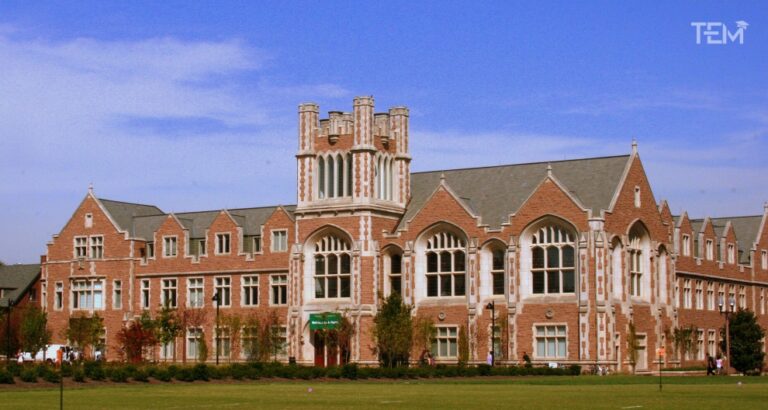
There is a particular confidence that comes from longevity, and Washington University School of Law has had more than a century and a half to earn it. Founded in 1867, WashU Law has been shaping lawyers, scholars, and legal thinkers for generations. Located on Washington University’s expansive campus in St. Louis, Missouri, the school combines intellectual rigor with a deeply collaborative academic environment designed to prepare students for an increasingly complex legal world.
Under the leadership of Dean Stefanie Lindquist, the Nickerson Dean and Professor of Political Science by courtesy, WashU Law continues to emphasize a clear institutional belief: “The pursuit of justice demands courage.” More than a slogan, it reflects the school’s broader commitment to developing lawyers who are intellectually disciplined, ethically grounded, and prepared to engage with the legal challenges of a globally interconnected society.
That international perspective is visible throughout the institution. WashU Law’s alumni practice across all 50 U.S. states and in more than two dozen countries worldwide. Its student body represents 35 states, Washington, D.C., and multiple countries, with students arriving from a wide range of academic and professional backgrounds.
A National Leader in Career Outcomes
Among WashU Law’s most significant distinctions is its nationally recognized graduate success.
In the 2026 U.S. News & World Report rankings, the school was ranked No. 1 in the nation for employment outcomes ten months after graduation, a measure that reflects the institution’s ability to connect legal education with meaningful career placement.
The numbers behind that ranking are equally notable. Nearly 74 percent of the Class of 2023 secured positions in large law firms or judicial clerkships. The school also maintains one of the strongest federal clerkship placements in the country, ranking No. 11 nationally in that category, while its International Law program ranks No. 19.
These results point to a law school that not only delivers academic excellence but also provides students with the professional opportunities and networks necessary to thrive after graduation.
A Diverse and Accomplished Student Community
WashU Law’s entering classes reflect both academic strength and broad diversity of experience.
The school’s most recent incoming class included 264 first-year students with LSAT scores ranging from 165 to 176 between the 25th and 75th percentiles, and undergraduate GPAs ranging from 3.58 to 4.0. Beyond academic metrics, the class also reflects significant personal and professional diversity.
Approximately 44 percent of students identify as first-generation law students, while a similar percentage identify as students of color. More than 30 languages are spoken within the student body, and nearly half of the incoming students entered law school with prior professional experience ranging from one to five years.
The result is an academic environment shaped not by uniformity, but by varied perspectives and lived experiences that enrich classroom discussion and legal analysis.
Personalized Learning at Scale
WashU Law’s 4.9:1 student-to-faculty ratio is more than a statistic; it defines the educational experience.
Small class sizes allow students to work closely with faculty members who are active scholars, practitioners, and thought leaders in their respective fields. The school offers 19 clinical education programs, 15 trial and advocacy courses, 9 advocacy competitions, and 17 study abroad and semester exchange opportunities, giving students extensive experiential learning options throughout their legal education.
Its academic journals and research institutes further reinforce the school’s intellectual depth. The Center for Empirical Research in the Law (CERL) advances data-driven legal scholarship, while the Cordell Institute focuses on intellectual property, innovation, and technology law. The Whitney R. Harris World Law Institute, named after the Nuremberg prosecutor, strengthens the school’s work in international law and human rights.
Together, these programs position WashU Law as both a research-driven institution and a practice-oriented law school.
Advancing Legal Education Through Technology and Innovation
WashU Law has also emerged as a significant voice in the growing intersection between law and technology.
The school has actively integrated artificial intelligence into its curriculum through participation in initiatives such as the AI Curriculum Corps, ensuring students are prepared for the technological transformation reshaping legal practice. Faculty members have contributed to national conversations about the future of legal education, including Bloomberg Law’s discussions on AI competency in modern legal training.
That broader public engagement extends well beyond technology. WashU Law faculty are regularly featured in outlets such as The New York Times, CNN, STAT, and Law360, contributing expertise on constitutional law, public policy, healthcare, technology, and civil liberties.
The school’s alumni and student achievements further reinforce its national presence. In 2026, alumnus Christian Menefee, JD ’13, was sworn into the United States House of Representatives following a special election victory. WashU Law’s Jessup moot court team also earned top international finishes this year, while Professor John Inazu received a major scholar award recognizing his contributions to legal and constitutional scholarship.
A Legacy That Continues to Evolve
More than 150 years after its founding, Washington University School of Law continues to evolve without losing sight of the values that built its reputation. Its enduring strength lies not only in rankings or outcomes, but in its willingness to adapt legal education to the realities of a changing world while maintaining a rigorous commitment to justice, scholarship, and professional excellence.
In an era increasingly defined by technological disruption, global complexity, and evolving legal systems, WashU Law remains focused on preparing lawyers capable of asking difficult questions, navigating uncertainty, and shaping the future of the profession itself.