
Have you ever stopped to wonder who actually keeps the massive, complex gears of our modern world turning without ever lifting a heavy hammer? It’s a fascinating thought, isn’t it? Enter the world of white-collar workers. These aren’t just people behind desks; they are the architects of our economy, the strategists, and the visionaries who use pure brainpower to manage, plan, and innovate.
It is truly impressive when you realize that this term—once just about clean white shirts in dusty factories—has evolved into a powerhouse category covering everything from saving lives in hospitals to coding the apps we can’t live without. Whether you are aspiring to join their ranks or just curious about how this engine runs, you are in for a treat. We are about to peel back the layers on who they are, what they do, and the incredibly exciting future waiting just around the corner. Let’s dive in!
Let’s Know More About White-Collar Workers
1. What’s a White-Collar Worker? (The Real Definition)
Picture this: jobs that run entirely on brainpower. That is the essence of white-collar work. We aren’t talking about physical labor or heavy lifting here; we are talking about using your mind to manage complex systems, strategize, or master a specific profession.
The name itself gives us a nostalgic wave, doesn’t it? It’s a bit old-fashioned, dating back to when office folks strictly wore crisp white shirts to distinguish themselves from blue-collar workers in tougher, messier environments who wore blue. Simply put: white-collar jobs are office jobs where thinking is the main muscle you use.
2. How White-Collar Work Got Here
It is wild to think about, but this whole sector really kicked off when factories started booming. Before that era, most people were farmers or craft makers. But suddenly, those giant factories needed organizers and managers to keep things running.
At first, snagging a white-collar job felt like hitting the jackpot—cleaner, safer, and less physically draining than the alternative. Then, the sector just exploded! It grew to cover money stuff, health stuff, computers, teaching… literally everything. And when the internet arrived? Game changer. Now, it is totally normal for loads of white-collar workers to work from the comfort of their homes and chat online.
3. What Makes a White-Collar Worker… Well, White-Collar?
You might be surprised, but most of these roles share some super-specific DNA:
- It’s Pure Brain Work: The focus is mainly on thinking, solving sticky problems, and planning ahead.
- The Office Vibe (Mostly): While offices are typical, working from home is becoming really common, too.
- Schooling is a Big Thing: You can’t just walk in; you usually need college or special training—often years of it.
- Skills That Shift: Job skills are key, but here is the kicker: they are always changing. There is always something new to learn.
- You Call the Shots: You are often in charge of stuff, meaning you get freedom and are responsible for making things happen.
- Non-Stop Communication: It’s a lot of talking and writing. We are talking getting info and giving it out—emails, reports, meetings, the whole deal.
4. Okay, So What Are Some White-Collar Jobs? Examples Please!
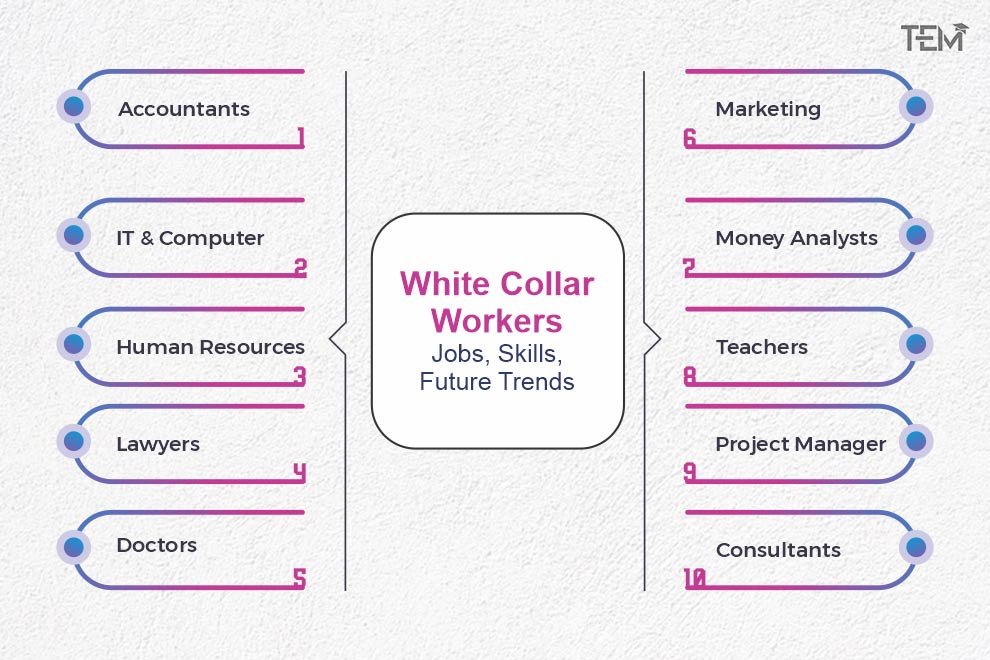
White-collar jobs? Oh, there are tons of them! Basically, if you are managing, organizing, or using serious know-how, you are in the club. These roles take brains, skills, and often a good chunk of schooling.
Let’s Break It Down by Category:
- Accountants & Auditors: The Money Watchers
These folks are crucial. They keep track of money, do taxes (ugh, taxes!), and ensure companies play by the rules. You gotta know your numbers inside out.
Examples: Tax people, company money checkers, fraud finders.
- IT & Computer Folks: The Tech Wizards
Where would we be without them? They build software, run computer systems, and keep us safe from hackers. You need to be a code genius here.
Examples: App makers, cyber cops, network builders, data crunchers.
- Human Resources (HR) Crew: The Heart of the Office
HR folks hire new people, help employees with problems, handle paychecks, and ensure the company follows worker laws. You gotta be a people person.
Examples: Hiring managers, worker helpers, pay experts, and rule followers for employees.
- Lawyers & Legal Eagles: Rule Experts
Lawyers give legal advice, defend people in court, and write up legal papers. It covers everything: business, crime, you name it. A law degree is a must-have.
Examples: Courtroom lawyers, deal makers, legal advisors, paperwork pros.
- Doctors, Nurses & Medical Staff: Health Heroes
These are the people who figure out what’s wrong and make us feel better. Whether in hospitals or clinics, one needs serious schooling and licenses here.
Examples: Heart doctors, kid doctors, nurses on the front lines, therapists for your mind, pharmacists.
- Marketing & Sales Bosses: Brand Builders
They plan marketing campaigns and lead sales teams. They study what we want and how to sell it. You gotta be creative and strategic.
Examples: Ad creators, sales leaders, brand managers, market researchers.
- Money Analysts & Advisors: Financial Brains
Financial analysts look at numbers to help companies make smart choices, while advisors help people plan their investments.
Examples: Stock pickers, investment gurus, money planners, budget bosses.
- Teachers & School Leaders: Knowledge Spreaders
From principals to professors, they run schools and create lessons. Lots of schooling and experience in education are needed.
Examples: College professors, school principals, lesson planners, and education experts.
- Project Managers: The “Get-It-Done” People
They plan projects and keep them on track to finish on time and on budget. They are total organization freaks.
Examples: Building project leaders, tech project chiefs, timeline masters.
- Consultants: The “Ask-Us-Anything” Experts
Companies hire them to solve specific problems in management, tech, or HR. You need to be a sharp thinker.
Examples: Business fixers, tech advisors, efficiency experts, strategy gurus.
5. White-Collar Work: Where Does It Happen?
Think white-collar work just means a cubicle? Think again. The workplace is evolving fast!
- The Office—Still Classic: From cubicles to fancy corner offices, these are still big places built for teamwork.
- Home Offices are HUGE Now: Thanks to tech (and recent global events), working from home is massive and super common.
- Meeting Rooms: This is where ideas clash in a good way. It’s where strategies get hatched with teams or clients.
- Travel Mode: Consultants and salespeople often travel to see clients or check sites. It could be across town or the world!
6. What You Gotta Know: Skills & Schooling
It’s not just about showing up; you need the toolbox to back it up.
- Education, Education, Education: A college degree is often the starting point. Advanced degrees and certifications (like CPA or PMP) show you’re a real pro.
- Tech Smarts: You have no choice here. You gotta be comfy with computers, software, and job-specific programs.
- People Skills (They’re Vital!): Communication, problem-solving, and leadership sound soft, but they are hard skills that make careers.
- Never Stop Learning: The world changes fast. You gotta keep learning and upgrading your skills to stay relevant.
7. White-Collar vs. Blue-Collar: The Big Showdown!
What is the actual difference? Let’s look at the facts:
| Feature | White-Collar Workers | Blue-Collar Workers |
| Type of Work | Brain work, thinking jobs | Bodywork, hands-on, physical jobs |
| Work Place | Offices, sometimes your couch! | Factories, construction sites, outdoors |
| Skills & School | College often needed, soft skills too | Job training, technical skills, being strong |
| Money | Usually better pay, plus benefits | Pay varies a lot, maybe hourly |
| Job Outlook | Depends on the economy, room to grow | Depends on industry; maybe union protection |
8. The Big Picture: Economy and Society
The split between these two worlds is a big deal for our society.
- The Money Stuff (Economics):
Sadly, the Pay Gap Gets Wider because white-collar folks often earn more. Also, Jobs Change with Tech; technology helps white-collar roles grow, while some blue-collar jobs don’t see the same boost.
- The Society Stuff (Social):
Job Status is still a thing—white-collar work is often seen as ‘better,’ even if it shouldn’t be. And regarding Work-Life Balance, both sides have issues. White-collar workers face stress and long hours, while blue-collar workers face body strain.
9. Where Do You Find Them? (Industry Breakdown)
They are everywhere, but especially here:
- Finance & Banking: Money management and investments.
- Tech & IT: Cybersecurity and systems.
- Healthcare: Doctors, nurses, and researchers.
- Education: Teaching and running schools.
- Legal: Lawyers keeping things legal.
- Marketing & Ads: Selling stuff.
- Consulting: Expert advice for businesses.
10. The Path: Schooling and Training
How do you get in?
- College Degree: Often gotta have it for jobs like accountants or HR specialists.
- Fancy Degrees: Sometimes you need more, like a Master’s or Doctorate for lawyers, doctors, or professors.
- Certifications: These are your ‘Show-Me-You-Know-It’ papers. Industry certs prove you’re legit.
11. Keeping Your Career Strong:
- Always Be Learning: Continuing education is a thing.
- Join the Club: Professional associations are great for networking.
- Find a Mentor: Learn from experienced folks.
- Get More Letters After Your Name: MBAs and CFAs boost skills and open doors.
12. The Perks vs. The Downsides
The Good Stuff (Perks):
- Better Paychecks: Higher salaries reflect the schooling.
- Job Security: Usually more stable.
- Nice Workplaces: Offices are comfy and climate-controlled.
- Climb the Ladder: Career paths to move up are clearer.
- Work-Life Balance: Can be good with flexibility.
- Respect Factor: Society sees them as important.
13. The Tough Stuff (Downsides):
- Stress City: High pressure and deadlines can be brutal.
- Clocking Crazy Hours: Long workweeks are common in finance or law.
- Desk Jockey Life: Sedentary problems are real health risks.
- Mental Drain: Burnout is a danger from decision fatigue.
- Competition is Fierce: Lots of people want these jobs.
14. What to Watch For: The Future
The future is knocking, and it looks different!
- AI and Robots: Automation is taking over routine stuff like data entry. It’s good for efficiency, but brings job worries too.
- Remote Work: This is the new normal. Hybrid models (some office, some home) are likely here to stay.
- Digital World: Companies are going digital, so you must learn digital data analysis to not get left behind.
- Gig Life: Freelance and contract work is growing for white-collar roles, too.
15. Future Outlook:
- Skills Upgrade: Constant learning is key.
- Hybrid Work: Get used to it!
- Soft Skills Rule: People skills are super important now.
- Diversity Matters: In a big way—it’s beneficial for everyone.
- Sustainability Counts: Companies care about being green, and white-collar workers drive this.
My Opinion
Here is the bottom line from an expert perspective: The landscape of white-collar workers is undergoing a seismic shift that we cannot ignore. While the ‘white shirt’ definition is fading, the reliance on high-level cognitive skills is at an all-time high. The future belongs to those who can blend technical expertise (like AI literacy) with the deeply human ‘soft skills’ that machines cannot replicate—empathy, complex strategy, and ethical leadership.
We are moving away from traditional career ladders toward dynamic ‘career webs’ where adaptability is your greatest asset. If you are entering this field, do not just aim for a job title; aim for a skillset that bridges the gap between digital innovation and human connection. That is where the real value lies in the coming decade.
Found this deep dive helpful? Don’t keep it to yourself! Share this blog with your friends and colleagues—let’s help everyone navigate the exciting future of work together!
Simran Khan