Nuclear power is having a quiet but real comeback. After two decades of slow growth, the world’s reactor fleet is expanding again, led by a handful of nuclear energy-producing countries that are building faster, restarting idled reactors, and breaking ground on the first small modular reactors (SMRs).
This guide ranks the top nuclear energy-producing countries using the latest complete generation data, then walks through what’s actually changing in 2026, from new reactors connecting to the grid to the countries placing the biggest bets on nuclear’s next chapter.
Which Country Produces the Most Nuclear Energy?
The United States produces more nuclear energy than any other country. Its 94 Nuclear reactors generated 785.6 TWh of electricity in 2025, the latest complete annual figure from the IAEA Power Reactor Information System (PRIS). That’s roughly 29% of all the nuclear electricity generated worldwide. China ranks second and is closing the gap quickly, while France produces less in raw volume but depends on nuclear more than any other major economy, drawing about 68.1% of its electricity from it.
Global Snapshot of Nuclear Power in 2026
As of August 2026, the World Nuclear Association Reactor Database reports:
- 441 operable reactors
- About 404 GW of net capacity
- 79 reactors under construction
Nuclear supplies around 9% of global electricity. Most new construction remains concentrated in Asia, led by China. Lifetime extensions and higher capacity factors keep the United States and several European fleets productive even with little or no new build.
Top Nuclear Energy-Producing Countries: Latest Complete Annual Data
Since 2026 is still underway, full-year 2026 generation totals don’t exist yet. The table below uses 2025 figures, the most recent complete year on record, which is the standard way energy agencies report annual rankings.
| Rank | Country | 2025 Generation (TWh) | Nuclear Share (%) | Operable Reactors | Under Construction |
| 1 | United States | 785.6 | 17.7 | 94 | 0 |
| 2 | China | 448.4 | 5.0 | 64 | 37 |
| 3 | France | 373.5 | 68.1 | 57 | 0 |
| 4 | Russia | 204.9 | 18.7 | 34 | 7 |
| 5 | South Korea | 175.6 | 31.0 | 26 | 4 |
| 6 | Japan | 94.7 | 9.4 | 33 | 2 |
| 7 | Canada | 81.1 | 13.0 | 17 | 1 |
| 8 | Spain | 51.5 | 18.9 | 7 | 0 |
| 9 | India | 49.1 | 3.2 | 24 | 8 |
| 10 | Sweden | 44.8 | 26.7 | 6 | 0 |
Data note: The generation figures above come directly from IAEA PRIS country records (updated July 2026). Nuclear share percentages are compiled from IAEA and World Nuclear Association analysis and may reflect a slightly different data vintage than the generation totals. Reactor status and 2026 developments discussed later in this article are based on the latest IAEA PRIS and IEA data available at the time of publication, since full-year 2026 production figures are not yet available.
What the Nuclear Production Ranking Measures
A few different numbers get thrown around when people talk about nuclear power by country, and they measure different things:
- TWh (terawatt-hours) generated: the actual amount of electricity a country’s reactors produced in a year. This is the fairest way to rank countries by output.
- Nuclear share: the percentage of a country’s total electricity that comes from nuclear power. A country can rank low in raw output but high in share, like Slovakia or Hungary.
- Installed capacity (GW or MW): the maximum electricity a country’s reactors could produce if run at full power constantly. It’s a measure of size, not actual output.
- Reactor count: the number of individual reactors operating. A country with fewer, larger reactors can outproduce one with more, smaller units.
Keeping these separate matters, because the country with the most reactors, the country with the highest output, and the country most dependent on nuclear power are three different answers.
Top Nuclear Energy Producers: Country-by-Country
United States
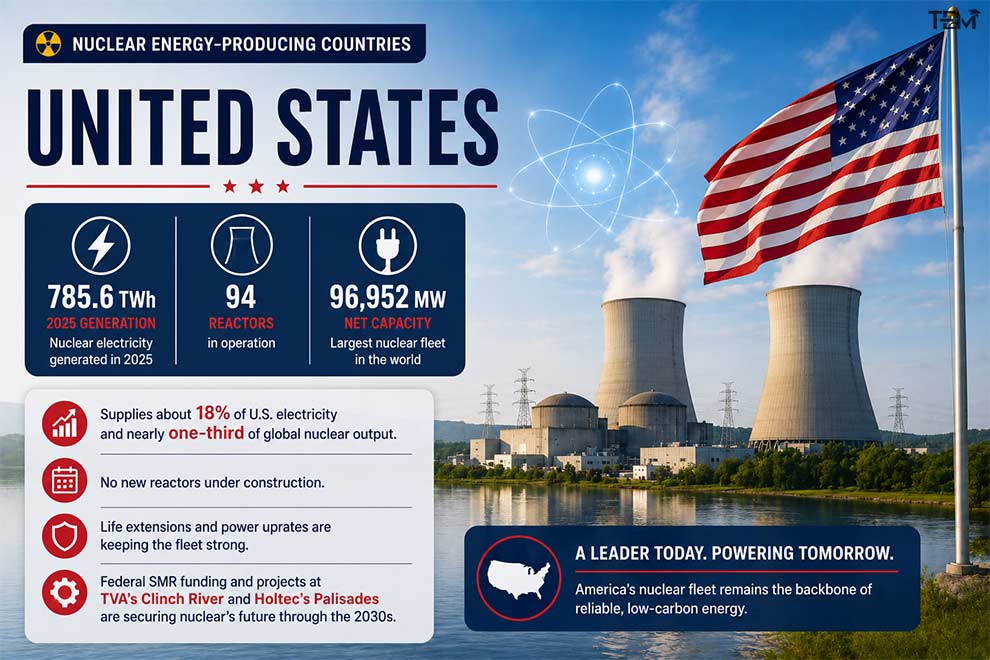
2025 generation: 785.6 TWh. 2026 status: 94 reactors in operation; 96,952 MW net capacity, the largest fleet in the world.
The U.S. has held the top spot for decades, and its fleet still supplies about 18% of national electricity while accounting for close to a third of global nuclear output. No new reactors are currently under construction, but life extensions, power uprates, and federal SMR funding decisions, including projects led by TVA at Clinch River and Holtec at Palisades, are extending the fleet’s role well into the 2030s.
China
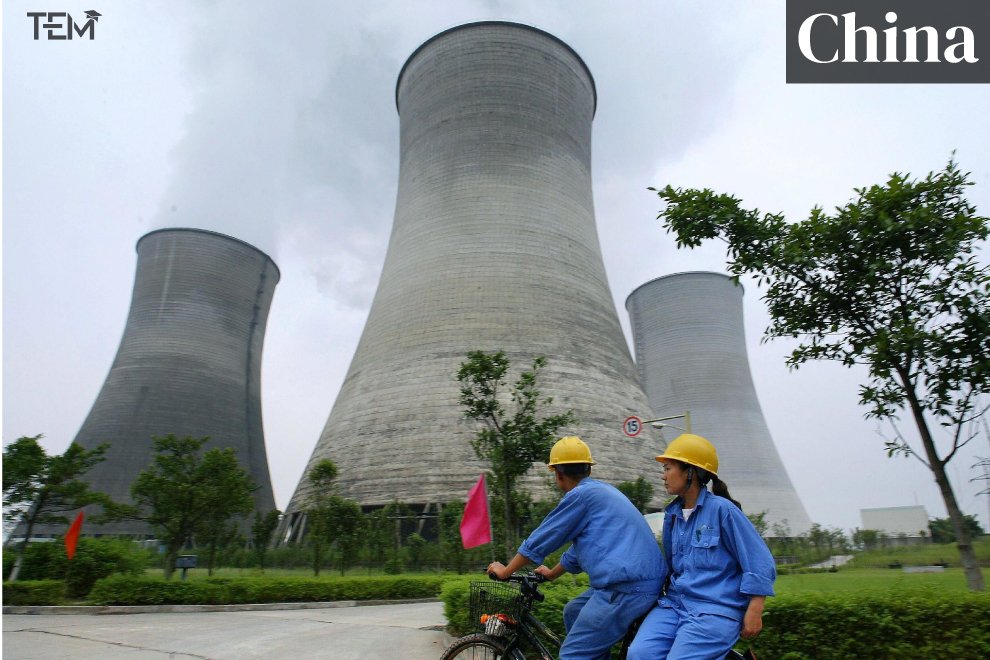
2025 generation: 448.4 TWh. 2026 status: Around 64 reactors operating; 37 more under construction, the largest build-out anywhere.
China is closing in on the U.S. faster than any other nuclear energy-producing country. Two new reactors, Sanao-1 and Taipingling-1, connected to the grid in February and March 2026 alone. Roughly half of all nuclear capacity under construction worldwide sits in China, and its installed base is projected to approach 100 GW by around 2030.
France

2025 generation: 373.5 TWh; 2026 status: 57 reactors; 63,000 MW net capacity; no new construction underway, but the highest nuclear share of any major economy.
France remains the world’s most nuclear-dependent large economy. Flamanville-3, a long-delayed EPR unit, reached commercial operation in late 2024 and now anchors the fleet. With a couple of new reactors planned rather than under active construction, France is treating its existing fleet as the backbone of its 2050 decarbonization plan.
Russia

2025 generation: 204.9 TWh; 2026 status: 34 reactors; construction continuing at Kursk II and Leningrad II.
Russia keeps expanding its domestic fleet while also exporting reactor technology abroad. Kursk 2-1 connected to the grid at the very end of 2025, with sister units under construction at both Kursk and Leningrad. Russia is also one of only two countries currently running a small modular reactor, in its case a marine-based design.
South Korea
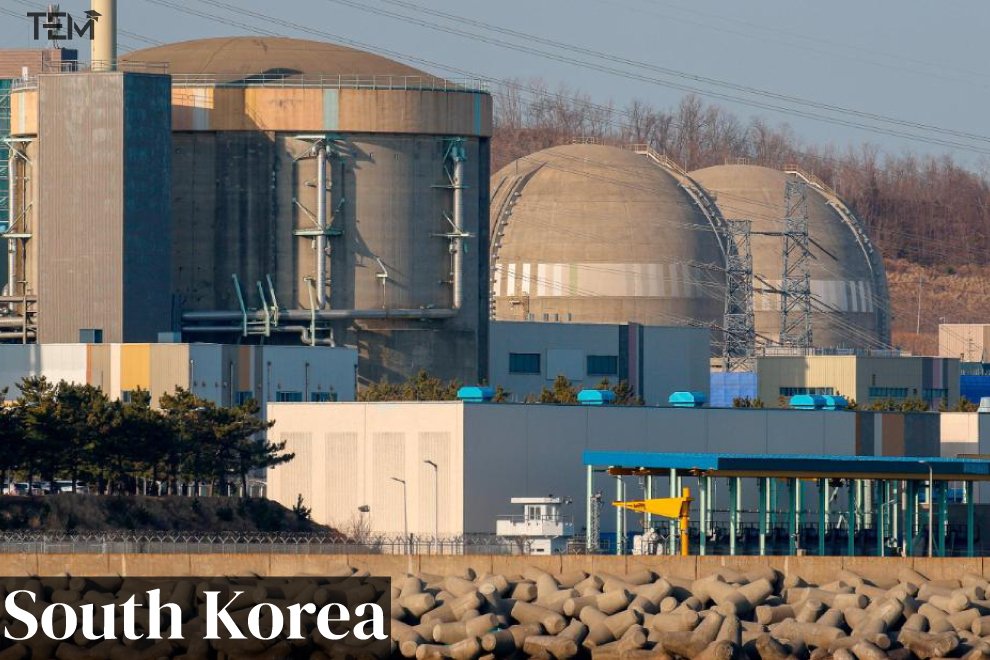
2025 generation: 175.6 TWh (31.0% nuclear share); 2026 status: 26 reactors; 25,609 MW net capacity; four more under construction.
South Korea runs one of the most reliable large fleets anywhere and keeps building. Shin-Hanul-1 and 2 are already online, while Shin-Hanul-3 and 4 are under construction, with Shin-Hanul-4 breaking ground in May 2026. South Korea is also developing its own SMR designs for domestic use and export.
Japan
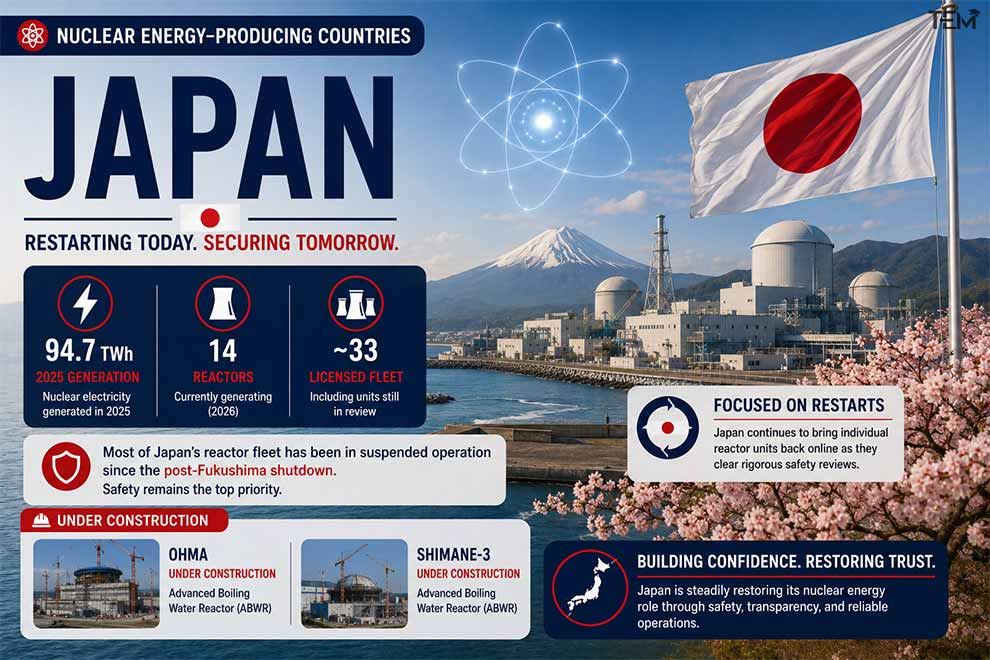
2025 generation: 94.7 TWh. 2026 status: 14 reactors currently generating, out of a broader licensed fleet of roughly 33, including units still working through restart approval.
Japan’s story in 2026 is really about restarts, not new builds. Most of its reactor fleet has sat in suspended operation since the post-Fukushima shutdown, and the country continues to bring individual units back online as they clear safety reviews. Two reactors, Ohma and Shimane-3, remain under construction.
Canada

2025 generation: 81.1 TWh (13.0% nuclear share). 2026 status: 17 CANDU pressurized heavy-water reactors; 12,714 MW net capacity.
Canada’s entire fleet runs on CANDU technology, which uses natural (unenriched) uranium fuel. The bigger 2026 story is Darlington SMR1, a 300 MW small modular reactor that started construction in April 2026, the first grid-scale SMR construction start in the country and a potential first for the G7.
Spain

2025 generation: 51.5 TWh (18.94% nuclear share); 2026 status: 7 reactors; 7,123 MW net capacity; no new construction.
Spain’s fleet is stable but aging, and current policy still calls for phasing out all seven reactors by 2035. For now, nuclear remains Spain’s largest source of low-carbon electricity, and utilities continue negotiating life-extension terms that could push some retirements later.
Sub-Image
India
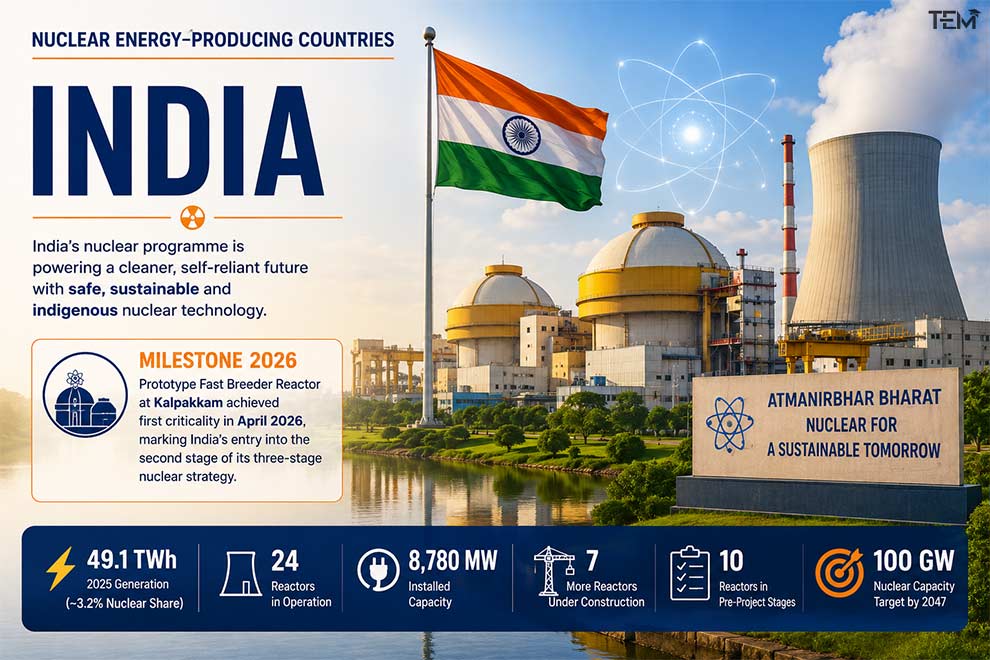
2025 generation: 49.1 TWh (about 3.2% nuclear share); 2026 status: 24 reactors; 8,780 MW installed capacity; 7 more under construction plus 10 in pre-project stages.
India’s nuclear programme hit a genuine milestone in April 2026, when its Prototype Fast Breeder Reactor at Kalpakkam achieved first criticality, moving the country into the second stage of its long-planned three-stage nuclear strategy. Rajasthan-7 and restarted Tarapur units add near-term output, and India has set a target of 100 GW of nuclear capacity by 2047.
Sub-Image
Sweden
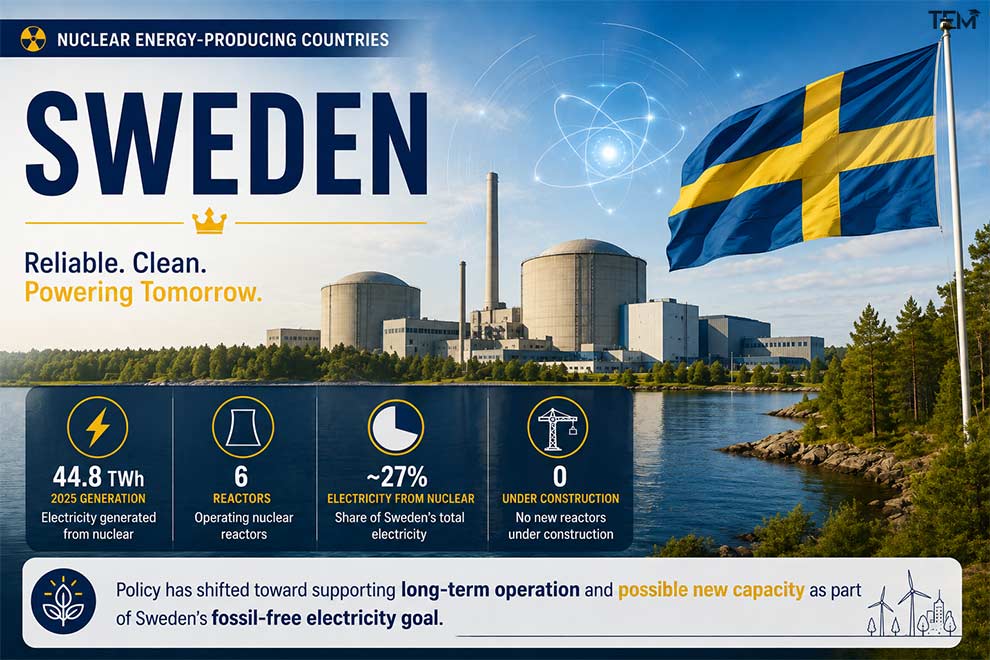
2025 generation: Sweden generated 44.8 TWh from six reactors and obtained nearly 27% of its electricity from nuclear. No units are under construction. Policy has shifted toward supporting long-term operation and possible new capacity as part of a fossil-free electricity goal.
Ukraine: Why Its Nuclear Data Requires Caution
Ukraine operates 15 reactors, and nuclear has historically supplied around half of its electricity. The World Nuclear Association table lists an estimated 50.2 TWh for 2025. However, the war has disrupted normal reporting. Current IAEA PRIS country records do not provide a fully comparable 2025 generation figure on the same basis as other countries. For that reason, Ukraine is not placed in the main Top 10 ranking. Readers should treat any 2025 output number for Ukraine as an estimate pending restored, consistent reporting
Largest Nuclear Producers vs. Highest Nuclear Dependence
Two countries can both be nuclear leaders in completely different ways. Production measures how much nuclear electricity a country generates in absolute terms. Nuclear share measures how important nuclear power is within that country’s own electricity mix. The United States dominates by volume but gets under a fifth of its power from nuclear, while smaller countries like Slovakia and Hungary barely register in global rankings yet depend on nuclear for roughly half their electricity or more.
| Country | 2025 Generation (Volume) | Nuclear Share (Dependence) |
| United States | 785.6 TWh | 17.7% |
| France | 373.5 TWh | 68.1% |
| Slovakia | 18.0 TWh | 64.4% |
| Ukraine | ~50.2 TWh | ~52.0% |
| Hungary | 15.2 TWh | 45.2% |
| South Korea | 175. TWh | 31.0% |
| Canada | 81.1 TWh | 13.0% |
| Spain | 51.5 TWh | 18.9% |
| India | 49.1 TWh | 3.2% |
France sits at an unusual intersection here: it’s a top-three producer by volume and the most nuclear-dependent major economy, which is part of why its energy policy differs so much from those of countries like the U.S. or China.
Global Nuclear Power Snapshot in 2026
| Indicator | 2026 Status |
| Reactors in operation | 441 |
| Operating nuclear capacity | ~404 GW |
| Reactors under construction | 79 |
| Capacity under construction | ~85.8 GW |
| Countries with reactors in operation | 31 |
Source: IAEA Power Reactor Information System data compiled by the World Nuclear Association, as of August 2026.
Nuclear energy is expanding again, but the growth is heavily concentrated. According to the IEA’s Global Energy Review 2026, about 3 GW of new nuclear capacity came online in 2025, with China, India, and Russia each completing a new reactor. Those additions were roughly offset by 3 GW of retirements, two-thirds of it in Belgium. Ten construction projects broke ground in 2025 alone, nine of them in China and one in Russia. Of the 78 to 85 GW currently under construction worldwide, about half sits in China. Outside China, Egypt, India, and Türkiye each have around 5 GW under construction, while Japan, South Korea, and the UK each have two reactors underway. This buildout also supports the clean-energy workforce more broadly; readers exploring careers in the sector can see how nuclear fits alongside other green jobs in the wider energy transition.
What’s Changing in Nuclear Energy in 2026?
China
China is the biggest nuclear construction story of 2026. The IAEA PRIS database recorded new grid connections at Sanao-1 on March 12 and Taipingling-1 on February 13, along with several new construction starts across sites like Zhangzhou, Lufeng, and Xudapu.
India
India’s fleet keeps expanding on multiple fronts. PRIS recorded Rajasthan-7’s first grid connection in March 2025, restarts at Tarapur-1 and Tarapur-2, and construction starts at Kaiga-5 and Kaiga-6 in 2026. The Kalpakkam fast breeder reactor’s first criticality in April 2026 was the headline moment for the year.
Japan
Japan’s 2026 story is its restart programme. The IEA notes that Japan continues bringing back online reactors whose operations had been suspended since the post-Fukushima safety overhaul, gradually rebuilding the share of electricity nuclear contributes to the grid.
Canada
Canada started construction on Darlington SMR1, a 300 MW small modular reactor, on April 22, 2026, according to IAEA PRIS. It’s the clearest signal yet that SMRs are moving from paper designs to poured concrete.
South Korea
South Korea continues building large reactors while also developing SMR technology. PRIS recorded a construction start for Shin-Hanul-4 on May 29, 2026, joining sister unit Shin-Hanul-3 already underway.
Nuclear Energy Countries to Watch in 2026
- China: the largest construction pipeline in the world, with new reactors connecting to the grid almost every quarter.
- India: the fastest-growing programme among established nuclear states, headlined by the Kalpakkam fast breeder milestone.
- Japan: its restart pace is the single biggest swing factor in how quickly the country’s nuclear share recovers.
- Canada: first out of the gate on grid-scale SMR construction among G7 countries.
- South Korea: building new large reactors at home while positioning its SMR designs for export.
Conclusion
The list of top nuclear energy-producing countries hasn’t changed much at the very top: the United States, China, and France still lead by volume, just as they have for years. What’s different in 2026 is everything happening underneath that ranking. New reactors are connecting to the grid in China and India, Japan’s restart programme is slowly rebuilding its nuclear share, and Canada just broke ground on North America’s first grid-scale small modular reactor. Nuclear power isn’t reshaping the global energy mix overnight, but the direction is clear, and the countries investing now are setting up how this ranking looks when the 2027 numbers come in. For more on the environmental and energy trends shaping how countries power their grids, see our coverage in Environment Studies.
FAQs
- Which country has the most nuclear reactors?
The United States operates the most reactors, 94 in total. China is closing the gap fast, running around 64 reactors with dozens more under construction.
- How many nuclear reactors are operating worldwide right now?
As of August 2026, 413 to 440 nuclear power reactors are operating across 31 countries, with a combined capacity of roughly 404 GW, based on IAEA PRIS data compiled by the World Nuclear Association.
- Which country relies most on nuclear power for its electricity?
France relies on nuclear more than any other major economy, drawing about 65% to 70% of its electricity from its 57 reactors. Slovakia and Ukraine also get roughly half their power from nuclear.
- How much nuclear electricity does the world produce each year?
The world generated about 2,667 TWh of nuclear electricity in 2025, the latest complete annual total, supplying close to 9% of global electricity.
- Which countries are building new nuclear reactors in 2026?
15 countries are actively building new nuclear power globally. China leads by a wide margin, followed by India, Russia, South Korea, and Japan. Canada also started construction on its first grid-scale small modular reactor, Darlington SMR1, in April 2026.