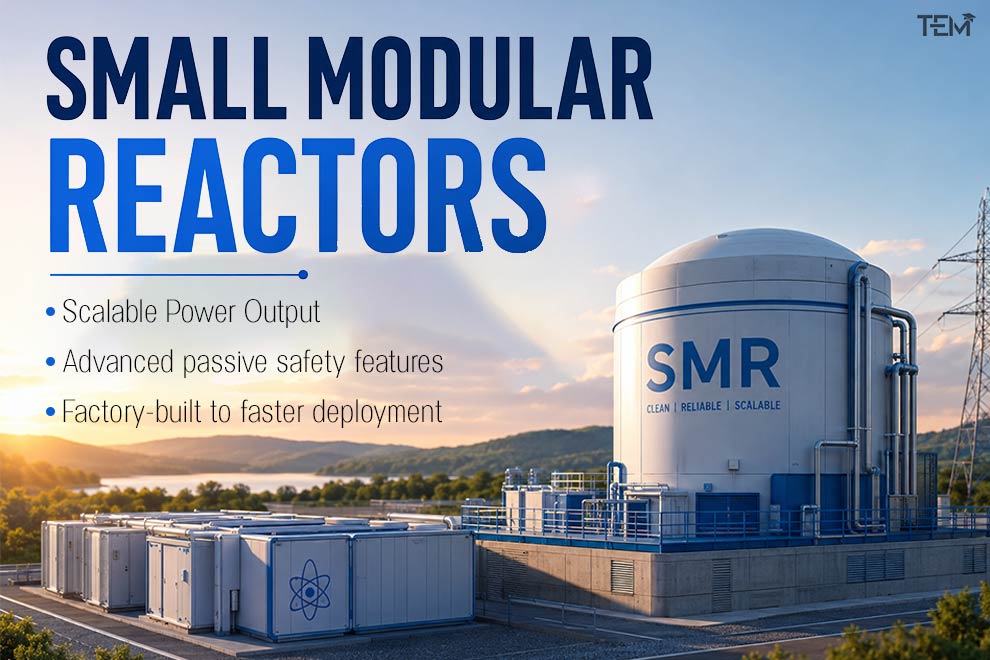
Small modular reactors, or SMRs, are nuclear reactors designed to produce electricity at a smaller scale than conventional large reactors and to make greater use of modular construction. However, the term does not describe a single reactor technology. Different designs use distinct fuels, coolants, neutron spectra, and safety mechanisms. In 2026, the sector is moving from design development toward licensing, site preparation, manufacturing preparation, and early deployment in several countries.
Nevertheless, the technology is not yet a mature global commercial fleet. The International Energy Agency reports that most nuclear capacity currently under construction globally remains centered on traditional large reactors.
This article examines SMR technology, real-world deployment progress, key benefits, structural challenges, and realistic commercial expectations for 2026.
What Is a Small Modular Reactor?
A small modular reactor is a nuclear reactor designed with a smaller electrical output and modular construction approach, allowing components or modules to be manufactured and assembled using standardized processes. Understanding the core concepts requires breaking down the three constituent terms:
The term small describes electrical generation capacity and physical footprint. While the International Atomic Energy Agency uses a general reference point of less than 300 megawatts electrical per module, there is no single universal definition across every global regulatory authority. Consequently, an SMR should not be defined strictly as any reactor under 300 megawatts electrical.
The term modular refers to standardized factory fabrication and assembly. Major reactor components and structural systems are manufactured inside central factory facilities using repeatable, quality-controlled processes. These pre-assembled modules are then transported to the project location for final site installation.
The term reactor signifies that energy generation relies on controlled nuclear fission occurring within a central core. The underlying physics of splitting heavy atomic nuclei to produce thermal energy remains identical to traditional nuclear facilities.
How Do SMRs Work?
Small modular reactors convert thermal energy into electricity through a fundamental thermodynamic sequence shared across nuclear energy technologies:
Fuel -> Fission -> Heat -> Coolant -> Steam/Heat -> Turbine -> Generator -> Electricity
Nuclear fuel housed within the reactor core undergoes fission, generating thermal energy. A liquid or gaseous coolant flows through the core to absorb this heat and transfer it to a steam generator or secondary heat exchanger. The generated steam spins a turbine connected to an electrical generator, producing grid power. While the general conversion process remains constant, the exact physical arrangement, coolant medium, and operating pressure depend entirely on the specific reactor design.
What Makes Small Modular Reactors Different From Conventional Reactors?
Small modular reactors differ from traditional nuclear power stations across scale, manufacturing methods, and deployment strategies. The primary structural differences are summarized in the comparison table below:
| Feature | Conventional Large Reactor | Small Modular Reactor |
| Scale | Typically greater than 1,000 MWe per unit | Smaller output per module, commonly using 300 MWe as a reference threshold |
| Construction | Large site-based civil engineering and construction | Greater factory modularization and off-site fabrication |
| Deployment | Large single centralized plant deployment | Potential for staged deployment and module addition |
| Manufacturing | More custom and site-specific component fabrication | Greater factory manufacturing potential across fleets |
| Capacity Addition | Capacity added in large single increments | Capacity added in smaller progressive increments |
| Technology Maturity | Fully established commercial designs | Includes evolutionary and advanced nuclear concepts |
Small modular reactors are intended to reduce civil construction complexity and enable staged capital investment. However, whether SMRs ultimately cost less per unit of electricity than conventional stations remains an open commercial question.
Main Types of SMR Technology
Light-Water SMRs
Light-water designs represent an evolutionary step from existing commercial pressurized water reactors and boiling water reactors. They utilize standard light water as both coolant and neutron moderator, running on low-enriched uranium fuel. Light-water concepts maintain the closest connection to established commercial reactor operations. As a result, light-water SMRs currently demonstrate high technical maturity and regulatory readiness compared to advanced concepts.
High-Temperature Gas-Cooled SMRs
High-temperature gas-cooled reactors utilize inert gases, such as helium, as coolants alongside solid graphite moderators. Many HTGR designs operate at temperatures above 700°C, enabling high-temperature heat applications and potentially improving thermal efficiency compared with lower-temperature reactor systems. High operating temperatures enable these units to supply high-grade industrial heat for applications such as hydrogen production and chemical manufacturing. Many designs incorporate durable fuel configurations like tristructural isotropic particle fuel.
Molten Salt Reactors
Molten salt reactors use liquid salt mixtures as either the primary coolant or as a combined liquid fuel matrix. Operating at high thermal conditions under near-atmospheric pressure, these systems reduce internal mechanical stress on containment structures. However, molten salts present complex corrosion and material degradation challenges.
In 2026, IAEA-related research and technical discussions continued to highlight materials development as an important challenge for molten-salt reactor technologies
Fast-Neutron SMRs
Fast-neutron reactors operate without a conventional moderator, maintaining an unmoderated neutron spectrum to sustain fission. They frequently employ liquid metals, such as sodium or lead, as coolants. Fast reactors can support improved fuel utilization and, depending on the design and fuel cycle, may be capable of breeding fissile material or consuming some long-lived actinides
SMR vs Microreactor: What’s the Difference?
Microreactors are generally much smaller than SMRs and are designed for applications such as remote communities, industrial sites, microgrids, and other specialized uses. Their exact capacity threshold varies by definition. While small modular reactors primarily target regional power grids or major industrial projects, microreactors are engineered for specialized niche applications. Terminology varies among international energy agencies, meaning not every small nuclear system is categorized as an SMR.
Why Are Countries Developing SMRs?
Governments and utility companies are pursuing small modular reactors to address energy security and decarbonization goals. Lower initial project scale reduces the absolute upfront capital investment needed to begin construction. Staged capacity additions allow utilities to bring single modules online to generate early revenue while subsequent units are being built. Centralized factory manufacturing aims to reduce site construction schedules and avoid historical megaproject cost overruns.
Smaller electrical outputs offer grid flexibility for smaller regional grids unable to absorb gigawatt-scale power plants. High operating thermal outputs provide high-grade industrial heat for manufacturing processes, district heating, and clean fuel synthesis. SMRs could potentially be deployed at or near some retiring fossil-fuel sites, particularly where existing grid connections and industrial infrastructure can be reused. These factors offer clear potential advantages, but actual commercial benefits depend entirely on specific reactor designs, regulatory frameworks, supply chain maturity, and project management.
What Are the Advantages of SMRs?
Small modular reactors offer technical characteristics designed to improve deployment flexibility. Standardized factory production is intended to reduce some site-based construction work and potentially shorten construction schedules once manufacturing processes are established at scale. Their smaller physical footprint may make some sites more suitable for SMR deployment than for a large reactor, subject to regulatory, safety, cooling, grid, and site-specific requirements. Progressive deployment enables site capacity to expand alongside growing electricity demand. Co-generation capability allows simultaneous production of grid electricity and high-temperature industrial heat. SMRs are designed to provide firm electricity generation, subject to the performance and availability of the specific reactor design.
What Are the Challenges of SMRs?
Despite their potential advantages, small modular reactors face critical economic and operational challenges. Smaller output power reduces unit economies of scale, meaning SMRs are not automatically cheaper per megawatt of capacity than large plants. First-of-a-kind projects face higher initial engineering, regulatory review, and construction costs. Licensing advanced non-light-water technologies requires new regulatory frameworks and safety evaluations.
Factory manufacturing benefits can only be realized if vendors secure sufficient order volumes to justify building dedicated component manufacturing plants. Specialized fuel requirements, including high-assay low-enriched uranium, face global supply constraints. Spent nuclear fuel still requires long-term radioactive waste management facilities. Scaling deployment across nations requires expanded workforces of nuclear engineers, plant operators, regulators, and specialized manufacturing labor.
What Is the Current Status of SMRs in 2026?
The global status of small modular reactors in 2026 can be evaluated using a three-tier operational framework:
| Feature | Conventional Large Reactor | Small Modular Reactor |
| Scale | Typically greater than 1,000 MWe per unit | Smaller output per module, typically below 300 MWe in commonly used definitions |
| Construction | Large site-based civil engineering and construction | Greater factory modularization and off-site fabrication |
| Deployment | Large single centralized plant deployment | Potential for staged deployment and module addition |
| Manufacturing | More custom and site-specific component fabrication | Greater factory manufacturing potential across fleets |
| Capacity Addition | Capacity added in large single increments | Capacity added in smaller progressive increments |
| Technology Maturity | Fully established commercial designs | Includes evolutionary and advanced nuclear concepts |
Source: IEA Global Energy Review 2026; project names and technology details cross-checked against IAEA and national project sources. Status varies by project and definition. Project classifications should be checked against current IAEA, IEA, and OECD-NEA data because construction, demonstration, and commercial-operation categories are not always defined identically.
Major SMR Developments in 2026
The year 2026 marks an important transition as several projects in Western countries are moving through licensing, site preparation, contracting, and construction-related milestones.
Canada: Darlington BWRX-300 Milestone
In March 2026, Ontario Power Generation submitted a formal application to the Canadian Nuclear Safety Commission for a 20-year Licence to Operate the first GE Vernova Hitachi BWRX-300 unit at the Darlington site. On March 30, 2026, the regulator lifted a major construction hold point, allowing workers to place the foundation basemat for the reactor building. The CNSC said its assessment found that OPG had met the prerequisites required for the regulatory milestone. The CAD 20.9 billion project targets connecting the first of four planned units to the electricity grid by the end of 2030.
United Kingdom: Wylfa SMR Deployment Contract
In April 2026, Rolls-Royce SMR and Great British Energy – Nuclear signed a delivery contract for three small modular reactors at the Wylfa site in Anglesey, North Wales. The UK National Wealth Fund has committed up to £599 million to support Rolls-Royce SMR’s development
Manufacturing and Supply Chain Integration
Industrial progress in 2026 extends beyond reactor sites into manufacturing supply chains. Rolls-Royce SMR unveiled a dedicated modular manufacturing strategy in April 2026, followed by formal vendor contracts in May 2026 for key nuclear-island structural components.
How Many SMR Designs Are Being Developed?
Tracking global reactor concepts requires separating active commercial projects from paper designs. The OECD Nuclear Energy Agency reported in its January 2026 SMR Dashboard update that its broader database tracked 129 SMR designs worldwide. However, only 78 designs were actively covered within its Digital Dashboard, with the remaining 51 categorized as inactive, confidential, paused, or cancelled. The number of SMR designs should not be confused with the number of commercially ready reactors. Market deployment is consolidating around a smaller group of well-funded concepts.
SMR Fuel: Why HALEU Matters
High-Assay Low-Enriched Uranium, or HALEU, is uranium enriched between 5% and 20% uranium-235. Standard commercial light-water reactors run on low-enriched uranium enriched below 5%. Some advanced non-light-water reactor designs are designed around HALEU fuel to achieve higher fuel burnup, compact reactor core dimensions, and longer operating cycles between refueling shutdowns. In 2026, the IAEA and other nuclear-energy organizations continued to highlight fuel availability, enrichment capacity, transportation and infrastructure as important considerations for advanced-reactor deployment.
Are SMRs Safer Than Large Nuclear Reactors?
Many SMR designs incorporate passive safety systems and smaller reactor cores, but a reactor’s overall safety cannot be judged from size alone. SMR designs rely heavily on passive safety mechanisms. Smaller core sizes contain lower absolute radioactive inventories and produce less residual decay heat after shutdown. Natural physical processes, such as gravity-driven coolant flow, natural circulation, and ambient heat dissipation, can maintain core cooling without operator intervention or continuous electrical power. The IAEA has identified SMRs as an area of significant international interest. Despite inherent passive features, SMRs require robust containment structures, reliable shutdown systems, and strict regulatory oversight.
Can SMRs Replace Large Nuclear Power Plants?
Small modular reactors are intended to complement large nuclear stations rather than fully replace them. Large gigawatt-scale reactors are well suited to supplying large amounts of continuous electricity to major grids, while SMRs may be better suited to smaller grids, industrial sites, or staged capacity additions. Future low-carbon power systems will likely utilize both large reactors and modular units based on regional market requirements.
Where Could SMRs Be Used?
The smaller output and flexible operating profiles of small modular reactors enable applications beyond traditional power generation. SMRs can provide low-carbon electricity to regional power grids. High thermal outputs enable co-generation of industrial process heat for chemical facilities and paper mills. SMRs can supply thermal energy to municipal district heating systems or drive large-scale seawater desalination plants. High-temperature gas-cooled reactors can supply energy for clean hydrogen production via high-temperature electrolysis. SMRs can also replace fossil fuel generation in off-grid mining sites and remote communities.
Interest has expanded regarding SMR integration with data centers supporting artificial intelligence and cloud computing. While research in 2026 continues to evaluate SMR power configurations for high-density computing, these concepts remain analytical studies rather than operational commercial campuses.
The Biggest Question: Are SMRs Commercially Ready?
Commercial readiness varies substantially across SMR concepts. The maturity spectrum across current design concepts can be categorized across five distinct developmental stages:
| Development Stage | Stage Meaning | Current Commercial Status |
| Concept | Preliminary design formulation and physics modeling | Dozens of early-stage paper concepts globally. |
| Licensing | Active safety evaluation by national nuclear regulators | Advanced light-water designs in Western nations. |
| Demonstration | Construction of prototype or demonstration units | Selected gas-cooled and advanced reactor concepts. |
| Construction | Physical site excavation and civil engineering works | First-of-a-kind projects at different stages in Canada, China, Russia, and other countries. |
| Operation | Active grid power generation and operational feedback | Land-based HTR-PM demonstration plant and floating Akademik Lomonosov. |
SMR vs Large Nuclear Reactor
Evaluating small modular reactors alongside traditional large reactors highlights fundamental trade-offs in project scale, economic risk, and application fit:
| Comparison Factor | Small Modular Reactor | Large Nuclear Reactor |
| Electrical Output per Unit | Smaller output per module | Large output, typically 1,000 MWe to 1,650 MWe |
| Construction Methodology | High potential for factory modular assembly | Site-intensive civil engineering construction |
| Upfront Capital Investment | Lower potential upfront commitment per module | High capital commitment per single project |
| Capacity Addition Profile | Staged deployment of progressive modules | Large single-phase generation commitment |
| Technology Maturity | Varies, with light-water designs leading | Established commercial technology fleet |
| Target Power Market | Small grids, remote sites, industrial co-generation | Large centralized electricity networks |
| Cost Certainty | Developing through initial deployment projects | Better established for mature series designs |
What Does the Future of Small Modular Reactors Look Like?
The small modular reactors story in 2026 is no longer limited to conceptual reactor designs on paper. Projects are entering formal licensing, site preparation, and manufacturing stages across several countries. At the same time, the technology remains unevenly mature across different developer concepts. Persistent commercial questions around elevated first-of-a-kind costs, specialized fuel supply chains, regulatory standardization, and repeatable factory manufacturing must still be answered before mass deployment occurs. Early commercial demonstration projects over the coming decade will determine whether standardized factory production successfully delivers lower electricity costs. Small modular reactors could complement renewable generation and, in some markets, provide an alternative to retiring fossil-fuel capacity.
However, achieving widespread commercial adoption requires long-term capital commitment, established supply networks, and consistent policy support across international jurisdictions.
FAQs
- What is the difference between an SMR and a microreactor?
Microreactors are generally much smaller than SMRs and are designed for applications such as remote communities, industrial sites, microgrids, and other specialized uses. Their exact capacity threshold varies by definition.
- Are SMRs safer than traditional nuclear reactors?
SMR designs incorporate passive safety features that rely on natural forces such as gravity and convection for emergency cooling. However, overall safety depends on design quality, operating standards, and regulatory oversight.
- How much electricity does an SMR produce?
The electrical output varies by design, but SMR modules are generally much smaller than conventional gigawatt-scale reactors. Multiple modules can be combined at a single site to increase total generating capacity.
- Are SMRs operating in 2026?
Yes, operating SMR units in 2026 include China’s land-based HTR-PM high-temperature gas-cooled reactor demonstration plant and Russia’s floating Akademik Lomonosov nuclear power plant.
- Which countries are developing SMRs?
Leading nations developing small modular reactors include Canada, the United Kingdom, the United States, China, Russia, and South Korea.