Traditional learning models often struggle to maintain student focus in an era of constant digital distractions. A 2024 Harris Poll survey conducted for Discovery Education found that nearly half of teachers report student engagement has declined since 2019, with one in three students saying they are “always” bored in class.
From gamification in higher education to the latest trends in gamification in online education for 2026, this article provides the insights and tools needed to bridge the engagement gap and foster a generation of lifelong learners.
What is Gamification in Education?
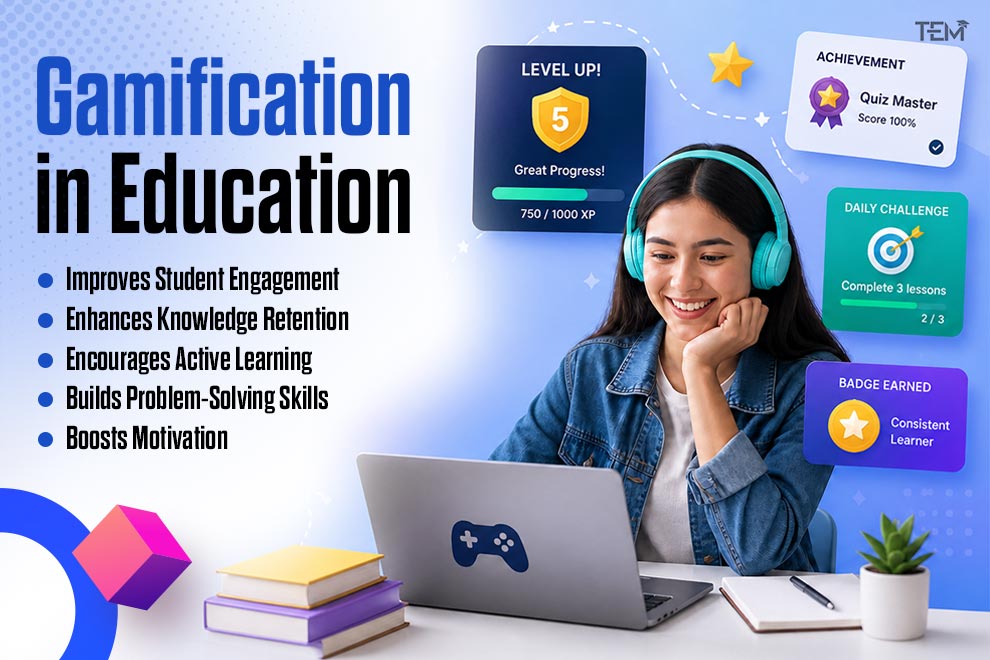
Gamification in education is the integration of game elements such as points, badges, leaderboards, and interactive challenges into educational environments to increase student engagement, motivation, and learning outcomes.
It is worth distinguishing this from game-based learning, a related but different approach. Gamification applies game mechanics to an existing activity (like a quiz or homework set). Game-based learning, by contrast, uses an actual game as the primary vehicle for instruction. In practice, classrooms often blend both, but the two terms are not interchangeable.
Key components include:
- Points & Scoring Systems: Immediate quantification of effort and progress.
- Badges & Achievements: Visual representations of mastery and milestones.
- Leaderboards: Friendly competition to drive performance.
- Quests & Challenges: Structured tasks designed to build problem-solving skills.
- Progress Bars & Streaks: Visual indicators of momentum, like a completion bar or a daily streak, that motivate students to keep showing up consistently.
Real-World Pioneer: Quest to Learn (K-12 Model)
To see full-scale gamification in action at the K-12 level, consider Quest to Learn (Q2L), a public middle and high school in Manhattan, New York, created in partnership with the Institute of Play and the NYC Department of Education.
How Quest to Learn Gamifies the Classroom:
- Quests & Boss Levels: Instead of standard multi-week units, students embark on “Quests.” Trimesters culminate in a “Boss Level,” a two-week intensive challenge where students collaborate in teams to solve complex, real-world problems (e.g., designing eco-system models or simulating crisis diplomacy).
- Leveling Up vs. Letter Grades: Grades are mapped to game progression. Students start at “Novice” and level up to “Apprentice,” “Master,” and “Expert” as they demonstrate mastery.
- Integrated Subjects: Core subjects are framed as system challenges; for example, Math and Science are integrated into a combined module called “Codeworlds.”
How Gamification Works in Education
The psychological power of gamification is rooted in human biology, specifically the brain’s reward system. By triggering dopamine releases during moments of achievement, gamified systems transform the learning process into a series of positive reinforcements. Instead of facing an overwhelming syllabus, students navigate a path of smaller, manageable “quests” that provide a constant sense of progression and accomplishment
1. Core Mechanics
Research backs this design choice: students who actively retrieve information the way a gamified quiz forces them to retain 50–80% of it after a week, compared with just 10–15% for students who passively re-read material.
2. Levels and Progression
A five-year study of engineering students at the Polytechnic University of Madrid found that consistent weekly use of gamified formative assessment was a stronger predictor of final exam performance than speed or competitiveness.
Benefits of Gamification in Education
Improves Student Engagement: Teachers rank gamification as the single most effective engagement strategy ahead of visuals, student choice, and instant feedback on their own.
- Enhances Knowledge Retention: Gamified programs show roughly 45% higher knowledge retention than non-gamified formats.
- Encourages Active Learning: Students in active, gamified formats score around 54% higher on assessments than those in passive lecture settings.
- Builds Problem-Solving Skills: In one controlled study, challenge-based gamification improved student performance by nearly 90% compared with lecture-only instruction.
Boosts Motivation: Yu-kai Chou’s Octalysis framework, which maps eight core drives of human motivation, is now referenced in more than 3,700 academic publications.
Gamification in Education Examples
- Badges & Certifications: Digital tokens earned upon completion of a module increasingly formatted as shareable micro-credentials.
- Branching Scenarios: Interactive decision trees where students experience direct consequences based on their choices in simulated real-world scenarios.
- Quiz-Based Learning: Short, competitive classroom review games that reinforce core concepts through real-time leaderboards.
Gamification in Higher Education
Gamification design framework pioneer Yu-kai Chou defines gamification as:
“The craft of deriving all the fun and engaging elements found in games and applying them to real-world or productive activities.”
Real-World Higher Ed Applications:
- Stock Market Simulations: Business students trade simulated portfolios in real-time market conditions.
- Moot Courts: Law students engage in interactive argument scenarios with peer voting and scoring.
- Medical & VR Simulations: Nursing and medical students practice clinical decision-making in low-stakes virtual environments.
Case Study: Indiana University’s “Multiplayer Classroom”
At Indiana University, Professor Lee Sheldon famously transformed higher education course delivery by modeling entire university classes after Massively Multiplayer Online Games (MMOs):
- Zero-XP Starting Point: Instead of starting with an “A” (100%) and losing points on mistakes, students start the semester at 0 Experience Points (XP) and “level up” as they complete work.
- Guilds & Solo Quests: Traditional individual homework assignments are framed as “Solo Quests,” while group projects are assigned as “Guild Missions” or “Raids.”
- Impact: Indiana University reported lower absenteeism, fewer missed assignments, and significantly higher student satisfaction compared to standard lecture formats.
The broader university shift is backed by current research: a 2026 study using structural equation modeling found that AI-driven gamification significantly boosts engagement, motivation, and course completion in large-scale university online courses.
Gamification in Online Education
- Self-Paced Progression: Online platforms allow learners to unlock new content modules only after demonstrating mastery of foundational skills.
- Community Challenges: Collaborative group quests that combat remote learning isolation by encouraging student peer interaction.
- AI Integration: Platforms using AI-enabled gamification report roughly 47% higher interaction frequency and 38% better retention than gamification without AI personalization.
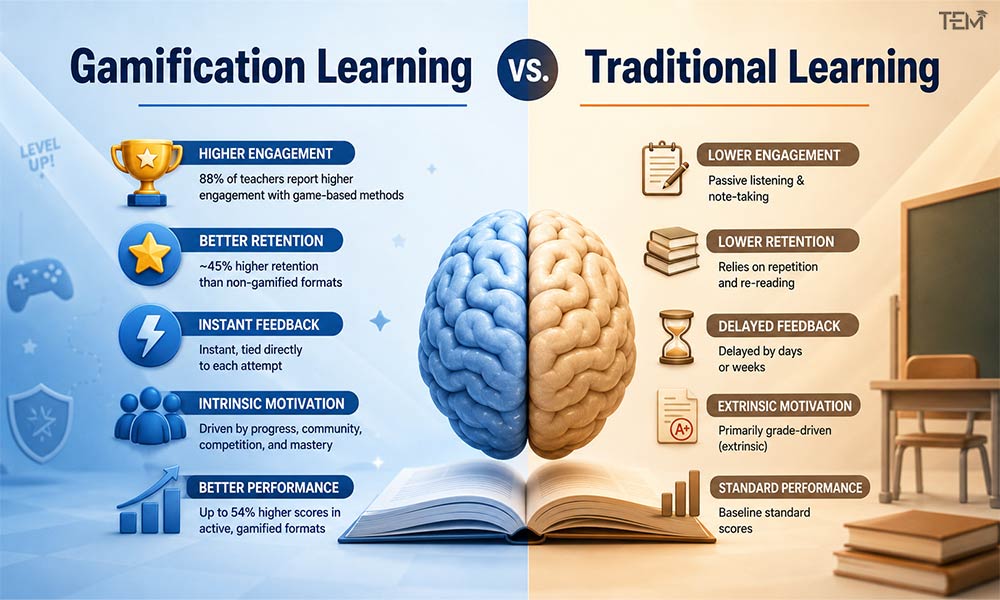
Gamification Learning vs. Traditional Learning
The following table compares the distinct features of gamification in education vs traditional learning models to highlight why these interactive elements are essential for modern students.
Challenges of Gamification in Education
- Overuse of Rewards: Students might only perform for the “prize” rather than for the love of learning. Psychologists call this the overjustification effect when an external reward is introduced for a task someone already enjoyed, their intrinsic motivation can decline once the reward disappears (a concept rooted in Edward Deci and Richard Ryan’s Self-Determination Theory). The safest fix is making gamified elements optional rather than mandatory, so intrinsically motivated students aren’t undermined.
- Technology Access Disparities: High-tech gamification tools can widen equity gaps if students lack consistent device or internet access at home.
- Alignment with Learning Objectives: Game mechanics that are overly complex can distract students from the actual curriculum content.
Key Takeaway: Research suggests the simplest and most common gamification elements points, badges, and leaderboards (PBL) are also the ones most often linked to these downsides when they are bolted on without a clear learning goal behind them.
Best Gamification Tools & Platforms
- Kahoot!: Features game-based learning quizzes for live classroom settings. Kahoot! reports more than 70 million monthly active users, giving it the widest reach of any live classroom quiz platform.
- Quizizz (now Wayground): Quizizz rebranded to Wayground in 2025, expanding from a quiz tool into a full self-paced supplemental learning platform now used in roughly 90% of U.S. schools across 150+ countries. It remains best known for its flexible “homework mode.”
- Classcraft: Turns the entire classroom experience into an ongoing role-playing game that reinforces positive behavioral choices and teamwork.
- Duolingo: The gold standard for language learning through daily streaks, XP points, and adaptive skill trees.
1. Define Learning Objectives:
Prerequisite Phase.
Identify the specific skill or knowledge gap you want to address. Never add game mechanics without a clear educational target.
2. Select Appropriate Game Mechanics:
Design Phase.
Choose elements (points, progress bars, scenario-based quests) that complement your learning goal without creating unnecessary distraction.
3. Choose the Right Platform or Tool:
Tooling Phase.
Pick an EdTech platform (such as Wayground or Kahoot!) that matches your classroom’s hardware infrastructure and student age group.
4. Establish Clear Rules and Rewards:
Execution Phase.
Ensure students understand how points or achievements are earned. Keep rules transparent and emphasize progress over raw performance.
5. Monitor, Iterate, and Collect Feedback:
Review Phase.
Gather feedback from learners and analyze assessment data to refine mechanics that feel frustrating or overly competitive.
Implementation Note: Start small. Pilot gamification in one unit or class before rolling it out across a full curriculum. An estimated 80% of gamification efforts fall short of expectations when institutions lean on generic point systems and leaderboards without designing for deeper behavioral engagement. A small pilot helps catch design problems early.
Future of Gamification in Education (2026 Trends
- AI-Powered Personalization: AI-enabled gamification is associated with roughly 47% higher interaction frequency and 38% better retention than non-AI gamification.
- VR/AR Immersive Learning: Early data backs the shift: industry studies indicate VR trainees absorb information up to four times faster than traditional classroom learners and report far greater confidence in applying new skills.
- Blockchain Credentials: This isn’t hypothetical; the EU’s Europass Digital Credentials initiative and U.S. Department of Education pilot programs across 20 states are actively issuing blockchain-backed badges, while platforms like LinkedIn support direct, verified-credential displays.
Conclusion
Gamification is far more than a passing classroom trend; it is a fundamental evolution in how educators motivate, assess, and empower learners. By thoughtfully integrating game mechanics with clear learning objectives, educational institutions across K-12, higher education, and corporate spaces can transform passive learning into active mastery.
To get started today, choose a single unit and introduce a small gamified element like a weekly leaderboard or visual progress tracker and measure the shift in student momentum for yourself.
FAQs
- Does gamification work for all age groups?
Gamification is the integration of game elements like points, badges, and leaderboards into non-game educational contexts to increase motivation and active participation.
- What are the most common gamification elements?
The most common elements are Points, Badges, and Leaderboards (often referred to as the PBL triad), along with progress bars, daily streaks, and timed challenges.
- Is there academic research proving gamification works?
Yes. Meta-analyses across dozens of independent studies show that game-based and gamified learning significantly raise academic achievement, and controlled studies show challenge-based gamification can improve assessment performance by nearly 90% compared to traditional lectures.