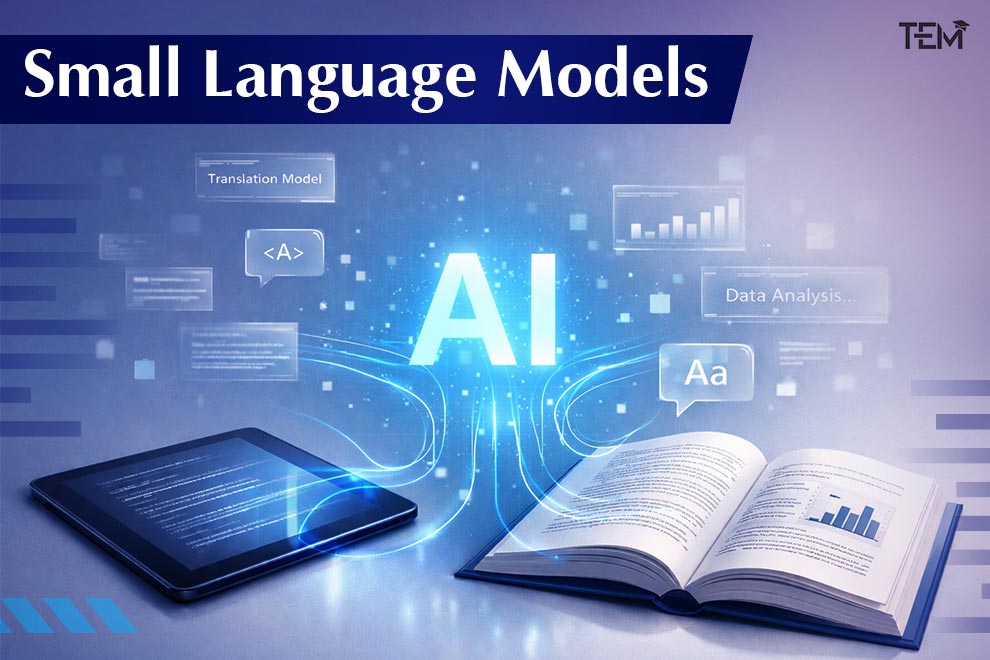
Small language models (SLMs) are quietly transforming AI in everyday life. From voice assistants on smartphones to specialized academic tools, these compact AI models deliver advanced language understanding without requiring massive computing clusters or high-bandwidth cloud connections.
While Large Language Models (LLMs) grab headlines for their massive scale and broad capabilities, lightweight models are reshaping real-world AI deployment in education, mobile applications, and resource-constrained environments.
In this guide, you’ll learn what these systems are, how they differ from their larger counterparts, real-world examples in use today, their benefits and limitations, and why they matter for researchers, teachers, and students. By the end, you’ll see why these tools are central to making AI affordable, accessible, and practical.
What Are Small Language Models?
At their core, these compact AI systems are artificial intelligence systems trained to understand and generate human language using far fewer parameters than large language models.
Parameters are the internal weights that help an AI system learn patterns in data. Fewer parameters result in a more compact and resource-efficient architecture.
Most of these models range from a few million to a few billion parameters, compared to the hundreds of billions used by large-scale systems.
Due to their smaller size, these models require less memory and computing power, making them suitable for mobile devices, edge environments, and offline use.
Despite their compact nature, they still perform essential natural language processing tasks such as text classification, translation, summarization, and basic text generation, with a strong focus on efficiency and accessibility.
- Text classification and sentiment analysis
- Summarization and translation
- Question answering and domain-specific text generation
Role of Small Language Models in Modern AI Systems
In ecosystems where cost, speed, and privacy matter more than general trivia knowledge, SLMs are often the preferred choice.
They serve as the foundation for on-device AI, running directly on local hardware without sending sensitive data back to external servers. This enables real-time translation, voice interaction, and quick summaries on edge systems with zero cloud latency.
[ User Input ] ──► [ Local Device / SLM ] ──► [ Instant Response ]
(No Server Request / No Cloud Dependency)
Furthermore, compact models allow developers and academic researchers to iterate, fine-tune, and experiment far faster without incurring massive compute bills. Recent benchmarks show that modern SLMs deliver strong reasoning and summarization capabilities at a fraction of the compute cost required by massive foundational models.
Why Small Language Models Exist
Large models like GPT-4 or Gemini are incredibly capable, but they come with severe trade-offs:
- High Infrastructure Costs: They require expensive cluster GPUs and heavy server networks.
- Energy & Environmental Impact: Massive parameter counts require substantial energy for training and inference.
- Data Dependency: They rely on constant, high-speed internet connectivity.
SLMs were developed as a practical response to these challenges. By reducing parameter counts and optimizing architectures for specific tasks, SLMs deliver faster inference, lower costs, and straightforward local deployment.
Research indicates that deploying SLMs can reduce inference costs by up to 80%, while optimized small models can achieve 70–90% of the accuracy of larger counterparts on targeted tasks using up to 10× fewer computational resources.
Key Difference Between LLM and SLM
| Feature | Large Language Model (LLM) DOCX | Small Language Model (SLM) DOCX |
| Parameter Count | Tens to hundreds of billions+ | Millions to ~10 billion |
| Resource Needs | Very high (Enterprise server clusters) | Low (Laptops, mobile, edge devices) |
| Primary Deployment | Cloud-based infrastructure | Local, on-device, embedded, or edge systems |
| Training & Fine-tuning Cost | Exceptionally high | Relatively low and budget-friendly |
| Best For | Open-ended reasoning, massive context, broad knowledge | Specialized tasks, fast response times, high-privacy environments |
How Small Language Models Work
SLMs rely on the same fundamental Transformer architectures as large models, but they utilize specialized optimization techniques to achieve high performance at a small scale:
1. Knowledge Distillation
In distillation, a smaller “student” model is trained to mimic the reasoning and output behavior of a larger “teacher” model. This allows the SLM to retain high reasoning quality while shedding billions of unnecessary parameters.
2. Task-Specific Fine-Tuning
Instead of trying to know everything about every topic, an SLM can be fine-tuned on a targeted dataset (e.g., medical literature, local curriculum, or legal documents). This narrow focus allows it to outperform much larger generalist models within its specific domain.
3. Model Quantization
Quantization reduces the precision of the model’s weights (for example, converting 16-bit floating-point numbers into 8-bit or 4-bit integers). This significantly cuts down RAM and VRAM requirements, allowing SLMs to run smoothly on standard consumer hardware.
Examples of Small Language Models Used Today
While classic architectures like DistilBERT and BERT-mini pioneered small-scale NLP, recent advancements have brought ultra-capable generative SLMs to light:
- Microsoft Phi Series (e.g., Phi-3.5 / Phi-4-Mini): Designed specifically to prove that high-quality data distillation enables small models (~3.8B parameters) to achieve exceptional math and logic performance.
- Meta Llama 3.2 (1B & 3B variants): Ultra-compact models optimized specifically for on-device deployment, mobile systems, and efficient fine-tuning.
- Google Gemma 2 (2B variant): Lightweight open models built from Gemini technology, offering high performance for on-device reasoning and coding.
- DistilBERT & MobileBERT: Efficient, non-generative models ideal for fast classification, naming entity recognition, and sentiment analysis.
Open Source Small Language Models
Open-source compact language models play a crucial role in education and research. Because their architectures and weights are publicly available, students and researchers can study, modify, and experiment with them without the high costs associated with large proprietary systems.
Open-source SLMs allow academic institutions to:
- Run experiments on standard hardware
- Teach practical AI concepts hands-on
- Build domain-specific models without large budgets
This openness has accelerated innovation and learning, making AI more accessible to a global academic community.
Small Language Models Available on Hugging Face
Open-source SLMs play a pivotal role in democratizing technology for educational institutions and independent researchers:
- Academic Freedom: Students and researchers can inspect model weights, study architecture designs, and modify parameters without relying on black-box commercial APIs.
- Accessibility via Hugging Face: Platforms like Hugging Face host thousands of pre-trained SLMs alongside easy-to-use libraries. This lets educators bring hands-on AI experiments into the classroom on standard lab computers without requiring expensive enterprise infrastructure.
Advantages & Limitations of Small Language Models.
| SLM Strengths | SLM Limitations |
| Low Operational Cost | Reduced World Knowledge |
| Fast Inference / Speed | Lower Complex Reasoning |
| High Data Privacy | Smaller Context Windows |
| Runs Offline / On-Device | Requires Niche Tuning |
While SLMs excel at targeted tasks, understanding these trade-offs is essential when picking the right tool for your project.
How Small Language Models Power Mobile and Edge Devices
One of the most important applications of these models is on-device and edge AI. Unlike cloud-based systems, edge AI runs directly on devices such as smartphones, tablets, and embedded systems.
SLMs enable:
- Offline language processing
- Real-time translation and transcription
- Intelligent assistants without constant internet access
This capability is particularly valuable in areas with limited connectivity and for applications where latency and privacy are critical. As mobile devices continue to grow more powerful, these models will play an even greater role in delivering intelligent features locally.
A 2025 study of SLM energy efficiency on devices like Raspberry Pi and Jetson Nano shows that optimized small models can dramatically reduce latency and energy cost compared with cloud‑based inference, underscoring their value for on‑device education tools and offline AI.
Applications of Small Language Models
1. Education
- Local Tutoring Assistants: Schools can run SLMs on internal networks to provide automated essay feedback and study assistance while maintaining 100% student data privacy.
- Offline Learning Tools: Institutions in remote or low-connectivity regions can deploy AI tools locally on low-cost devices like Raspberry Pis.
- Hands-On Learning: Engineering students can fine-tune complete models on single consumer GPUs, gaining practical experience in model architecture and training.
2. Academic Research
- Domain-Specific Analysis: Researchers can quickly adapt an SLM to parse specialized scientific papers, historical manuscripts, or legal documents.
- Reproducibility: Compact, open-weights models allow researchers to publish code and exact model states, ensuring scientific studies remain easily reproducible.
Why Small Language Models Matter in Education
For education, small language models are transformative. They allow schools, colleges, and universities to integrate AI without the prohibitive costs associated with large models.
SLMs support:
- Personalized learning tailored to individual students
- Low-cost AI tools for institutions with limited budgets
- Data privacy, as student information can remain on local devices
- Hands-on learning, enabling students to build and experiment with real AI systems
For example, a college language department can deploy an SLM on local servers to provide instant grammar feedback and text summaries for students, without sending assignments to external cloud platforms.
This keeps student data private while offering real-time academic support. Such practical deployments show why SLMs are especially suited for classroom-scale AI adoption.
By lowering barriers, these language models democratize AI education and empower learners to engage with advanced technology directly, supporting trends such as microcredentials in education, where skill development and AI literacy become increasingly important.
Small Language Models in Academic Research
In research, these systems are widely used for prototyping, experimentation, and reproducibility. Their efficiency allows researchers to test hypotheses quickly and iterate without extensive computational resources.
They are especially valuable in:
- Natural language processing research
- Linguistics and social science studies
- Student thesis and dissertation projects
As research increasingly emphasizes efficiency and sustainability, SLMs are becoming a preferred choice in many academic settings.
Are Small Language Models the Future of Practical AI?
The future of AI is unlikely to belong exclusively to massive models or tiny models—it will be a hybrid approach.
In this ecosystem:
- Large Language Models handle broad, highly complex reasoning and multi-step orchestration.
- Small Language Models handle specialized, high-volume tasks, on-device operations, and local data processing with maximum efficiency.
By bringing advanced language processing directly to local hardware, SLMs make AI technology more sustainable, private, affordable, and inclusive for classrooms and research labs around the world.
Why I See Small Language Models as a Turning Point
Small language models are more than compact AI systems; they are changing how advanced language AI is built and applied in practical settings. By focusing on efficiency, accessibility, and practicality, they bring AI from massive data centers into classrooms, research labs, and everyday devices, making advanced technology usable even where resources are limited.
As education and research continue to adopt responsible and sustainable AI, SLMs will remain central to this shift, helping students, teachers, and researchers explore and apply AI without high costs or technical barriers.
Share This Insight
If this article helped you understand how AI is evolving in education and research, share it with fellow educators, students, and researchers. Good ideas spread faster when shared.
FAQs
- What is the main difference between an LLM and an SLM?
LLMs prioritize broad capability and scale (tens to hundreds of billions of parameters), whereas SLMs focus on task efficiency, lower latency, and local deployment using smaller parameter counts.
- Can Small Language Models run without an internet connection?
Yes. Because SLMs require significantly less memory and processing power, they can be installed directly onto smartphones, laptops, or local edge hardware to run entirely offline.
- Are SLMs accurate enough for academic research?
Yes, especially when fine-tuned on specific domains. While they have less general knowledge than massive models, a specialized SLM often outperforms a broad LLM within its narrow field of expertise.