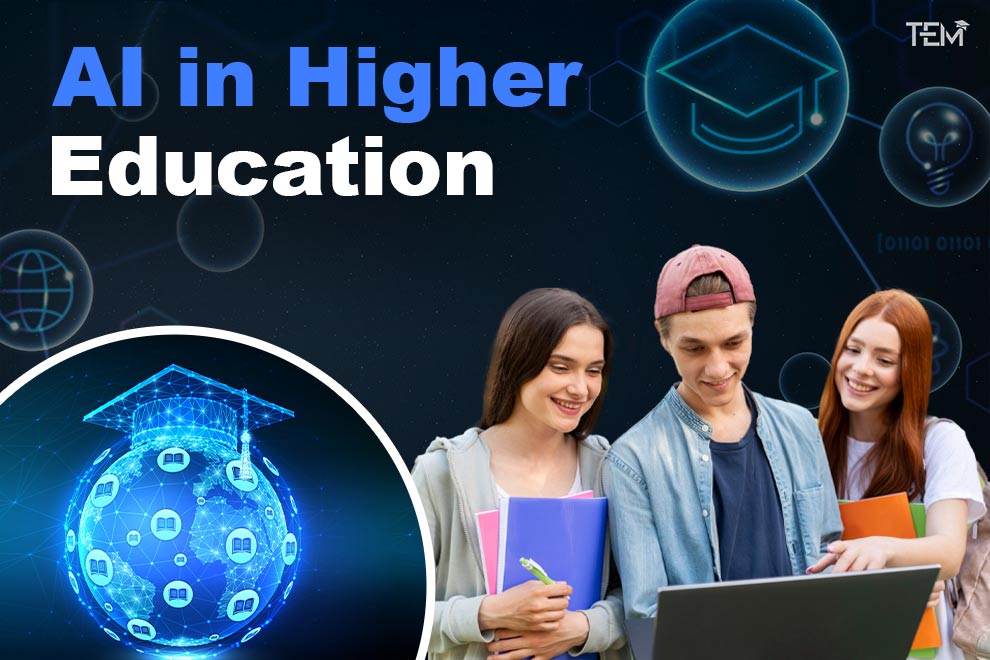
AI in higher education is no longer an emerging experiment; it is already transforming how universities teach, evaluate, support, and govern learning. From generative AI tools used daily by students to data-driven systems guiding academic and administrative decisions, AI has moved from the margins to the core of institutional life.
Despite its rapid integration, the conversation around AI in higher education remains unsettled. Universities face a complex mix of opportunity and uncertainty. While AI promises personalized learning, operational efficiency, and deeper insights into student success, it also raises critical questions about academic integrity, data privacy, bias, and institutional responsibility.
What higher education needs now is clarity grounded in evidence, not speculation or fear-driven narratives. How is AI actually being used today? What do global surveys and research reveal about student and faculty adoption? And how should universities strategically prepare for the next phase of AI integration?
This article examines AI through a research-backed, global lens, exploring current uses, measurable impact, governance considerations, and the future direction institutions must embrace.
What Global Research Shows About AI in Higher Education
Insights from globally recognized institutions and policy bodies reveal consistent trends in how AI is entering higher education:
- UNESCO emphasizes AI’s potential to expand access and improve learning outcomes, while cautioning against bias, lack of transparency, and ethical misuse.
- World Bank research highlights AI’s growing role in institutional planning, student services, and workforce-aligned skill development, particularly in emerging economies.
- Deloitte Insights documents increased adoption of generative AI across admissions, advising, academic operations, and administrative efficiency.
- Inside Higher Ed surveys show rising faculty engagement with AI tools, alongside uncertainty around governance, assessment policies, and long-term impact.
Together, these findings indicate that AI adoption is accelerating globally, but governance frameworks and ethical clarity are still catching up.
AI in Higher Education: At a Glance
- What it is: The use of artificial intelligence to support teaching, learning, administration, and institutional decision-making in universities.
- Why it matters: AI is changing how students learn, how educators teach, and how institutions operate at scale.
- Where it’s used: Personalized learning, student support, admissions, assessment, research, and governance.
- What’s next: Universities must align innovation with ethics, transparency, and academic integrity.
What Does AI in Higher Education Really Mean?
Artificial intelligence in higher education refers to the use of computational systems that can analyze data, learn patterns, and support decision-making across teaching, learning, research, and administration. Unlike traditional educational technologies, AI systems adapt over time, respond to user behavior, and generate insights that would be difficult to achieve manually.
In universities, AI is not a single tool or platform. It is an ecosystem of technologies that includes machine learning models, natural language processing, predictive analytics, and generative AI. These systems are embedded within learning management platforms, student support services, research workflows, and institutional planning processes.
How AI in Higher Education Differs From Other Sectors
AI adoption in higher education is fundamentally different from its use in schools or corporate environments. Universities operate at the intersection of academic freedom, ethical responsibility, and public trust. Decisions around AI use must balance innovation with fairness, transparency, and long-term societal impact.
Unlike K–12 education, higher education institutions support independent research, complex assessment models, and diverse student populations. Unlike corporate settings, universities are accountable not just for outcomes, but for values, academic integrity, equity, and intellectual development.
This makes AI adoption in higher education uniquely complex and uniquely important to get right.
Why AI Adoption Accelerated So Quickly
The rapid acceleration of AI in higher education has been driven by three forces:
- Widespread access to generative AI tools has lowered the barrier to entry for students and faculty.
- Data-rich university environments, where learning analytics and institutional data enable AI systems to function effectively.
- Post-pandemic digital transformation has normalized online learning, automation, and technology-supported decision-making.
As a result, AI has moved beyond experimentation into a phase of strategic maturity that universities must understand and govern.
How AI Is Being Used in Higher Education Today
AI applications in higher education are broader and more embedded than many assume.
Research reviews and institutional studies show that AI is already influencing multiple layers of the university ecosystem.
Teaching and Learning Support
One of the most visible uses of AI in higher education is in teaching and learning support.
AI-powered systems help students:
- Clarify complex concepts
- Receive instant feedback on practice tasks
- Access personalized learning resources
- Navigate coursework more efficiently
These tools do not replace educators. Instead, they function as learning companions supporting students outside the classroom and freeing faculty to focus on higher-value academic engagement.
Assessment and Academic Evaluation
AI is also being used to support assessment processes, particularly in large or digitally delivered courses. Current applications include:
- Automated feedback on formative assessments
- Pattern analysis to identify learning gaps
- Support for grading consistency in large cohorts
However, this area also raises some of the most sensitive questions around academic integrity, fairness, and transparency, topics universities are actively grappling with.
Student Services and Administration
Beyond teaching, AI is increasingly present in student services and university operations. Institutions are using AI to:
- Improve academic advising and early-alert systems
- Enhance student support through conversational AI
- Streamline admissions, scheduling, and administrative workflows
These applications aim to improve responsiveness and scalability, particularly in institutions serving large and diverse student populations.
AI in Higher Education: Applications, Benefits, and Risks
| Area of Use | How AI Is Applied | Key Benefit | Core Risk |
| Teaching & Learning | Adaptive platforms, AI tutors | Personalized learning | Over-reliance on automation |
| Student Support | Chatbots, predictive analytics | Improved retention | Data privacy concerns |
| Assessment | AI-assisted grading | Faster feedback | Academic integrity risks |
| Administration | Enrollment & resource planning | Operational efficiency | Algorithmic bias |
| Research | Data analysis & modeling | Accelerated discovery | Transparency issues |
Student and Faculty Adoption Trends in Higher Education
Understanding how AI is actually being used on campus requires looking beyond tools and into human behavior. Global surveys and institutional research reveal a clear pattern: AI adoption among students is widespread and accelerating, while faculty adoption is growing but uneven.
What Global Surveys Reveal About Student AI Use
Recent international studies and institutional surveys show that a large majority of university students already use AI tools as part of their academic workflow. Students primarily rely on AI to:
- Clarify difficult concepts
- Summarize academic material
- Support research and idea generation
- Improve writing structure and clarity
What stands out is not just the scale of adoption, but the lack of formal guidance. Many students report using AI without clear institutional policies or shared expectations. This gap has created uncertainty around what constitutes acceptable use, particularly in assessment contexts.
Rather than replacing learning, evidence suggests students view AI as a support mechanism, one that helps them manage workload, understand content faster, and study more efficiently. However, without structured guidance, usage varies widely in quality and ethical alignment.
Faculty Adoption and Preparedness Gaps
Faculty engagement with AI is more cautious. While many educators acknowledge the potential of AI to support teaching and assessment, fewer feel confident using it effectively. Research highlights several recurring challenges:
- Limited formal training in AI tools
- Unclear institutional policies
- Concerns about academic integrity
- Uncertainty about how AI fits within existing pedagogy
This gap between student usage and faculty preparedness is one of the most critical issues facing higher education today. Without targeted professional development and shared frameworks, AI risks becoming a parallel system rather than an integrated educational tool.
The Growing Importance of AI Literacy
Across institutions globally, AI literacy is emerging as a foundational requirement. This extends beyond technical skills to include:
- Understanding AI limitations and bias
- Evaluating AI-generated outputs critically
- Applying AI ethically within academic contexts
Universities that treat AI literacy as a core academic competency, not an optional add-on, are better positioned to harness AI’s benefits while minimizing risk.
ChatGPT and Generative AI in Higher Education
No development has shaped the AI conversation in higher education more than generative AI tools such as ChatGPT. Their rapid adoption has forced universities to confront fundamental questions about learning, assessment, and academic trust.
Why Generative AI Changed the Conversation
Unlike earlier educational technologies, generative AI directly engages with core academic tasks: writing, reasoning, problem-solving, and synthesis. This immediacy explains both its appeal and the concern it has generated.
For students, generative AI offers instant support for drafting, brainstorming, and understanding complex material. For educators, it challenges long-standing assumptions about how learning is demonstrated and assessed.
Legitimate Academic Uses vs. Misuse Concerns
Research and institutional guidance increasingly distinguish between misuse and meaningful use. Legitimate applications of generative AI in higher education include:
- Supporting early-stage idea development
- Enhancing feedback and revision processes
- Assisting with language and accessibility needs
- Encouraging reflective learning when used transparently
Concerns arise when AI is used to replace critical thinking or bypass learning outcomes. This distinction has shifted the focus from banning AI tools to redesigning assessments and expectations.
How Universities Are Responding
Universities worldwide are moving away from blanket restrictions toward more nuanced responses. These include:
- Updating academic integrity policies to address AI use explicitly
- Redesigning assessments to emphasize process, reflection, and originality
- Providing clear guidance on acceptable and unacceptable AI use
- Investing in faculty development and student training
This shift reflects a broader recognition that generative AI is not a temporary disruption, but a permanent feature of the higher education landscape.
Benefits of Driving AI Adoption in Universities
Despite ongoing debates, AI adoption in higher education continues to grow because its benefits address long-standing institutional challenges.
Personalization and Student Engagement
AI enables universities to move beyond one-size-fits-all education. Adaptive learning systems and analytics-driven insights help institutions respond to individual learning needs, improving engagement and academic confidence.
Efficiency and Institutional Scalability
AI-supported systems allow universities to scale support services without compromising quality. From advising to administration, automation reduces bottlenecks and frees staff to focus on higher-impact work.
Data-Informed Decision-Making
AI enhances universities’ ability to analyze patterns in enrollment, retention, and performance. When used responsibly, these insights support evidence-based planning and early intervention strategies.
Ethical, Academic, and Governance Challenges
As AI becomes embedded in higher education, its risks are no longer theoretical. Universities now face concrete ethical, academic, and governance challenges that require deliberate institutional responses rather than reactive measures.
Academic Integrity and Assessment Design
One of the most pressing concerns surrounding AI in higher education is academic integrity. Traditional assessment models, particularly those focused on unsupervised written submissions, are increasingly vulnerable to misuse of generative AI.
However, research and institutional guidance suggest that integrity challenges are not best addressed through prohibition alone. Instead, universities are beginning to rethink assessment design by:
- Emphasizing process-based evaluation over final outputs
- Incorporating reflective components that document learning journeys
- Designing assessments that require contextual reasoning and applied thinking
This shift aligns assessment practices more closely with real-world skills while reducing opportunities for misuse.
Bias, Transparency, and Trust in AI Systems
AI systems are only as reliable as the data and assumptions that shape them. In higher education, this raises concerns about algorithmic bias, particularly when AI is used in admissions, advising, or performance prediction.
Limited visibility into how AI systems generate recommendations can undermine trust among students and faculty. As a result, responsible institutions are prioritizing:
- Clear documentation of how AI tools are used
- Human oversight in high-stakes decisions
- Regular evaluation of AI systems for bias and unintended consequences
Trust in AI within higher education depends not on technical sophistication alone, but on accountability and explainability.
Data Privacy and Institutional Responsibility
Universities manage vast amounts of sensitive student and research data. The integration of AI systems introduces additional risks related to data security, consent, and third-party access.
Global guidance emphasizes that institutions must treat data governance as a foundational element of AI strategy. This includes defining who owns AI-generated data, how long it is retained, and how it is protected across platforms.
Global Policy and Institutional Responses
As AI adoption accelerates, higher education institutions are increasingly guided by international frameworks and shared policy principles rather than isolated experimentation.
What Global Institutions Recommend
International organizations such as UNESCO advocate for a human-centered approach to AI in education, emphasizing inclusion, equity, and responsible oversight. Rather than focusing solely on efficiency or innovation, these frameworks emphasize education’s broader social responsibility.
Key recommendations include:
- Embedding ethical considerations into AI adoption from the outset
- Ensuring AI supports, rather than replaces, human decision-making
- Building AI literacy across the academic community
These principles are shaping national policies and institutional strategies worldwide.
How Universities Are Developing AI Policies
Universities are at varying stages of policy development. While some institutions have formal AI governance frameworks in place, many are still developing guidance that balances innovation with academic values.
Common policy elements include:
- Definitions of acceptable and unacceptable AI use
- Expectations for transparency in AI-assisted work
- Guidelines for faculty and student training
- Mechanisms for ongoing review and adaptation
Institutions that treat AI policy as a living framework rather than a static rulebook are better equipped to respond to rapid technological change.
The Future of AI in Higher Education
Looking ahead, AI’s role in higher education will continue to expand but not uniformly. Its impact will depend on how strategically and ethically institutions choose to engage with it.
Emerging Applications and Long-Term Trends
Future developments are likely to include:
- Deeper integration of AI into curriculum design
- More sophisticated learning analytics for student support
- Expanded use of AI in research and interdisciplinary collaboration
At the same time, scrutiny around ethics, fairness, and academic values will intensify.
Skills Universities Must Develop
To remain relevant and credible, higher education institutions must develop capabilities beyond technical adoption. These include:
- Critical AI literacy for students and faculty
- Ethical reasoning and policy awareness
- Institutional leadership equipped to govern AI responsibly
Universities that invest in these capabilities will shape AI’s role proactively rather than reactively.
What This Means for Higher Education Leaders
AI in higher education is now a question of strategic alignment rather than adoption. Institutions that succeed will be those that move beyond experimentation and align AI adoption with educational purpose.
This requires leadership that views AI not as a shortcut, but as a tool that must be guided by human judgment, academic values, and long-term vision. By grounding AI strategy in evidence, ethics, and inclusivity, higher education can harness its potential while preserving what matters most.
My Perspective on AI’s Role in Higher Education
AI in higher education is reshaping learning and institutional practices, whether universities are fully prepared or not. The real question is not how fast universities adopt AI, but how wisely they choose to use it. Technology should strengthen education’s purpose, not dilute it.
If higher education leaders approach AI with clarity, institutional responsibility, and long-term vision, it can become a powerful ally in expanding access, improving learning outcomes, and supporting educators rather than sidelining them. The opportunity ahead is significant but only for those willing to lead with responsibility and foresight.
Shaping the future of higher education starts with informed decisions.
If you found this perspective valuable, share it with educators, academic leaders, and policymakers who are navigating AI’s role in learning. Thoughtful conversations today will define education tomorrow.
FAQs
1. Will AI reduce the need for human educators in universities?
No. Credible research and institutional practice show that AI functions best as a support system, not a replacement. Teaching, mentorship, ethical judgment, and academic leadership remain fundamentally human responsibilities.
2. Can AI help improve student retention and success rates?
Yes. When used responsibly, AI-powered analytics can identify early risk signals, personalize academic support, and help institutions intervene before students disengage or drop out.
3. Is AI adoption affordable for smaller or mid-sized universities?
AI adoption does not always require large-scale infrastructure. Many institutions begin with targeted, cloud-based tools focused on advising, assessment, or administration before scaling strategically.
4. How should universities prepare students for an AI-driven workforce?
Universities should focus on AI literacy, critical thinking, ethical reasoning, and adaptability. Understanding how AI works and its limitations is now as important as technical proficiency.
5. How should universities regulate ChatGPT and generative AI use?
Universities should adopt clear, principle-based policies rather than blanket bans. This includes defining acceptable academic use, redesigning assessments, requiring transparency when AI is used, and maintaining human oversight to protect academic integrity and ethics.