Reported by The Education Magazine | 4 February 2026
Carnegie Mellon University (CMU) has launched Learnvia, a nonprofit artificial intelligence learning platform backed by a $55 million grant from the Gates Foundation, marking the largest higher education grant in the foundation’s history.
The initiative targets one of the most persistent challenges in higher education: high student dropout rates linked to introductory “gateway” courses, particularly in science, technology, engineering, and mathematics (STEM).
Education researchers estimate that nearly 30% of U.S. college students leave their programs after struggling in early foundational courses, with Calculus I widely cited as a major barrier to degree completion.
What Learnvia is designed to do
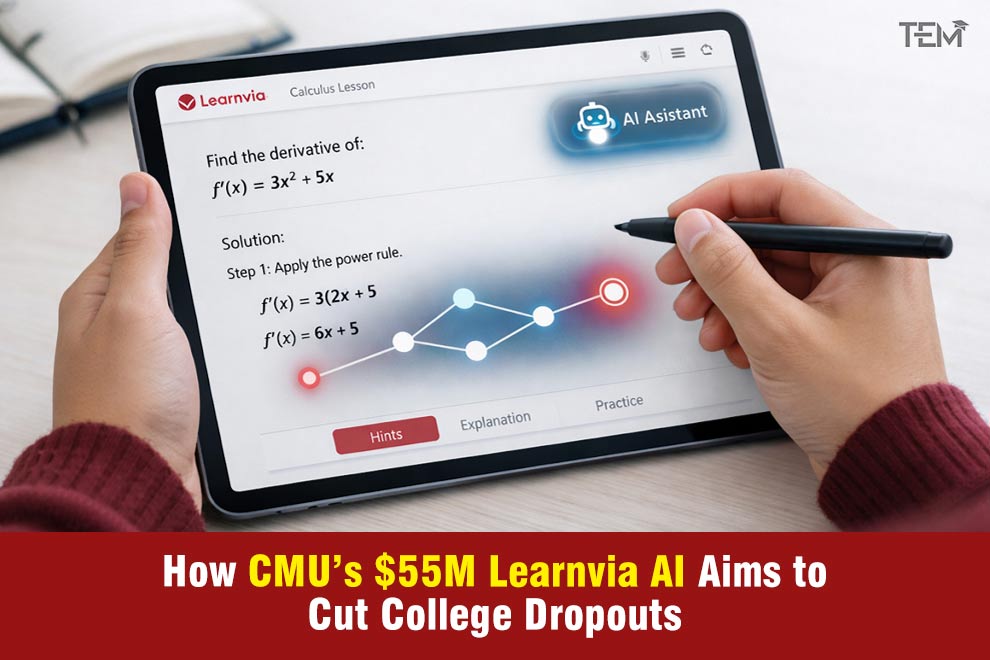
Learnvia is built on decades of learning science research at Carnegie Mellon and focuses on helping students understand concepts rather than providing direct answers.
The AI-powered platform adapts to each learner’s progress and errors, guiding students through problems step by step instead of delivering final solutions. This approach aligns with the principles of ethical AI for students by prioritizing guided learning over automated answers.
According to the CMU announcement, the system is designed to:
- Identify where a student is struggling
- Provide scaffolded hints instead of final solutions
- Reinforce conceptual understanding
- Support independent problem-solving
The platform is offered at no cost to students and institutions.
Why gateway courses drive student dropouts
Gateway courses are required introductory classes that students must pass to advance in a degree program. In STEM fields, these courses often involve complex mathematics and abstract reasoning.
For students with limited academic preparation, financial pressures, or work commitments, failing a single course can delay graduation or lead to withdrawal from college altogether.
This issue is a central focus of the Gates Foundation’s vision for postsecondary success, which highlights how course completion directly impacts a student’s long-term economic path.
Education experts say these early academic barriers disproportionately affect first-generation, low-income, and underrepresented students.
How Learnvia supports instructors and institutions
Learnvia also includes an analytics dashboard designed for faculty and academic leaders.
The dashboard allows instructors to track where students are struggling in real time, revealing patterns such as widespread misunderstandings of specific concepts or assignments. This reflects the broader evolution of AI in higher education, where data informs instructional decisions.
Faculty can use this data to adjust lesson pacing, revisit difficult material, or redesign assessments before learning gaps widen.
CMU researchers stress that Learnvia is intended to support human instruction, not replace faculty or tutoring services.
A shift toward nonprofit, university-led edtech
Unlike many commercial education technology platforms, Learnvia operates as a nonprofit initiative led by a university.
Analysts note that this model represents a shift away from subscription-based edtech tools toward institution-led systems focused on public benefit and student success. This shift is increasingly supported by the adoption of small language models tailored for specific academic needs.
The Gates Foundation said the project aligns with its broader goal of improving college completion and reducing inequities in higher education.
Global implications for STEM education
While Learnvia is currently being rolled out across 38 U.S. institutions, including large community colleges, its potential applications extend beyond the United States.
Gateway courses taught in English-medium STEM programs are common in regions such as India, Africa, and Southeast Asia. CMU officials have indicated that the platform’s learning framework is designed to scale internationally.
Education observers say tools like Learnvia could play a role in expanding access to affordable engineering and science education worldwide.
What Happens Next
Carnegie Mellon plans to expand Learnvia into additional high-failure gateway subjects, including introductory chemistry and computer science, beginning with pilot implementations expected later in 2026.
CMU officials have also indicated that more institutions will be onboarded in the second half of 2026, following evaluation of early outcomes in calculus courses.
Further updates on subject expansion, institutional participation, and international partnerships are expected as the project progresses.
FAQs
- Is Learnvia free for students?
Yes. Learnvia is a nonprofit platform funded through the Gates Foundation grant and is free to use.
- Does Learnvia replace tutors or professors?
No. The platform is designed to support learning outside the classroom and provide instructors with better insight into student progress.
- Will Learnvia be available outside the U.S.?
CMU has indicated that international expansion is a long-term goal, though current deployments are focused on U.S. institutions.