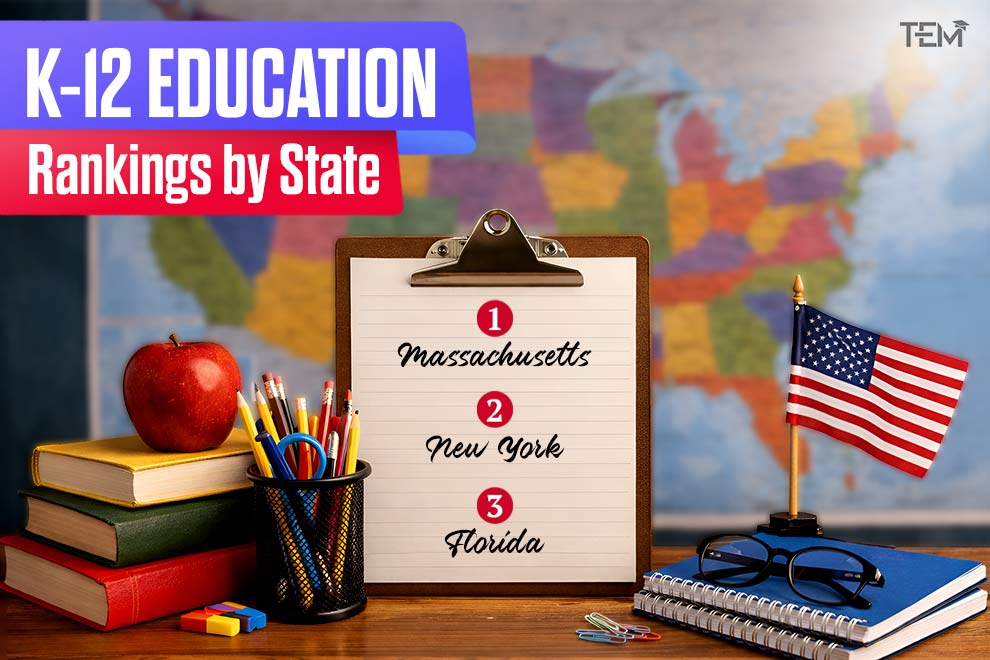
Massachusetts, Connecticut, and New Jersey lead the most recent 2026 K-12 rankings, driven by strong NAEP scores and high per-pupil funding, while New Mexico, Louisiana, and Alaska rank lowest. Rankings combine NAEP test data, U.S. Census Bureau funding figures, and safety and outcome reports from U.S. News & World Report, WalletHub, and ConsumerAffairs.
Key Takeaways
- No single “official” ranking exists. U.S. News, WalletHub, and NAEP-based rankings each use different methodologies and produce different top 10s.
- New York spends more per pupil than any other state ($31,918 in FY2024, U.S. Census Bureau).
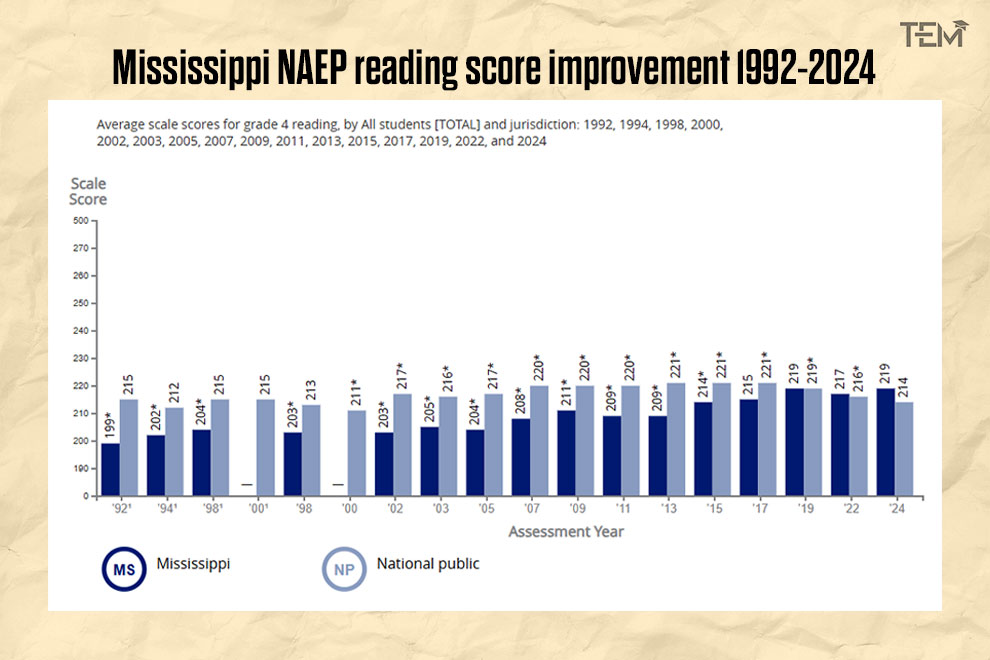
- Mississippi’s 4th-grade NAEP reading gains since 2013 are one of the best-documented turnarounds in U.S. education policy.
- Vermont and New Hampshire have the lowest student-teacher ratios in the country, both around 11:1.
Where a child grows up in America largely determines the quality of education they receive.
Some states produce high reading and math scores, strong graduation rates, and well-funded classrooms. Others struggle with limited resources, lower academic outcomes, and widening achievement gaps. A few are rapidly closing that gap through smarter policy and digital innovation.
K-12 education rankings by state help parents, policymakers, and educators see which systems are working and why. The most trusted measure comes from the National Assessment of Educational Progress, often called The Nation’s Report Card.
Combined with reports from U.S. News & World Report, WalletHub, and ConsumerAffairs, a clear picture emerges across academic performance, school funding, college readiness, and safety.
This guide breaks down the top-performing states, the data behind their success, which states are improving fastest, and the trends shaping the future of American education.
How K-12 Education Rankings by State Are Measured
Ranking an entire state’s education system is complex. No single metric captures the full picture of school quality.
That is why most national reports combine several indicators from trusted data sources such as the U.S. Census Bureau, the National Education Association, and the National Assessment of Educational Progress.
These indicators generally fall into three categories.

1. Academic Performance
Academic performance remains the most influential factor in education rankings.
The National Assessment of Educational Progress (NAEP) measures math and reading proficiency for 4th and 8th graders across all states, allowing direct comparisons of student outcomes.
States that consistently score high on NAEP, such as Massachusetts and Florida, tend to rank near the top of national education reports.
Key academic indicators include:
- Reading and math proficiency rates
- Graduation rates
- College readiness scores
- Standardized test performance
- Achievement gaps between student demographic groups
2. School Funding and Resources
Funding significantly affects classroom quality, teacher retention, and student opportunities.
Census Bureau data for FY2024 shows per-pupil spending ranging from $31,918 in New York down to $11,060 in Idaho, nearly a three-to-one gap.
Education rankings also analyze:
- Per-student spending
- Teacher salaries
- Classroom size and student-teacher ratios
- Infrastructure and technology access
Higher investment does not always guarantee stronger outcomes, but well-funded systems often have greater stability and resources.
3. School Safety and Learning Environment
Beyond academics and funding, the school environment plays a critical role in student success.
Reports such as the “Best & Worst School Systems” study from WalletHub evaluate factors including:
- School safety
- Bullying incidents
- Dropout rates
- Teacher qualifications
- Disciplinary climate
These metrics capture the broader conditions that shape the daily experience of students and teachers.
The Current Leaders in K-12 Education
Across most national rankings, a small group of states consistently appear near the top.
According to recent analyses from U.S. News & World Report, states such as Massachusetts and New York remain among the strongest K-12 systems in the country.
1. Massachusetts
For more than a decade, Massachusetts has been widely regarded as the national leader in K-12 education.
Students in the state consistently rank near the top in NAEP reading and math scores, reflecting strong academic standards and highly trained educators.
Several factors contribute to the state’s performance:
- Rigorous curriculum standards
- Strong teacher preparation programs
- High levels of education funding
- Consistent policy focuses on academic outcomes
Massachusetts also benefits from a strong education culture that emphasizes college readiness and STEM learning.
2. New York
New York often competes with Massachusetts for the top position in national rankings.
One of its defining strengths is education funding. According to the U.S. Census Bureau’s 2024 Annual Survey of School System Finances, New York spent $31,918 per pupil in FY2024, the highest of any state.
The state also performs well in:
- Graduation rates
- Access to advanced coursework
- College preparation programs
Recent policies, including a statewide “bell-to-bell” school smartphone restriction passed in May 2025 and in effect for the 2025-26 school year, aim to improve classroom focus and student engagement.
3. Florida
In recent years, Florida has emerged as a major success story in education rankings.
While historically considered a mid-tier system, the state has improved dramatically in NAEP reading and math performance, particularly at the elementary level.
Education analysts attribute Florida’s rise to:
- Early literacy reforms
- Statewide accountability systems
- Targeted reading intervention programs
These improvements have positioned Florida as one of the fastest-improving education systems in the United States.
4. New Jersey
New Jersey ranks among the strongest academic performers in the country, consistently earning high marks in both NAEP scores and graduation rates.
Several factors contribute to the state’s standing:
- Consistently high reading and math proficiency rates
- Strong graduation rates and college readiness programs
- Significant investment in statewide digital learning infrastructure
This combination of academic strength and forward-looking digital strategy places New Jersey firmly among the top three education systems in the country.
The Most Improved K-12 Education System in the U.S.
While some states have long dominated national education rankings, others are rapidly improving. These states demonstrate that policy reforms, targeted funding, and literacy programs can significantly raise student achievement.
In recent years, one of the most notable examples is Mississippi.
Mississippi’s Literacy Transformation
For decades, Mississippi ranked near the bottom of national education reports. However, over the past five years, the state has shown significant improvement in early literacy.
Data from the National Assessment of Educational Progress shows that Mississippi’s fourth-grade reading scores have risen faster than those of many other states.
Between 2013 and 2022, the state climbed from one of the lowest-ranked in the nation to near the national average in 4th-grade reading, a shift widely referred to as the “Mississippi Miracle.”
Education researchers attribute this progress to several key reforms:
- Mandatory early literacy screening
- Intensive teacher training in reading instruction
- Statewide reading coaches and intervention programs
- Retention policies tied to third-grade reading proficiency
Mississippi’s progress has become a case study in how evidence-based literacy strategies can improve statewide academic outcomes.
States Facing the Biggest Education Challenges
Despite national progress in some areas, several states continue to face persistent challenges in K-12 education.
According to data from the National Assessment of Educational Progress, states such as New Mexico, Alaska, and Louisiana have struggled with lower reading and math proficiency rates.
1. New Mexico
New Mexico frequently appears near the bottom of national education rankings.
Several factors contribute to these outcomes:
- High student poverty rates
- Rural school accessibility challenges
- Teacher shortages in certain districts
Despite increased education funding in recent years, academic outcomes have improved more slowly than expected.
2. Alaska
Geography presents unique challenges for Alaska.
Many schools serve remote communities, making teacher recruitment, infrastructure, and resource distribution more complex.
These structural barriers contribute to persistent gaps in standardized test performance.
3. Louisiana
Louisiana has made progress in some academic areas, but it still struggles with overall proficiency rates and long-term student outcomes.
However, education reforms focused on curriculum alignment, and accountability may improve performance in the coming years.
The Funding vs Performance Paradox
One of the most surprising insights in K-12 education rankings by state is that higher spending does not always guarantee stronger academic outcomes.
Data from the U.S. Census Bureau shows significant variation in per-student spending across states.
1. Highest Spending States
States with the largest education investments include:
- New York
- Massachusetts
- Connecticut
These states invest heavily in teacher salaries, school infrastructure, and student support services.
According to estimates from the National Education Association, these states also offer some of the highest average teacher salaries in the country, which helps attract experienced educators.
2. Lower Spending States
At the other end of the spectrum are states such as:
- Utah
- Idaho
These states spend far less per student but sometimes achieve respectable academic outcomes through efficient resource allocation and strong curriculum frameworks.
This contrast highlights an important lesson: how education funding is used may matter more than how much is spent.
Student–Teacher Ratios and Classroom Impact
Class size remains another important factor in education quality.
According to national education data, Vermont maintains one of the lowest student–teacher ratios in the country, effectively tied with New Hampshire, at roughly 11 students per teacher.
Smaller classroom sizes can allow teachers to:
- Provide individualized attention
- Identify learning gaps earlier
- Support struggling students more effectively
However, research shows that teacher quality and instructional methods often have an even greater impact on student success than class size alone. In states where classrooms remain large, families often turn to one-on-one tutoring support to give children the individualized attention a crowded classroom can’t.
Why Education Rankings Matter for Families and Policymakers
K-12 education rankings influence more than academic research. They shape real decisions for families, educators, and governments.
Parents frequently consult state education rankings when deciding where to live, particularly when relocating for work.
Reports from organizations such as ConsumerAffairs specifically analyze school quality for families considering interstate moves.
For policymakers, these rankings highlight systemic strengths and weaknesses, guiding decisions on:
- Funding priorities
- Curriculum reforms
- Teacher recruitment strategies
- Education technology investments
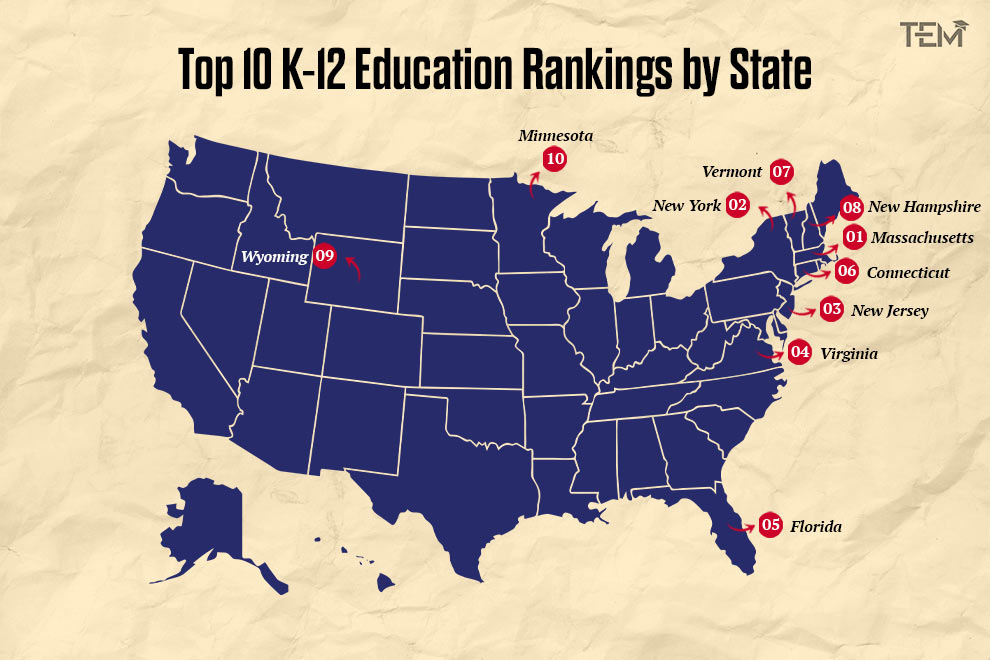
Top 10 K-12 Education Rankings by State (2026)
Different organizations use different methodologies, so no two national rankings produce the same top 10. The table below is an editorial snapshot drawing on patterns across U.S. News & World Report, WalletHub, and NAEP results rather than a reproduction of any single published list. Its top three match WalletHub’s July 2026 Best & Worst School Systems report, which ranked Massachusetts, Connecticut, and New Jersey first through third. Ranks 4 through 10 are editorial judgments and will differ from source to source. Data as of October 2026.
| Rank | State | Key Strengths |
| 1 | Massachusetts | Nation-leading NAEP scores, strong public school systems |
| 2 | Connecticut | Strong per-pupil funding and student support systems |
| 3 | New Jersey | Strong academic outcomes and digital learning initiatives |
| 4 | New York | Highest per-pupil funding, strong college readiness |
| 5 | Virginia | Balanced performance across reading, math, and graduation rates |
| 6 | Florida | Rapid literacy improvements and accountability reforms |
| 7 | Vermont | Among the lowest student–teacher ratios in the country |
| 8 | New Hampshire | Consistently high academic achievement |
| 9 | Wyoming | Solid student outcomes and small class sizes |
| 10 | Minnesota | Balanced academic performance and high graduation rates |
These states tend to combine strong academic standards, consistent investment in education, and supportive policy frameworks that prioritize student outcomes. For families researching school options within these states, exploring the best public schools in the USA can help narrow down specific districts and campuses.
The Rise of Digital Learning in State Education Systems
A major shift shaping modern K-12 education rankings by state is the role of education technology and digital learning infrastructure.
States that invest in technology integration are increasingly better positioned to support personalized learning and digital literacy.
For example, New Jersey and Virginia have developed statewide digital learning plans designed to improve:
- Broadband access in schools
- Digital curriculum adoption
- Teacher training for online instruction
These initiatives are becoming critical as schools incorporate AI tools, adaptive learning platforms, and blended learning environments.
States that build strong digital ecosystems today are likely to see improved student outcomes in the coming decade.
AI Readiness: The Next Frontier in K–12 Education
Artificial intelligence is beginning to influence how states think about education innovation.
Education systems across the country are exploring policies related to AI-assisted learning tools, academic integrity, and digital literacy.
Several states have already begun shaping early frameworks.
For example, New York recently introduced a “bell-to-bell” smartphone restriction policy designed to reduce distractions and improve classroom focus while schools explore structured technology use.
Meanwhile, states such as Virginia and New Jersey are expanding digital learning strategies that may support future AI integration in classrooms.
As artificial intelligence becomes more prominent in education, future rankings will likely evaluate states based not only on test scores but also on innovation, digital infrastructure, and AI readiness.
What Education Rankings Reveal About the Future
State education rankings reveal an important reality: successful education systems combine strong policy, well-supported teachers, and effective learning environments.
High-performing states share a pattern visible throughout this list: Massachusetts’s investment in teacher preparation, Mississippi’s early-literacy reforms, and New Jersey and Virginia’s digital learning infrastructure all point to the same lesson. Sustained, targeted investment beats broad, unfocused spending.
Education rankings are more than a scoreboard; they are a lens into how well a state prepares its students. For families, they inform relocation decisions and school choices. For policymakers, they expose gaps and guide smarter investments in curriculum, teachers, and infrastructure.
As education continues to evolve, the states that lead will be those combining academic rigor, teacher support, and forward-looking innovation, building environments where students thrive academically, socially, and technologically.
Education Rankings Are a Mirror of Opportunity
Every education system reflects the choices a state makes about its future.
The states leading today have built strong foundations through consistent investment, evidence-based policies, and a commitment to student success.
But rankings also show something equally important: progress is possible. States that were once considered underperforming are now rising by adopting smarter policies and focusing on early learning.
The real story behind K–12 education rankings by state is not simply which states lead today, but which ones are building the most resilient education systems for tomorrow.
If you found this analysis helpful, share it with educators, policymakers, and parents who care about the future of education.
FAQs
- Which state has the best K–12 education system in the U.S.?
Most national rankings consistently place Massachusetts among the top states for K–12 education due to its strong performance in reading and math on the National Assessment of Educational Progress. The state also benefits from high graduation rates, strong teacher preparation programs, and consistent investment in public schools.
- Which state ranks lowest in K–12 education?
Several recent rankings from organizations like WalletHub and U.S. News & World Report often place states such as New Mexico, Louisiana, and Alaska near the bottom. Lower rankings are typically linked to challenges in academic performance, funding disparities, and graduation rates.
- What state has the smallest student–teacher ratio?
Vermont is widely recognized for having one of the lowest student–teacher ratios in the United States. Smaller class sizes allow teachers to provide more individualized instruction and support, which can positively influence student learning outcomes.
- Do K–12 education rankings affect where families move?
Yes. Education quality is one of the most important factors families consider when choosing where to live. States with highly ranked public school systems often attract families looking for strong academic opportunities, which can also influence housing demand and community development.