Every classroom has moments when attention fades. Even the most carefully planned lesson can lose momentum when students feel tired or distracted. This is where classroom games become more than simple activities. They become tools that bring energy back into the learning process.
Games encourage participation in ways traditional instruction often cannot. When students are actively involved in thinking, responding, and collaborating, they retain information more effectively.
Marzano, Pickering, and Pollock (2001) identified games as one of nine high-yield instructional strategies producing above-average achievement gains. Plass, Homer, and Kinzer (2015) further confirmed that well-designed games improve both motivation and knowledge retention by creating conditions for active, goal-directed learning.
For teachers, the practical advantage is equally clear. Many activities require little preparation yet can immediately refocus a drifting class, reinforcing key concepts without interrupting the learning flow.
This guide introduces classroom games teachers can use instantly, from quick no-prep activities to collaborative challenges and digital tools that make every lesson feel active, enjoyable, and meaningful.
Quick Answer: Classroom games are structured learning activities that make lessons more engaging by encouraging participation, collaboration, and critical thinking. They can be used to introduce new concepts, review lessons, improve classroom management, and increase student motivation across all grade levels.
Key Takeaways
- Classroom games improve engagement and knowledge retention.
- Choose games based on your lesson objective.
- Short activities can quickly restore student focus.
- Adapt games for different ages and subjects.
- Debrief after each game to reinforce learning.
Why Classroom Games Improve Student Learning
Classroom games are not simply entertainment. When used thoughtfully, they support several important aspects of learning, from attention and motivation to collaboration among students.
1. The Science Behind Game-Based Learning
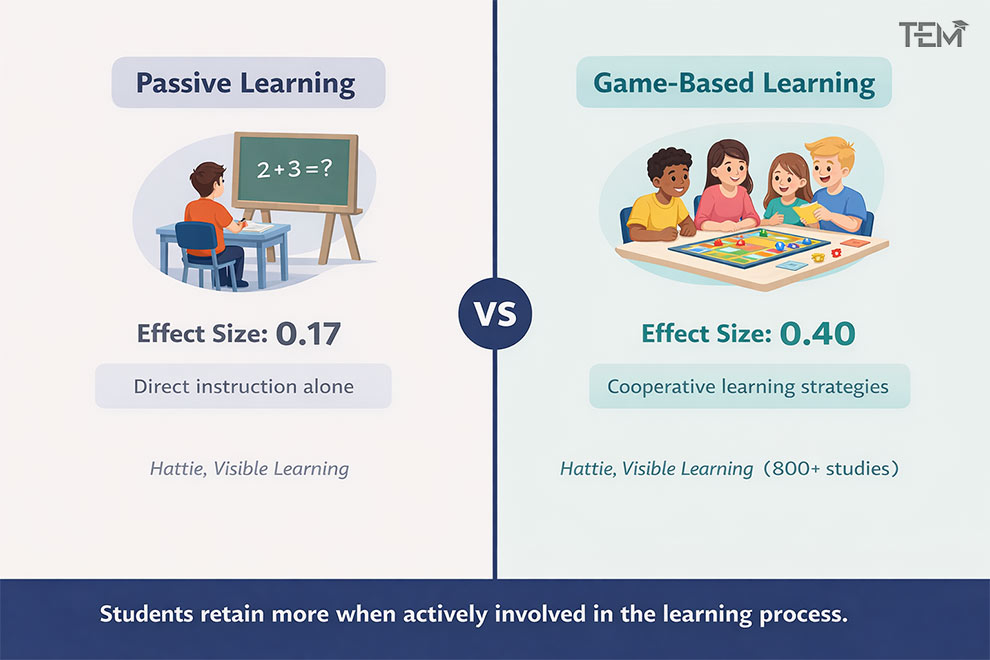
Games naturally shift students from passive listeners to active participants. Instead of receiving information, they must think, respond, and make decisions, which is exactly when deeper learning happens.
John Hattie’s Visible Learning meta-analysis, which reviewed over 800 studies, found that cooperative learning strategies carry an effect size of 0.40, well above the 0.20 threshold considered educationally meaningful. Games that involve teamwork tap directly into this effect.
Games also introduce an element of discovery. Whether students are solving problems, answering questions, or working in teams, the learning process becomes dynamic rather than routine.
2. Benefits Teachers Notice in the Classroom
Educators who use games regularly tend to see these results that align directly with the high-yield strategies documented in Classroom Instruction That Works:
- Increased classroom participation
- Stronger teamwork among students
- Better retention of lesson material
- Improved focus during long classes
Classroom Games by Subject
Sometimes the fastest way to find the right activity is by subject. Here are games organized by the four core subject areas, ready to drop into almost any lesson plan.
Classroom Games for Math
- Math Relay: Teams race to solve a sequence of problems in relay format, with each student solving one step before passing to the next teammate.
- Number Bingo: Students mark answers on a bingo card as the teacher calls out equations instead of numbers, reinforcing mental math under mild time pressure.
- Around the World: Two students face off answering a rapid-fire math question; the winner “travels” to challenge the next classmate around the room.
- Math Jeopardy: A category-and-points quiz format (see Classroom Jeopardy below) rebuilt around units like fractions, geometry, or algebra.
Classroom Games for English
- Word Chain: Students take turns naming a word that starts with the last letter of the previous word, building vocabulary and spelling awareness.
- Story Builder: Similar to Story Chain (below), but focused on genre, grammar, or literary devices the class is currently studying.
- Vocabulary Bingo: Students fill bingo cards with vocabulary words and mark them off as definitions are read aloud.
- Charades: Already covered in detail under “Fun Classroom Games Students Love” — a strong fit for character studies and literary terms.
Classroom Games for Science
- Science Quiz Relay: A relay-format review game (see Quiz Relay below) rebuilt around lab safety, the scientific method, or unit vocabulary.
- Mystery Object: A science-themed twist on Mystery Bag, where students use observation and questioning to identify a specimen, tool, or material.
- STEM Challenge: Small teams solve a hands-on engineering or design problem with limited materials and time, similar in spirit to the Marshmallow Challenge and Build the Tallest Tower activities below.
- Lab Escape Room: Students complete a sequence of science puzzles and mini-experiments to “unlock” the next clue, reinforcing process and procedure. For more structured formats, see our guide to game-based learning platforms and science and games.
Classroom Games for Social Studies
- Timeline Race: Teams compete to arrange event cards in correct chronological order, reinforcing sequencing and cause-and-effect.
- Geography Bingo: A map-based bingo variation using countries, capitals, or landmarks instead of numbers.
- Historical Role Play: Students take on the perspective of historical figures to debate or narrate events, encouraging empathy and deeper contextual understanding.
Classroom Games by Classroom Size
Class size changes which games work best. Use this as a quick filter before planning.
- Small Classes (10–20 Students): Discussion- and circle-based games thrive here. Think–Pair–Challenge, Word Association Circle, and Story Chain all work well because every student gets multiple turns without the activity dragging on.
- Medium Classes (20–35 Students): Most games in this guide are built for this range. Quiz Relay, Trashketball, and Charades balance participation with manageable pacing.
- Large Classes (40+ Students): Favor whole-room movement or digital formats that don’t rely on individual turn-taking. True or False Corners, Kahoot-Style Quiz Games, and team-based Classroom Jeopardy scale well because they keep everyone active at once.
Classroom Games by Learning Objective
Choosing a game by objective, rather than by name, is often the fastest path to the right activity.
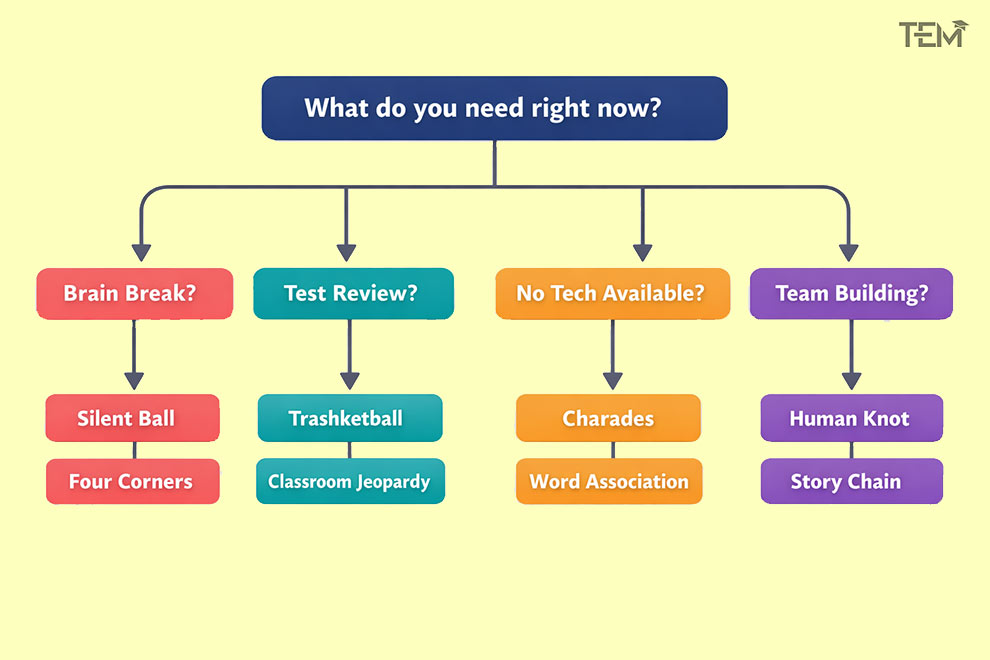
- Icebreaker Games: Two Truths and a Lie, Human Knot, Story Chain
- Revision Games: Quiz Relay, Classroom Jeopardy, Trashketball
- Vocabulary Games: Sparkle, Word Association Circle, Vocabulary Bingo
- Team Building Games: The Marshmallow Challenge, Build the Tallest Tower, Human Knot
- Brain Break Games: Silent Ball, Four Corners
- Problem Solving Games: Build the Tallest Tower, Virtual Escape Room, Lab Escape Room
- Communication Games: Think–Pair–Challenge, Story Chain — both build the same communication skills students need well beyond the classroom
Critical Thinking Games: Two Truths and a Lie, Mystery Bag, Digital Scavenger Hunt
Which Classroom Game Should You Choose? (Quick Decision Table)
| If You Want To… | Try This Game |
|---|---|
| Review vocabulary | Sparkle |
| Build teamwork | The Marshmallow Challenge |
| Improve focus | Silent Ball |
| Encourage discussion | Think–Pair–Challenge |
| Revise before a test | Quiz Relay |
Quick Classroom Games for Instant Engagement
Not every classroom activity needs detailed preparation. Some of the most effective classroom games require nothing more than a few minutes and a clear set of instructions. These quick games help teachers regain attention, introduce new topics, or review key concepts during a lesson.
Imagine it’s the last ten minutes before lunch and the room has stopped listening. Instead of pushing through another worksheet, a two-minute round of Silent Ball or Four Corners can reset the room while still reinforcing the lesson.
1. Silent Ball
⏱ 5 min | 👥 Grades 2–8 | 📦 One soft ball
Silent Ball is a simple activity that encourages focus and discipline.
Students stand or sit in a circle while quietly passing a soft ball to one another. The goal is to catch and throw the ball without speaking. If a student talks or drops the ball, they sit down for the remainder of the round.
Teachers often use this game as a short brain break. It helps students relax while still practicing concentration and self-control.
Pro tip: Use it right after lunch or between two heavy content blocks. Two or three rounds can fully reset the room.
2. Four Corners
⏱ 5–10 min | 👥 Grades K–6 | 📦 No materials needed
Four Corners is an energetic game that works well for younger students.
The teacher labels each corner of the classroom with a number or category. One student stands in the center with their eyes closed while the others quietly move to a corner. The student in the middle then calls out a corner number, and everyone in that corner sits down.
This game can also be adapted for learning. Teachers can assign each corner an answer choice, turning the activity into an interactive quiz.
Pro tip: The corner must be called randomly (not strategically), the student in the center genuinely cannot see where anyone has gone, which keeps the game fair.
3. Sparkle
⏱ 10 min | 👥 Grades 1–5 | 📦 A spelling word list
Sparkle is a popular classroom game used for spelling practice.
Students stand in a line or circle. The teacher announces a word, and each student says one letter of the word in sequence. The student who says the final letter says “sparkle,” and the next student sits down.
The activity continues with new words until one student remains. This game helps reinforce spelling skills while keeping the entire class involved.
Pro tip: Use your current week’s vocabulary list. Students rehearse the words several times by the end of a single round without it feeling like drill practice.
4. Popcorn Questions
⏱ 5–10 min | 👥 Grades 3–12 | 📦 A question list
Popcorn Questions is a fast-paced review activity.
The teacher asks a question related to the lesson. A student answers and then quickly chooses the next student to respond to another question, similar to popcorn popping around the room.
Because students never know when they will be called, they stay alert and engaged throughout the activity.
Pro tip: Allow students to “pass” once during the game. This reduces anxiety while still keeping everyone alert.
5. Think–Pair–Challenge
⏱ 10–15 min | 👥 Grades 4–12 | 📦 No materials needed
This activity encourages students to discuss ideas before sharing answers with the class.
First, students think about a question individually. Then they discuss their ideas with a partner. Finally, pairs present their responses or solutions to the class.
This game works well for deeper discussions because it allows students to organize their thoughts before speaking.
Pro tip: Works especially well for open-ended questions in English, history, or science where there is no single correct answer.
Fun Classroom Games Students Love
Some classroom games become instant favorites because they combine learning with excitement. These activities encourage creativity, quick thinking, and friendly competition while still reinforcing academic concepts.
1. Charades (Educational Version)
⏱ 10–15 min | 👥 Grades 3–12 | 📦 Index cards with terms
Charades is a simple yet highly engaging classroom activity.
Teachers write vocabulary words, historical events, scientific concepts, or literary characters on small cards. One student selects a card and silently acts out the concept while classmates try to guess the correct answer.
This activity works particularly well in language, history, and literature classes. Students remember concepts more easily because they associate them with actions and visual cues.
Pro tip: Let students write the cards themselves as part of a review activity. Writing the clue requires just as much thinking as acting it out.
2. Pictionary Learning
⏱ 10–15 min | 👥 Grades 2–10 | 📦 Whiteboard or paper
Pictionary transforms complex ideas into visual thinking exercises.
A student draws a word or concept on the board while their team attempts to guess what it represents. Teachers can tailor the game to any subject, such as mathematical terms, geography locations, science processes, or language vocabulary.
Drawing forces students to simplify ideas, which helps deepen understanding. At the same time, guessing encourages quick recall and collaboration.
Pro tip: Set a strict 60-second timer. The time pressure generates energy and keeps the game moving.
3. Word Association Circle
⏱ 5–10 min | 👥 Grades 3–12 | 📦 No materials needed
This game strengthens vocabulary and critical thinking.
Students sit in a circle. The teacher says a word related to the lesson topic, and the next student must quickly say a related word. The chain continues around the circle without repeating previous answers.
For example, during a science lesson on electricity, the chain might run: energy → current → circuit → conductor → copper → wiring.
The activity trains students to make quick mental connections between concepts.
Pro tip: Pause when a student’s word seems unexpected and ask them to explain the connection. This often generates the lesson’s best discussion.
4. Two Truths and a Lie (Educational Edition)
⏱ 10–15 min | 👥 Grades 5–12 | 📦 No materials needed
This popular icebreaker can also become a learning activity.
Students share three statements related to a lesson topic, two that are true and one that is incorrect. The class must identify which statement is false.
For example, in a history class, a student might say: “The Berlin Wall fell in 1989. Germany was reunified the same year. The wall was built in 1963.” (The lie: it was built in 1961.) The discussion that follows often leads to a deeper understanding of the topic.
Pro tip: Assign preparation as a five-minute task at the end of class. Students must know the content well enough to construct a convincing false statement. It’s a stealth assessment.
5. Mystery Bag
⏱ 10 min | 👥 Grades K–5 | 📦 A bag and one hidden object
Mystery Bag is an excellent activity for younger learners or creative subjects.
The teacher places an object inside a bag. Students ask yes-or-no questions to identify what the object might be. Each question helps narrow down the possibilities.
This game develops logical thinking, questioning skills, and observation.
Pro tip: Use objects that connect to upcoming content rather than just-covered material. It works beautifully as a lesson hook.
Classroom Games for Lesson Reviews
Review sessions can sometimes feel repetitive for students. However, when teachers introduce game-based review activities, the same content becomes much more engaging.
These games help students revisit important concepts while maintaining energy and participation.
1. Trashketball
⏱ 15–20 min | 👥 Grades 3–10 | 📦 Paper balls, a bin
Trashketball is one of the most popular classroom review games.
The teacher asks a question related to the lesson. If a student answers correctly, they earn the opportunity to throw a paper ball into a trash bin from a distance. Successful shots earn additional points.
The excitement of the throw motivates students to participate while reinforcing academic material.
Pro tip: Allow teams to confer before answering. This keeps quieter students involved and turns individual performance into a shared stake.
2. Classroom Jeopardy
⏱ 20–30 min | 👥 Grades 4–12 | 📦 Prepared category board (digital or paper)
Inspired by the well-known quiz format, Classroom Jeopardy organizes questions into categories and point values.
Students select categories and answer questions of increasing difficulty. The format encourages teamwork, discussion, and strategic thinking.
Teachers can design categories based on different units or topics within the course.
Pro tip: Include one “Daily Double” category. It adds strategy and generates genuine excitement during what could otherwise feel like routine revision.
3. Quiz Relay
⏱ 15–20 min | 👥 Grades 3–10 | 📦 A question list
Quiz Relay turns review questions into a collaborative race.
Students form teams and line up. The first student in each line answers a question from the teacher. If the answer is correct, the next teammate steps forward to answer another question.
The relay continues until one team successfully answers a set number of questions.
This activity works well for revision sessions before tests or exams.
Pro tip: Run all teams simultaneously rather than in sequence. The whole class stays active at once, which doubles the total review volume in the same time.
4. True or False Corners
⏱ 10 min | 👥 Grades 2–8 | 📦 No materials needed
Teachers assign one side of the classroom as “True” and the other as “False.”
When the teacher reads a statement related to the lesson, students must quickly move to the side they believe is correct. Afterward, the teacher explains the correct answer and the reasoning behind it.
This movement-based game helps maintain attention while reinforcing key ideas.
Pro tip: Ask a student on the correct side to explain why before you confirm it. Peer explanation often lands more effectively than teacher explanation.
Team-Building Games for the Classroom
Team-based activities help students develop communication, collaboration, and leadership skills. These abilities are just as important as academic knowledge in modern education.
Classroom team games encourage students to listen to one another, share ideas, and work toward common goals.
1. Build the Tallest Tower
⏱ 15–20 min | 👥 Grades 3–10 | 📦 Paper, tape, straws (or similar)
This activity challenges students to think creatively.
Teams receive a small set of materials such as paper, straws, or tape. Their task is to build the tallest free-standing structure within a limited time.
Beyond the fun competition, the exercise encourages planning, experimentation, and teamwork.
Pro tip: Debrief with three questions: What worked? What failed? What would you do differently? This turns a physical challenge into a lesson in metacognition.
2. The Marshmallow Challenge
⏱ 18 min | 👥 Grades 5–12 | 📦 20 spaghetti sticks, 1 yard tape, 1 yard string, 1 marshmallow per team
In this well-known classroom challenge, students must build a structure that holds a marshmallow on top using 20 spaghetti sticks, 1 yard of tape, 1 yard of string, and 1 marshmallow per team.
Developed by designer Tom Wujec and run with thousands of groups globally, this challenge consistently reveals a key insight: teams that prototype early and test frequently outperform teams that plan extensively and build only once.
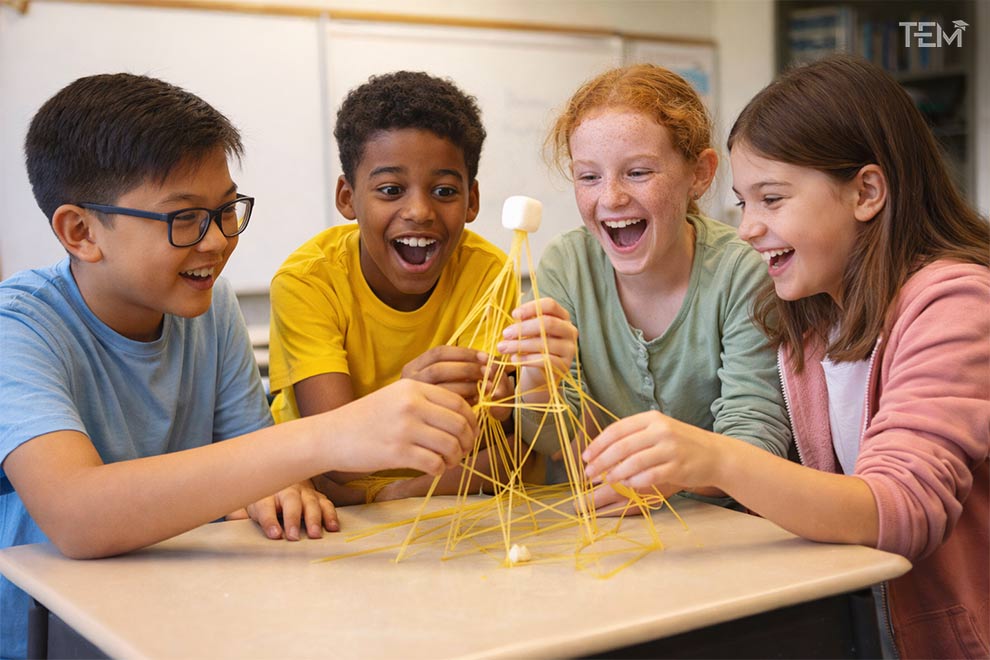
Although the activity appears simple, it requires problem-solving and collaboration.
Students quickly learn that testing ideas and adapting strategies is essential to success.
Pro tip: Use this to introduce design thinking or any unit on iterative problem-solving. The debrief is where the real learning happens.
3. Human Knot
⏱ 10–15 min | 👥 Grades 4–10 | 📦 No materials needed
Human Knot is a physical team-building activity that encourages communication.
Students stand in a circle and randomly hold hands with two different people across the circle. The group must then untangle themselves without letting go of their hands.
The challenge requires patience, cooperation, and creative thinking.
Pro tip: Run it once with talking allowed, then challenge a different group to do it in silence. The contrast makes for a strong discussion about communication in teamwork.
4. Story Chain
⏱ 10–15 min | 👥 Grades 2–10 | 📦 No materials needed
Story Chain is a collaborative creativity game.
One student begins a story with a single sentence. Each student adds another sentence, gradually building a shared narrative.
Teachers can guide the story around lesson themes, historical events, or creative writing exercises.
Pro tip: Record the story on the board as it develops. Students are regularly surprised by how creative the result is, which makes them more willing to engage again.
Digital Classroom Games for Modern Learning
Technology has created new opportunities for teachers to make lessons interactive. Digital classroom games allow students to participate using devices they already feel comfortable with, such as tablets, laptops, or smartphones.
These tools are especially useful for quizzes, quick assessments, and real-time feedback during lessons, and game-based learning research consistently shows that they increase motivation and improve knowledge retention across learner types.
Teachers should also keep digital citizenship in mind when introducing device-based activities, ensuring students engage responsibly and safely online.
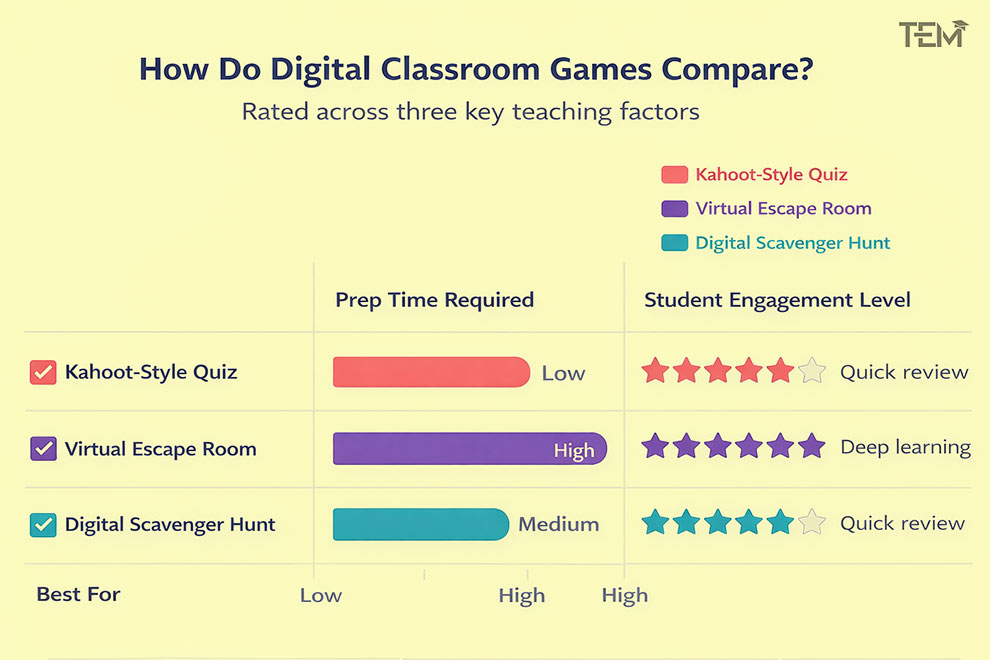
1. Kahoot-Style Quiz Games
⏱ 10–20 min | 👥 Grades 3–12 | 📦 Student devices
Interactive quiz platforms have become popular in classrooms around the world.
Teachers create multiple-choice quizzes that students answer using their devices. Points are awarded based on accuracy and speed, and a leaderboard appears after each question.
The format creates excitement because students can immediately see how they are performing compared to their classmates. At the same time, teachers can quickly identify topics that may need further explanation.
Pro tip: Run the quiz twice, once as a competition, once without a timer so students can read the explanations carefully. You get engagement and understanding in one session.
2. Digital Scavenger Hunt
⏱ 20–30 min | 👥 Grades 5–12 | 📦 Student devices, prepared clue list
A digital scavenger hunt turns research into an engaging challenge.
Teachers create a list of questions or clues related to a lesson topic. Students must search online resources, textbooks, or digital materials to find the answers.
This activity encourages independent learning while improving research and problem-solving skills.
Pro tip: Require students to cite the source for every answer. A fun activity becomes a lesson in academic research habits.
3. Virtual Escape Room
⏱ 30–45 min | 👥 Grades 5–12 | 📦 Student devices, pre-built scenario
Virtual escape rooms combine storytelling with academic challenges.
Students work together to solve puzzles, answer questions, and uncover clues that allow them to “escape” from a fictional scenario. Each correct answer unlocks the next stage of the activity.
Teachers often design escape rooms around subjects such as history timelines, scientific concepts, or literature themes.
Pro tip: Free tools like Google Forms, Breakout EDU Digital, or Genially make building escape rooms straightforward, even for first-timers.
4. Online Polling Games
⏱ 5–10 min | 👥 Grades 4–12 | 📦 Student devices
Quick online polls can transform ordinary classroom questions into interactive discussions.
Teachers ask questions and students submit answers anonymously through digital tools. The results appear instantly on the screen, allowing the class to analyze patterns and discuss different viewpoints.
This approach encourages participation from students who may hesitate to speak in front of the class.
Pro tip: Use anonymous polls for opinion or ethics questions. Anonymity produces more honest answers and more interesting discussions.
Classroom Games for Different Age Groups
Not every classroom game works equally well for every age group. The key is choosing activities that match students’ attention spans, learning levels, and interests.
1. Best Classroom Games for Elementary Students
Younger learners respond best to activities that involve movement, imagination, and visual thinking.
Effective classroom games for elementary students include:
- Four Corners
- Pictionary
- Mystery Bag
- Word Association
These games keep students active while reinforcing basic learning skills such as vocabulary, observation, and simple reasoning.
2. Games for Middle School Students
Middle school students enjoy activities that combine competition with creativity.
Games that work well at this level include:
- Charade
- Quiz Relay
- Two Truths and a Lie
- Story Chain
These activities allow students to express ideas while still focusing on academic topics.
3. Games for High School Students
Older students often prefer games that involve strategy, collaboration, or deeper thinking.
Some effective options include:
- Classroom Jeopardy
- Debate-style quiz games
- Digital scavenger hunts
- Virtual escape rooms
These activities challenge students to analyze information, solve problems, and work in teams.
Benefits for Different Learners
Classroom games work well because they don’t rely on a single way of absorbing information. A well-chosen mix reaches students regardless of how they learn best.
- Visual learners benefit from games like Pictionary, Geography Bingo, and Timeline Race, where seeing an idea drawn out or mapped visually makes it easier to remember.
- Auditory learners respond well to Popcorn Questions, Word Chain, and Charades, where listening closely and verbal quick-thinking drive success.
- Kinesthetic learners thrive in movement-based formats like Four Corners, Human Knot, and True or False Corners, which turn a concept into something physical.
- Collaborative learners get the most out of team formats like The Marshmallow Challenge, Build the Tallest Tower, and Quiz Relay, where shared problem-solving is the point of the activity.
Mistakes Teachers Make When Using Classroom Games
Classroom games are only as effective as how they’re used. A few common missteps can quietly undercut their value:
- Playing games without a learning objective. A game without a clear academic purpose becomes a distraction instead of a teaching tool.
- Choosing games that exclude quiet students. Formats that reward only the fastest or loudest students can leave more reserved learners disengaged.
- Spending too much time explaining rules. If setup takes longer than the game itself, energy and focus are lost before the activity even starts.
- Overusing competition. Constant winner-loser framing can create anxiety for some students and reduce willingness to participate.
- Not debriefing after the activity. Skipping a short reflection means students may remember the fun but miss the lesson connected to it.
Tips for Using Classroom Games Effectively
Even the best classroom game needs thoughtful planning. When games are used strategically, they can strengthen learning instead of distracting from it. If your primary goal is improving behaviour and focus alongside learning, exploring dedicated classroom management games can help you build a system that works across both.
Here are a few practical tips teachers often follow:
- Keep the Objective Clear: Every game should connect to a learning goal. Whether reviewing vocabulary or exploring new concepts, students should understand the purpose behind the activity.
- Set Simple Rules: Clear and simple instructions help avoid confusion. Students can focus on learning rather than trying to understand complicated rules.
- Encourage Participation from Everyone: Games work best when every student feels involved. Teachers can rotate turns, form small groups, or create team challenges to ensure balanced participation.
- Use Games as Short Learning Breaks: Not every activity needs to last long. Even a five-minute game can refresh attention and help students return to the lesson with greater focus.
How Classroom Games Support Long-Term Learning
Beyond the immediate energy boost, classroom games build skills that stay with students well after the activity ends.
- Active learning: Games require students to do something with information, not just receive it, which is the foundation of active learning as an instructional model.
- Critical thinking: Games like Two Truths and a Lie and Mystery Bag ask students to evaluate evidence and question assumptions in real time.
- Collaboration: Team-based formats build the kind of cooperative learning Hattie’s research links to above-average achievement gains.
- Communication: Speaking, explaining, and persuading during a game strengthens the same communication skills students need in group projects and presentations.
- Creativity: Open-ended games like Story Chain and Pictionary give students room to generate original ideas rather than recall a single correct answer.
- Confidence: Low-stakes, game-based practice gives quieter students a safe way to participate, gradually building the confidence to speak up elsewhere.
- Problem solving: Design-style challenges like the Marshmallow Challenge mirror real-world problem-solving, where testing and adjusting matter more than getting it right the first time.
- Memory retention: Repetition through play, rather than repetition through drills, tends to make information stick.
Many of these outcomes overlap with broader frameworks educators already use, including Bloom’s Taxonomy, formative assessment, project-based learning, Universal Design for Learning (UDL), and social-emotional learning (SEL) all areas where classroom games can play a supporting role in day-to-day classroom management and student engagement.
Turning Everyday Lessons Into Engaging Learning Moments
Classroom games remind us that learning does not have to feel routine. When lessons include moments of interaction, creativity, and collaboration, students become active participants rather than passive listeners.
The games in this guide show that meaningful engagement rarely requires complicated planning or expensive resources. A clear objective, a simple structure, and a good debrief can shift the entire classroom dynamic within minutes.
If you found these classroom game ideas helpful, share this guide with fellow educators or teaching communities who are looking for new ways to make learning more engaging. A single shared idea can transform an entire classroom experience.
FAQs
- What makes a classroom game effective for learning?
An effective classroom game connects directly to the lesson objective. It should encourage students to think, collaborate, or apply what they have learned rather than simply compete. The best activities are easy to explain, involve most students in the room, and allow teachers to quickly assess understanding while keeping the learning environment positive and engaging.
- How often should teachers use games in the classroom?
Classroom games work best when they are used strategically rather than constantly. Many educators introduce short activities during transitions, lesson reviews, or when student attention begins to decline. Even a five-minute interactive game can help restore focus and make the next part of the lesson more productive.
- Can classroom games help shy or quiet students participate?
Yes, well-designed games can create a safe environment for quieter students to contribute. Team-based activities, small group challenges, or anonymous digital quizzes allow students to participate without the pressure of speaking in front of the entire class. Over time, this type of participation can help build confidence and encourage more active involvement in discussions.
- Do classroom games work in online or hybrid learning environments?
Classroom games can be highly effective in online settings when adapted properly. Digital quizzes, virtual escape rooms, collaborative whiteboards, and online polls allow students to interact in real time. These activities help maintain attention in virtual classrooms and ensure that students remain actively involved in the learning process.