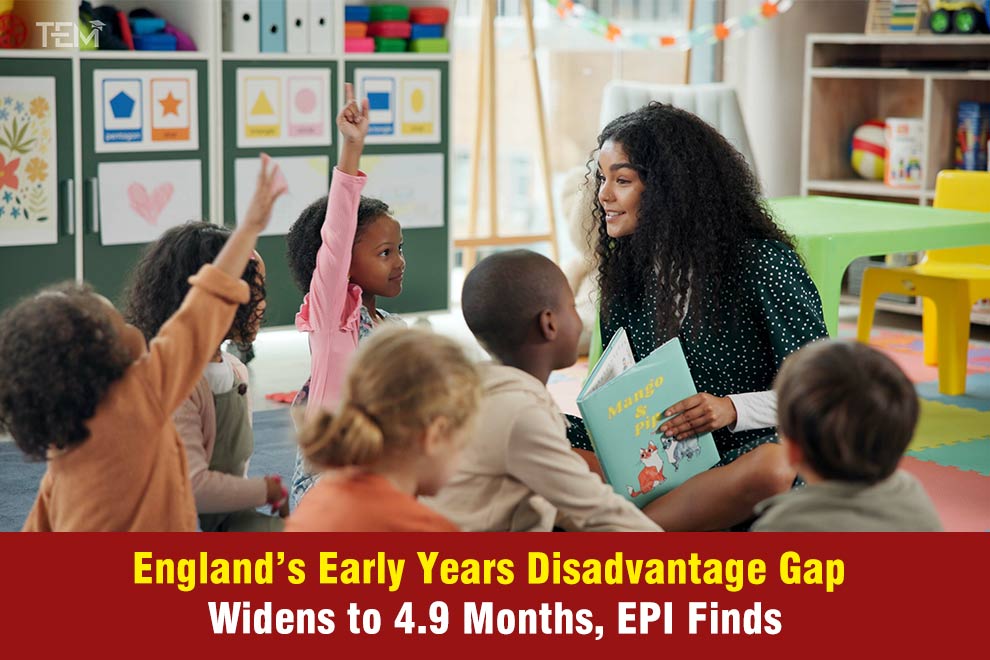
England’s early years disadvantage gap has reached its widest level since 2014, according to new research from the Education Policy Institute (EPI). The study found that disadvantaged children were around 4.9 months behind their peers by the end of Reception.
The findings suggest educational inequalities become established during the early years and can have lasting effects throughout a child’s education.
The findings come as the government works towards its target of 75% of children achieving a Good Level of Development (GLD) by 2028.
The report warns that without targeted support, disadvantaged pupils are likely to continue falling behind as they progress through school.
Key Findings from the EPI Research
The newly published data highlights a stark reality for early years education across the nation about England’s early years disadvantage gap. The report tracks how these early disparities grow over time:
| Educational Stage | Attainment Gap Measure | Key Finding |
| Age 5 (Reception) | 4.9 months of learning | Widest early years gap since 2014. |
| Age 11 (Primary) | Around 10 months of learning | The gap more than doubles by the end of primary school. |
The study emphasizes that around 40% of the total learning gap is already firmly established before children even finish their Reception Year.
Furthermore, this upward trend in inequality is widespread. Researchers noted that all 153 local authorities in England experienced widening gaps between ages 5 and 16, proving that the issue affects communities nationwide.
SEND Needs to Widen the Attainment Gap
The report identifies SEND as the single largest contributor to the widening early years attainment gap. For children requiring specialized support, the Reception Year attainment gap becomes even more pronounced.
Five-year-olds who have formal Education, Health and Care Plans (EHCPs) face a developmental gap of around 20 months compared to their peers.
The findings build on recent Department for Education data showing that EHCP numbers continue to rise across England, increasing pressure on schools and SEND services.
The EPI analysis concludes that providing inclusive support within early years environments is entirely central to narrowing these disparities and ensuring all children can access foundational learning.
Emily Hunt, Associate Director at the Education Policy Institute, said early intervention alone would not close the gap:
“Our research shows that early intervention is crucial in addressing the disadvantage gap. But it is not enough on its own. Disadvantaged pupils continue to fall behind at every stage of compulsory education.”
Researchers Call for Urgent Reforms
According to the report, policymakers should consider several specific policy recommendations aimed at restructuring early years education:
- Expand Early Years Access: The report calls for a major expansion of access to high-quality early years education, with a specific focus on families in lower-income areas.
- Review Childcare Funding: Researchers recommend a thorough review of current childcare funding mechanisms to ensure that resource allocation explicitly favors disadvantaged families.
- Support Funded Places: The analysis notes that government-funded childcare places must be fully funded so providers can maintain high standards without restricting access.
- Improve Access to High-Quality Provision: The report emphasizes that high-quality settings have the greatest impact and warns against creating a two-tier system where disadvantaged children end up in lower-quality providers.
The focus on quality also aligns with the government’s new Ofsted nursery inspection reforms, which will introduce 3,000 additional surprise inspections each year to strengthen standards and safeguarding across early years settings.
Final Thought
The latest findings present an evidence-based overview of the current trajectory of the British school system. The report from the Education Policy Institute demonstrates that England’s early years disadvantage gap has experienced a measurable widening trend.
The report concludes that reducing inequalities during the early years will be critical to improving long-term educational outcomes.
As the government works towards its 2028 Good Level of Development target, the researchers argue that expanding access to high-quality early years education will be essential to narrowing the disadvantage gap.