You spent years and a significant amount of money working toward a degree, trusting what your school told you about accreditation, job placement, or where your credits would transfer. Then, sometime after graduation, you learn that some of it wasn’t true, the accreditation didn’t hold up the way you were promised, the job placement numbers were inflated, or the credits you were told would transfer never did. It’s a more common story than most people realize, especially among students who attended schools later found to have misrepresented their programs.
If that sounds familiar, Borrower Defense to Repayment may be worth looking into. It’s a federal relief option that allows eligible borrowers to request discharge of federal student loans tied to a school’s misconduct. That said, eligibility depends heavily on individual circumstances, the evidence available, and the specific regulations that apply to your loan; not every situation qualifies, and approval is never automatic or guaranteed.
What Is Borrower Defense?
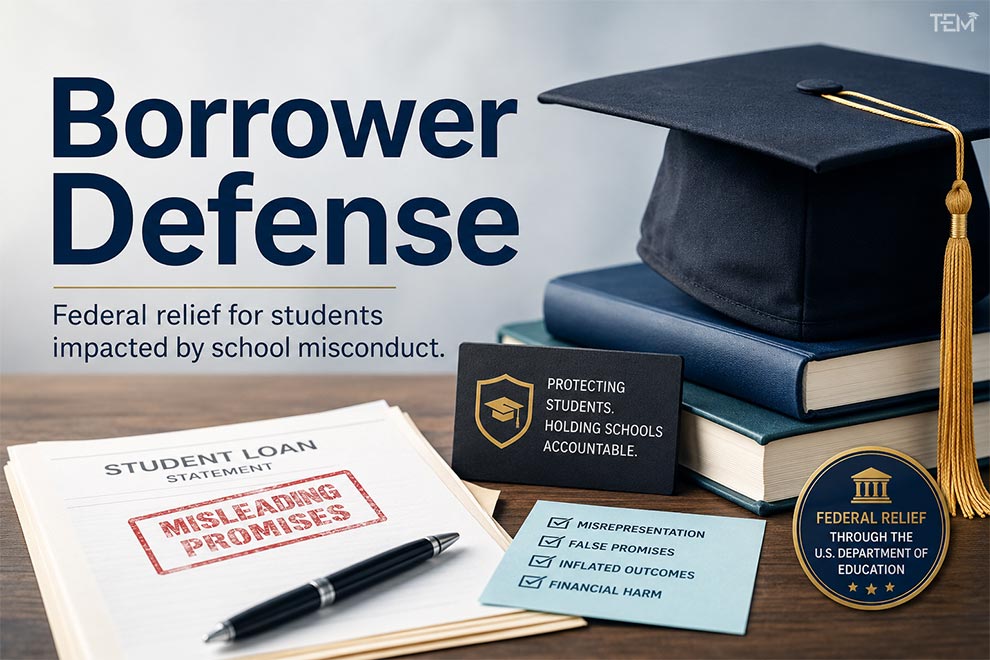
Borrower Defense to Repayment is a federal program that may discharge eligible federal student loans when a school’s misconduct caused financial harm. Approval depends on documented evidence and the U.S. Department of Education‘s current requirements, and outcomes are never automatic or guaranteed for every applicant.
Key Takeaways
- Borrower Defense applies only to eligible federal student loans, not private loans.
- Applicants generally need evidence that their school engaged in misconduct, such as fraud or misrepresentation.
- Approval is based on program requirements, evidence quality, and the specific regulations tied to your loan.
- Not every borrower qualifies; eligibility depends on individual circumstances and documentation.
- The application process is free through the U.S. Department of Education; no third party is required to file it.
Did You Know?
Borrower Defense applies only to eligible federal student loans. Private student loans are not covered, so it’s important to know which type of loan you have before applying.
What Is Borrower Defense to Repayment?
Borrower Defense to Repayment is a federal loan discharge provision built into the Direct Loan Program, authorized under the Higher Education Act. It allows a borrower to argue that a specific act or omission by their school related to the loan or to the educational services the loan paid for gives them a legal basis to have some or all of that federal student loan debt canceled.
The Department of Education created the program, and it’s administered through Federal Student Aid (FSA). Its purpose is straightforward: borrowers shouldn’t be on the hook for student loan debt tied directly to a school’s wrongdoing. The rule has existed since the mid-1990s, but it exists in the public consciousness mostly because of a wave of for-profit college closures and enforcement actions over the past decade, where large numbers of students were left holding loans for programs that didn’t deliver what was promised.
Because the underlying regulations have been revised several times since the program was created, the exact standard used to evaluate a claim can depend on when the loan in question was first disbursed. That’s a detail worth confirming directly on StudentAid.gov rather than assuming a single rule applies to every borrower.
Borrower Defense also doesn’t exist in isolation it sits inside a federal loan system that’s been through significant upheaval recently. The Department of Education proposed new borrowing and repayment rules for 2026, and a wave of related student loan changes — including new repayment plans and borrowing caps has since taken effect. None of these changes the core Borrower Defense standard, but it’s useful context for understanding why the broader student loan landscape feels unusually unsettled right now.
Quick Eligibility Checklist
Before diving into the details, here’s a fast way to see where you likely stand:
- You have eligible federal student loans.
- Your school made false or misleading claims.
- You have supporting documents or evidence.
- Your claim relates to the school’s misconduct.
If most of these apply to you, it’s worth reading on to understand the fuller eligibility picture below.
Who Qualifies for Borrower Defense?
Borrower Defense eligibility starts with your loan type: eligible borrowers generally hold federal Direct Loans (or FFEL/Perkins loans that have since been consolidated into a Direct Loan) used to attend a school where misconduct occurred. Beyond loan type, the core Borrower Defense requirements center on proving that specific misconduct actually happened. Qualifying misconduct typically falls into a few categories:
- Substantial misrepresentation about the school, the program, or job prospects
- Breach of contract between the borrower and the school
- Certain violations of state consumer protection law tied to recruitment or enrollment
Examples of situations that have supported claims include misrepresentation of a program’s accreditation status, inflated job placement statistics, false promises that credits would transfer to another institution, or misrepresented program costs.
Situations that generally do not qualify on their own include general dissatisfaction with the quality of instruction, disappointment with career outcomes absent any misrepresentation, and private student loans, which fall outside this program entirely. It’s worth being clear-eyed here: having a bad experience at a school is not the same as having a Borrower Defense claim; the program is built around demonstrable misconduct, not subjective dissatisfaction, and approval always depends on the specific facts and evidence involved.
Common Reasons Borrowers Apply
Most Borrower Defense claims center on a handful of recurring issues:
- False employment claims: inflated or fabricated job placement rates
- Misleading advertising: false advertising about costs, outcomes, or program benefits
- Accreditation misrepresentation: claiming an accreditation status the school didn’t actually hold, or one that affected licensure eligibility
- False transfer credit promises: telling students credits would transfer when they would not
- Program quality misrepresentation: misstating faculty credentials, facilities, or curriculum content
How to Apply for Borrower Defense
The Borrower Defense process generally follows five steps:
- Confirm loan eligibility. Verify that your loans are federal Direct Loans (or eligible FFEL/Perkins loans) connected to the school you’re citing.
- Gather supporting evidence. Collect documentation that clearly shows the school’s misconduct.
- Complete the application. File the official Borrower Defense application through your account at StudentAid.gov.
- Submit documentation. Attach your supporting evidence directly to the application.
- Monitor application status. Check your Federal Student Aid account regularly and respond promptly if the Department requests more information.
Documents You May Need
Strong Borrower Defense claims are usually backed by a paper trail. Useful documents include:
- Enrollment records and enrollment agreements: these prove the actual terms and promises the school offered you at the time you signed up.
- Marketing materials, brochures, or advertisements: these can demonstrate misleading advertising if what was promised doesn’t match reality.
- Emails and other correspondence with recruiters or school staff: these provide written evidence of specific promises or representations made to you directly.
- Financial documents, including loan statements and tuition bills: these establish exactly how much you borrowed and what it was used to pay for.
- Official school communications, catalogs, or syllabi: these show what the school itself claimed about the program’s content, faculty, or outcomes.
Tips Before Submitting Your Borrower Defense Application
A little preparation goes a long way with a claim like this. Before you submit:
- Gather all documents before starting: Having everything on hand makes the application faster and your claim stronger.
- Keep copies of everything you submit: You’ll want your own record of what was sent and when.
- Use only official government websites: File and check your status exclusively through StudentAid.gov.
- Respond quickly to requests for additional information: Delays on your end can slow down the entire review.
- Avoid companies that charge application fees: The Borrower Defense application is free; paying anyone to file it for you is unnecessary and a common scam.
Borrower Defense vs Other Student Loan Forgiveness Programs
Borrower Defense is one of several federal student loan forgiveness paths, but each serves a different purpose:
| Program | Who Qualifies | Purpose |
| Borrower Defense to Repayment | Borrowers whose school committed misconduct that caused financial harm | Discharge federal loans tied to the school’s wrongdoing |
| Public Service Loan Forgiveness (PSLF) | Borrowers in qualifying government or nonprofit roles who make 120 qualifying payments | Forgive the remaining federal loan balance after qualifying public service employment |
| Total and Permanent Disability Discharge | Borrowers with a qualifying total and permanent disability | Discharge federal loans due to disability |
| Closed School Discharge | Borrowers whose school closed while they were enrolled, or shortly after they withdrew | Discharge federal loans tied to the school’s closure |
If none of these fit your situation, it’s still worth understanding your everyday repayment options our full breakdown of student loan repayment plans covers standard, income-driven, and other choices in more detail.
What Happens After You Apply?
Once submitted, your application enters a review process at the Department of Education, which evaluates the evidence against the applicable regulations and, in many cases, gives the school an opportunity to respond. Possible outcomes include approval a full or partial student loan discharge denial, or a request for additional information from you.
Processing timelines can vary considerably and are affected by application volume and ongoing litigation around the program, so it’s best not to rely on a fixed estimate; check your Federal Student Aid account for the current status of your claim instead. Recent staffing reductions at Federal Student Aid have also been reported to affect oversight and processing capacity, which is one more reason not to expect a predictable turnaround. If the Department asks for more documentation, respond promptly, since delays on your end can slow the review further.
Common Mistakes to Avoid
- Submitting incomplete evidence. Vague or unsupported claims are harder to evaluate favorably.
- Assuming all loans qualify. Private student loans and some other loan types fall outside this program.
- Paying third parties to file a free application. The Borrower Defense application costs nothing to submit; companies charging a fee to “help” you file are a common scam.
- Ignoring official communications. Missed requests for information can stall or jeopardize a claim.
Staying alert to these mistakes also helps you avoid scams targeting borrowers who are actively going through the process.
What Students Can Learn from Borrower Defense
Beyond the application process itself, Borrower Defense offers a useful lesson in how to evaluate a school before enrolling:
- Research colleges carefully. Look past a school’s own marketing and check independent reviews and outcomes data.
- Verify accreditation. Confirm a school’s accreditation status directly with the accrediting body, not just the school’s claims.
- Review employment outcomes. Seek third-party verified job placement and salary data rather than relying on a school’s self-reported numbers.
- Read financial aid information carefully. Understand loan terms, total cost, and repayment obligations before signing anything.
- Keep important documents. Save enrollment agreements, marketing materials, and correspondence; they’re exactly the kind of records that matter if a Borrower Defense claim is ever needed later.
Conclusion
Borrower Defense can provide real relief for eligible borrowers affected by school misconduct, but it isn’t automatic, and it isn’t guaranteed. Before applying, review the official eligibility requirements, gather strong supporting documentation, and rely only on official government resources starting with StudentAid.gov throughout the process.
FAQ
- Is the Borrower Defense application free?
Yes. The Borrower Defense application is completely free and must be submitted directly through the U.S. Department of Education at StudentAid.gov. Be cautious of any company that charges a fee to file this application on your behalf; that’s a common scam tactic.
- Does Borrower Defense apply to private loans?
No. Borrower Defense to Repayment only applies to eligible federal student loans, primarily Direct Loans. Private student loans aren’t covered, since they fall outside the Department of Education’s Direct Loan Program and its discharge authority.
- Can international students apply if they have eligible federal loans?
Federal Direct Loans generally require U.S. citizenship or eligible noncitizen status, so most international students on visas don’t hold them. Eligible noncitizens who do have qualifying federal Direct Loans tied to a school’s misconduct may apply like any other borrower.
- What happens if my application is denied?
A denial isn’t necessarily final. Borrowers may be able to submit additional evidence, request reconsideration, or explore other relief options such as closed school discharge or income-driven repayment forgiveness, depending on individual circumstances.