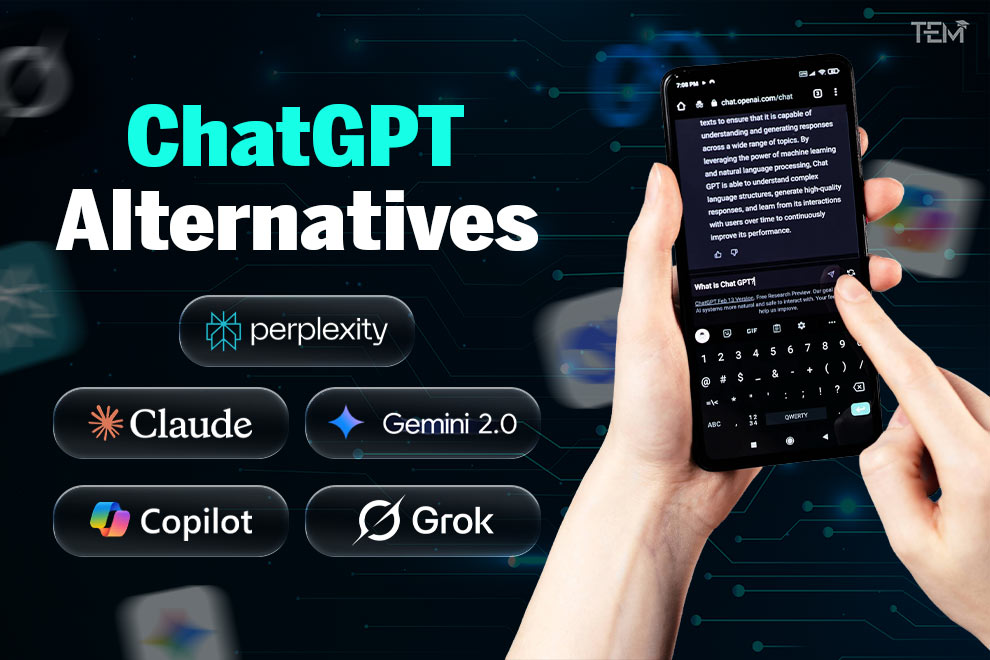
The landscape of Artificial Intelligence has shifted significantly since the early days of chatbots. Choosing an AI tool today is harder than it was a year ago. Many students start with ChatGPT, only to discover that research-heavy assignments, coding projects, and long academic papers often require different strengths. The best AI tool depends less on popularity and more on what you’re actually trying to accomplish.
This guide highlights the most effective platforms currently helping students excel in their studies based on real academic workflows.
Why do Students need ChatGPT alternatives?
Historically, general AI models were designed for conversation rather than strict academic accuracy. Students often run into knowledge cutoffs where the AI does not know about recent scientific breakthroughs, or they encounter factual hallucinations during critical assignments. A generic chatbot might also struggle with advanced math or niche coding languages. By using specialized tools, you get access to live web data, verified peer-reviewed journals, and better privacy controls to ensure your work remains credible.
Common Student Scenarios
To help you find the right tool quickly, we mapped out the most common academic tasks to the platform that handles them best:
| Scenario | Best Tool |
| Research Paper | Perplexity |
| Essay Writing | Claude |
| Coding Assignment | GitHub Copilot |
| Math Homework | WolframAlpha |
| Google Docs User | Gemini |
Best Free ChatGPT Alternatives: How We Tested Them
To find the top choices for education, we put the leading free platforms through a rigorous testing process based on actual coursework. We evaluated each platform across five core pillars: citation quality, research accuracy, PDF handling, writing quality, and overall ease of use.
Here is how the top performers handled our real-world testing.
Top 2026 Student Alternatives: Best for Research & Citations
Academic integrity is a major concern for universities today, meaning you need an AI that avoids making things up. Perplexity AI and Consensus are the frontrunners for heavy research.
- Our Experience: When we tested Perplexity with complex research prompts, it functioned as a conversational search engine, scanning millions of academic papers to find the truth.
- The Result: Instead of generic text, it provided accurate answers and cited every source it used.
- Recommendation: If you are building a bibliography, the alternative free version of Perplexity gives you enough search depth to verify your facts without spending money.
As AI researcher Andrej Karpathy once noted, the goal is for these models to act as a “lossy compressor” of the internet, but students need them to be precise.
Best for Google Users: Gemini Integration
If your school uses Google Classroom or you write all your essays in Google Docs, Google Gemini is the most seamless option.
- Our Experience: We tested Gemini by connecting it directly to our workspace. It read saved files, summarized unread emails from professors, and pulled data straight into presentations.
- The Result: The writing quality is clean, and the ease of use is unmatched because you do not have to copy and paste text between browser tabs.
- Recommendation: Choose this alternative paid or free option if you want an assistant that lives exactly where your schoolwork is already stored.
Best for Long Documents and Heavy Reading
One of the biggest challenges for university students is the sheer volume of reading. Claude has become the go-to tool when you are facing dense reading materials.
- Our Experience: We uploaded a 200-page PDF of a complex textbook and asked Claude to find specific patterns and summarize key arguments.
- The Result: It scanned the document in seconds. More importantly, its writing style feels less robotic and more human-like compared to other bots.
- Recommendation: Use Claude when you are buried in heavy literature reviews or legal case studies and need quick, natural-sounding summaries.
“AI should be a bicycle for the mind,” many tech leaders have said, and Claude acts as exactly that when dealing with massive academic workloads.
Best for Specific Tasks: STEM and Coding
Not every student is writing essays. For those in technical majors, specialized logic engines beat standard chatbots every time.
- WolframAlpha: Superior for math homework. It uses computational intelligence to solve equations step-by-step, helping you learn the logic rather than just giving you a flat answer.
- GitHub Copilot: The gold standard for computer science majors. It integrates into your code editor to assist with learning syntax and debugging scripts in real-time.
Which AI Tool Should Students Choose?
The right platform depends entirely on where you are in your academic journey. Here is our recommendation based on your current education level:
- If You’re in High School: Stick with Google Gemini or the free tier of ChatGPT. They are incredibly user-friendly, excellent for general homework help, and help you learn how to prompt AI safely.
- If You’re in College: Use Claude for your essay drafts and literature summaries. The natural tone and strong analytical skills will save you hours of editing time.
- If You’re a Research Student: Make Perplexity or Consensus your primary tool. You cannot afford to hallucinate sources on a thesis, and these tools ensure every claim is backed by a real link.
- If You’re Learning to Code: Invest your time in GitHub Copilot. It acts as a digital peer-programmer that catches errors while you type.
Comparing Your Options: Free vs. Paid
Choosing between an alternative free and an alternative paid version depends on your specific study routine. Most free versions in 2026 use slightly older models or place daily limits on your messages.
Paid tiers, usually priced at a monthly student rate, offer faster processing speeds during finals week, early access to new study tools, and higher file upload limits for large datasets. If you only need quick homework help, free versions work perfectly. If you are handling complex research daily, the premium upgrades are worth the investment.
Conclusion
The AI revolution in education has moved past the honeymoon phase. Today, the Best ChatGPT Alternatives for Students in 2026 (Free & Paid) are defined by practical utility and accuracy rather than just novelty. Whether you need a platform that is Best for Research & Citations or an option that is Best for Google Users, there is a specialized assistant ready to support your workflow. By diversifying the tools you use, you can ensure your work is accurate, well-cited, and completed efficiently. Stay curious and keep testing these Top ChatGPT Alternatives to find the one that fits your unique learning style.
FAQs
- What is the best free ChatGPT alternative for students?
Perplexity AI, Gemini, Microsoft Copilot, and DeepSeek are all strong free ChatGPT alternatives, depending on the student’s needs, with Perplexity being particularly useful for research-backed answers and Gemini being helpful for Google Workspace users.
- Which ChatGPT alternative is best for writing essays?
Claude is one of the strongest options for essay writing because it handles long text well and tends to follow detailed writing instructions more carefully.
- Which AI tool is best for math and coding students?
Coding students usually benefit more from tools such as GitHub Copilot and Cursor, while math and physics students often get the best results by combining a chatbot for explanation with WolframAlpha for accurate computation.