By The Education Magazine | February 23, 2026
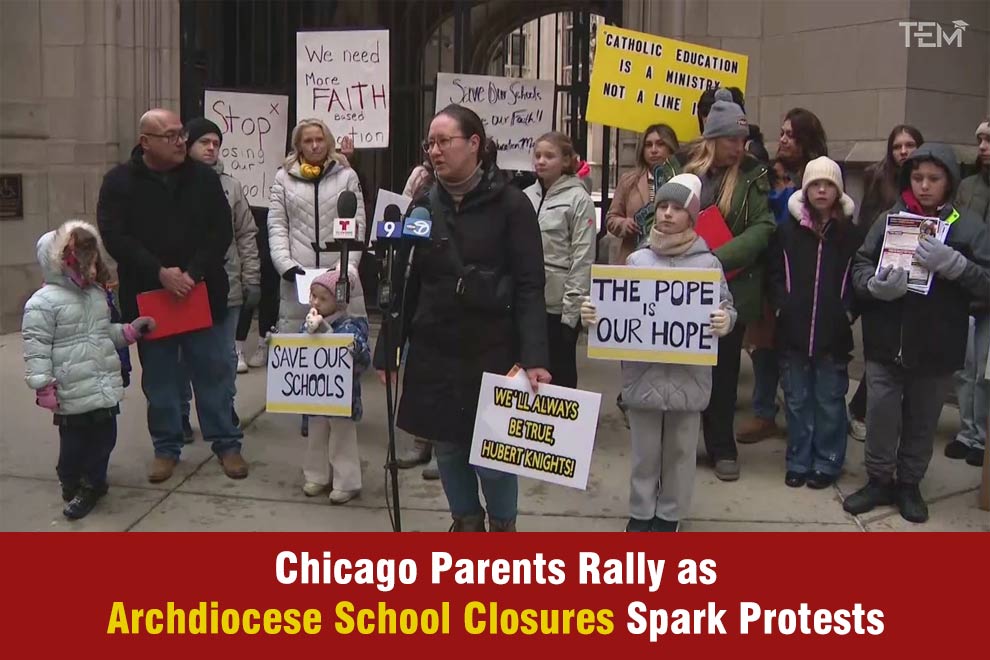
The Archdiocese school closure protests intensified in Chicago this weekend as hundreds of parents, students, and community members gathered at Holy Name Cathedral. The demonstration aims to oppose the planned shutdown of St. Hubert Catholic School and five other campuses across the region.
Families marched during Sunday Mass to appeal directly to Cardinal Blase Cupich, urging church leadership to reconsider decisions tied to declining enrollment and financial instability.
Students carried signs reading “Save Our School” and “Don’t Take Away My Home,” highlighting the emotional weight of the restructuring.
What Triggered the School Closure Decisions
The Archdiocese of Chicago announced plans to close six Catholic schools, citing:
- Sustained enrollment declines over the last decade.
- Rising operational costs and facility maintenance challenges.
- Long-term financial deficits at the parish level.
- Demographic shifts within urban neighborhoods.
While officials argue consolidation is necessary for the system’s survival, parents at St. Hubert Catholic School claim the decision was abrupt, noting that local fundraising efforts had already begun to address immediate financial gaps.
These local financial pressures are often worsened by broader national shifts in U.S. student loan rules and financial frameworks that have forced many educational institutions to tighten their operational models to remain viable.
Inside the Archdiocese School Closure Protests
The demonstrations represent one of the most visible community responses to Catholic school consolidation in recent years.
Key developments include:
- Mass Mobilization: Hundreds are attending the downtown cathedral demonstration
- Active Advocacy: Families organizing fundraising and advocacy campaigns
- Student Impact: Children are speaking publicly about the loss of their “second home.”
- Pressure on Leadership: Parish leaders are facing growing pressure to revisit the decision
The St. Hubert Catholic School Closure Debate
Supporters of St. Hubert have proposed alternative sustainability plans, focusing their concerns on:
- Community Disruption: The loss of a central support system for families.
- Capacity Issues: Limited space in nearby Catholic schools to absorb new students.
- Staff Uncertainty: Transition challenges for long-standing teachers and faculty.
Archdiocese leaders maintain that long-term enrollment projections, rather than short-term cash infusions, remain the primary factor guiding these difficult choices.
A National Enrollment Crisis
The situation in Chicago reflects a broader national trend. Across the United States, faith-based education is grappling with intense competition from charter and public school options, alongside rising tuition sensitivity.
Education analysts note that consolidation has become a standard, albeit painful, strategy to preserve the financial health of remaining campuses.
“Faith-based school closures increasingly intersect with regulatory scrutiny and financial sustainability, making community response a central policy issue,” said an education policy analyst familiar with diocesan restructuring.
This mirrors the restructuring seen in Chicago’s higher education diversity programs, where institutions are reassessing strategies in response to shifting policy signals.
What Happens Next
As the Archdiocese school closure protests continue, several questions remain:
- Will the Archdiocese reconsider specific closures based on community fundraising?
- How will transition plans support affected students during the mid-education cycle?
- Will this trigger a second wave of consolidation in 2027?
For the families involved, the immediate reality is one of uncertainty. The outcome of the St. Hubert debate may signal how future Catholic school consolidation in Chicago and other major U.S. cities will be handled.
FAQs
- Why are Catholic schools closing despite parent fundraising?
Even when short-term funding improves, dioceses often base decisions on multi-year enrollment trends and the rising costs of maintaining aging infrastructure.
- Could protests stop Catholic school closures?
In some cases, community advocacy has led to delays or revised “co-location” plans. However, final decisions typically depend on whether a school can prove long-term enrollment viability.