Reported by The Education Magazine | 3 February 2026
The US–India “Reset” and Its Hidden Education Signal
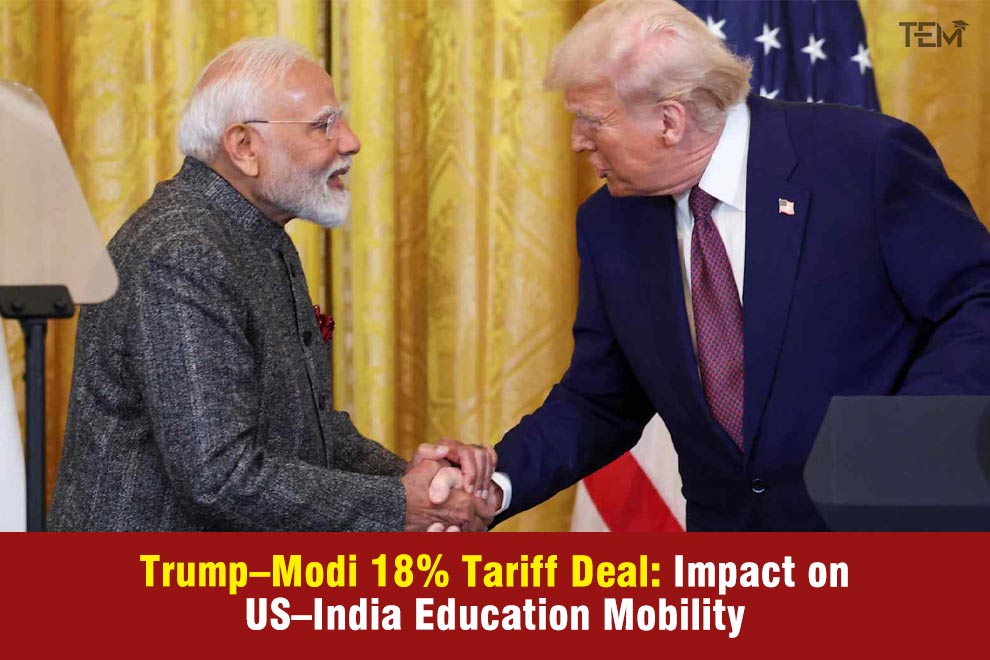
The United States and India have finalized a major trade agreement reducing tariffs on Indian goods to 18%, marking a significant reset in bilateral economic relations under President Donald Trump and Prime Minister Narendra Modi.
While the deal focuses primarily on trade and energy realignment, particularly India’s shift away from Russian energy imports, education experts say the agreement carries important indirect implications for student mobility, especially for Indian students seeking higher education in the US.
Historically, periods of diplomatic easing between Washington and New Delhi have coincided with reduced visa friction and improved approval trends, even in the absence of formal immigration policy changes.
Quick Stats: US–India Education Outlook (2026)
| Metric | Status (as of Feb 3, 2026) |
| US-India Tariff | Reduced to 18% (from 25%+) |
| Indian Enrollment | Down 75% Y-o-Y in 2025 |
| EU Mobility Pact | Signed Jan 27, 2026 |
| Key Risk | F-1 Scrutiny & 221(g) Administrative Processing |
F-1 Visa Scrutiny in 2026: Why Trade Signals Matter
Over the past year, Indian student enrollment in the United States declined by nearly 75%, according to recent IIE Open Doors Snapshot data. Largely due to heightened visa scrutiny, longer processing times, and higher rejection rates for F-1 applicants.
Education analysts note that trade normalization often acts as a soft policy signal, one that influences how immigration rules are interpreted and enforced on the ground.
Indian Student Visas Fell Sharply Under Tighter Reviews
The decline has affected:
- First-time undergraduate applicants
- STEM-focused graduate students
- Students from mid-income families are facing higher financial scrutiny
Universities across the US have reported under-enrolled programs and deferred admissions, particularly from India, which remains one of the country’s largest international student markets.
Expert Perspective: What US Universities Are Seeing
“When diplomatic relationships stabilize, we often see a noticeable softening in discretionary visa reviews,” said a Designated School Official (DSO) at a large public US university.
“Even without formal law changes, the consistency of F-1 approvals for Indian students tends to improve when the broader economic relationship is healthy. We are hopeful this 18% deal is the first step toward a smoother Fall 2026 intake.”
How This Compares Globally: The India–EU Mobility Framework
The education implications of the US–India deal are being closely compared to the India–EU ‘Mother of All Deals’, signed on 27 January 2026, which explicitly included frameworks for:
- Student mobility
- Research collaboration
- Academic exchange through programs like Erasmus+ and Horizon Europe
Unlike the India–EU agreement, which clearly outlines mobility provisions, the US–India trade deal signals a more informal but historically influential pathway. As students weigh their options, the cost of education in Germany continues to serve as a primary comparison point for those looking beyond the US.
Why This Matters for Students and Institutions
For Indian students weighing international study options in 2026, visa predictability and post-study pathways are becoming as important as tuition costs.
For US institutions, the deal may:
- Improve enrollment stability
- Reduce last-minute visa denials
- Restore confidence in the Indian applicant pipeline
Education leaders say that even incremental improvements in visa processing can have outsized effects on enrollment decisions, particularly for high-demand STEM and business programs.
A Strategic Shift With Long-Term Education Impact
Although the tariff agreement is not an education policy on paper, its ripple effects could reshape the US–India education corridor after a period of uncertainty.
If diplomatic alignment continues, experts expect:
- Gradual easing of F-1 visa scrutiny through 2026
- Improved student sentiment toward US universities
- Renewed competition between the US and the EU for Indian talent
For now, universities, students, and policymakers are watching closely, not for policy announcements, but for patterns.
What Happens Next
The trade agreement is expected to move into implementation phases over the coming months. Education stakeholders will be tracking:
- Visa approval trends for Fall 2026
- Changes in processing timelines
- Signals from US consulates in India
Any sustained shift could mark the beginning of a new era for US–India education mobility.
FAQs
1. Does the tariff deal directly change student visa rules?
No. The agreement does not modify visa laws, but experts say diplomatic easing often influences how existing rules are applied.
2. Could Indian student enrollment recover in 2026?
Education officials believe enrollment could rebound if visa approval consistency improves and processing delays ease ahead of the next admission cycle.
Also Read: U.S. Student Loan Update 2026: New Borrowing Caps & RAP Plan Proposed