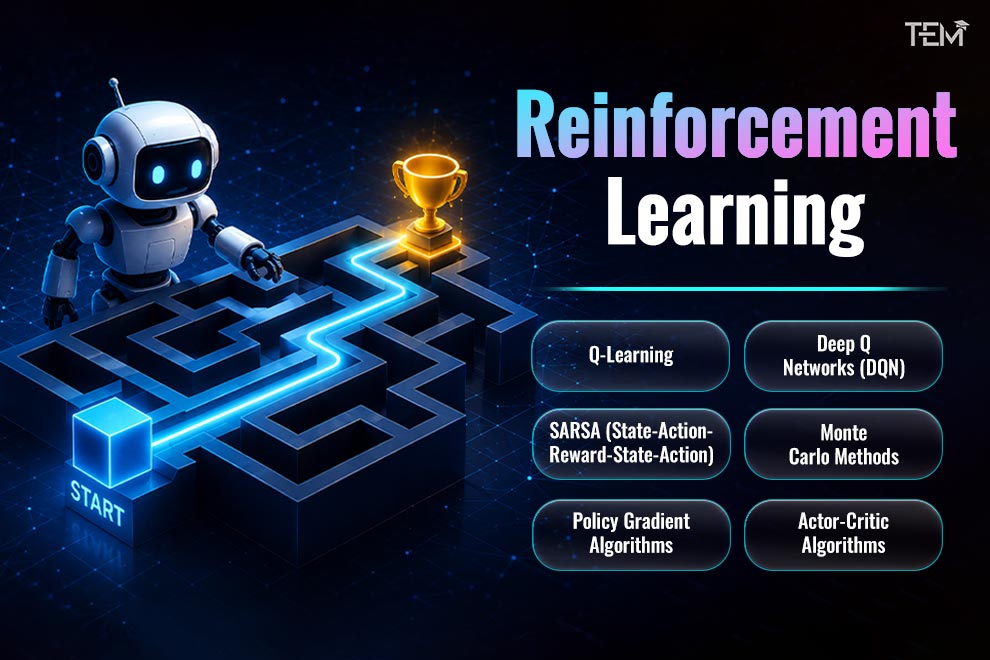
Reinforcement Learning is a branch of machine learning where AI systems learn to make decisions through a process of trial and error. Unlike traditional methods that rely on pre-labeled data, this approach uses a system of rewards and penalties to guide an agent toward a specific goal.
As we move into 2026, the reinforcement learning market is projected to reach over $16 billion, highlighting its role as an essential technology for businesses seeking a competitive edge.
In this guide, you’ll learn how reinforcement learning works, the most important algorithms, real-world applications, advantages, challenges, and future trends transforming AI systems in 2026.
How Reinforcement Learning Works
Reinforcement learning follows a structured learning cycle that allows intelligent systems to optimize decisions continuously. Unlike static programs, adaptive AI systems use this loop to grow smarter through every interaction.
- The AI Agent: The “brain” responsible for making decisions and performing actions. Examples include industrial robots and self-driving vehicles.
- The Environment: The physical or digital space where the agent operates, such as traffic systems or warehouses.
- Actions and Decisions: The agent executes calculated moves, like a robot choosing a path or a car applying brakes.
- Rewards and Penalties: This reward-based learning provides feedback. Success earns rewards, while poor choices receive penalties.
This is often calculated using the Q-learning formula:
$Q(s,a) = Q(s,a) + \alpha [r + \gamma \max Q(s’,a’) – Q(s,a)]$.
- Continuous Optimization: Through repeated feedback loops, the machine learning models gain experience, becoming more accurate and efficient than human-coded instructions.
Types of Reinforcement Learning
Reinforcement learning can be broadly categorized into two main approaches: positive and negative reinforcement. Both methods are essential for training AI agents to handle complex, real-world scenarios by refining how they respond to different environmental stimuli.
1. Positive Reinforcement Learning
Positive reinforcement is a method that encourages intelligent systems to repeat successful actions by providing specific rewards. This approach strengthens a desired behavior by associating it with a positive outcome.
Examples in Modern AI:
- Gaming Agents: AI systems receive points or level-up rewards for winning matches or achieving objectives.
- Recommendation Systems: These models receive positive feedback when a user clicks on a suggested video or product, leading to improved user engagement.
- Robotics AI: Industrial robots are rewarded for completing tasks successfully, such as correctly sorting a package in a warehouse.
Key Advantages:
- Faster Learning: Clear rewards help the system identify the most efficient path to a goal more quickly.
- Optimized Performance: Continuous positive feedback pushes the agent to maximize its efficiency over time.
- Improved AI Decision-Making: The agent builds a robust library of successful strategies.
2. Negative Reinforcement Learning
Negative reinforcement helps machine learning models avoid poor decisions or dangerous behaviors by introducing penalties or negative outcomes. This is particularly important for maintaining safety and operational standards in autonomous AI systems.
Examples in Modern AI:
- Self-Driving Cars: These vehicles receive “penalties” in their learning cycle for getting too close to obstacles or failing to stay in a lane, which helps them avoid collisions.
- Industrial Robotics: Systems are penalized for operational errors that could damage equipment or halt production lines.
- AI Navigation: Navigation engines are penalized for selecting inefficient routes, forcing the agent to correct and find faster paths.
Key Advantages:
- Reduces Mistakes: The system learns which boundaries it must never cross.
- Improves Safety: This is the primary method for training AI to handle high-risk environments where errors are costly.
- Enhances Long-Term Optimization: By filtering out bad choices, the agent focuses its resources on refining only the most effective strategies.
Top Reinforcement Learning Algorithms Explained
To build high-performing autonomous AI systems, developers choose specific reinforcement learning algorithms based on the complexity of the task and the environment. Here is a breakdown of the most influential methods used in 2026.
1. Q-Learning
Q-Learning is a value-based reinforcement learning algorithm that helps AI agents determine the best possible action by calculating the expected utility of a move. It is “model-free,” meaning the AI does not need a map of its environment to start learning.
- How It Works: The algorithm learns by updating “Q-values” based on experience and future potential outcomes.
- Real-World Uses: Commonly used in warehouse automation, robotics navigation, and game strategy optimization.
- Advantages: It is highly adaptable to different environments and effective for optimizing specific decisions.
- Limitations: It can suffer from slower learning in massive environments and has high memory requirements.
2. Deep Q Networks (DQN)
Deep Q Networks represent a significant leap by combining traditional reinforcement learning with neural networks. This allows the AI to handle massive amounts of data that would overwhelm standard algorithms.
- How It Works: The algorithm uses deep learning models to estimate the best actions within large-scale, complex environments.
- Real-World Uses: Powers advanced gaming AI, robotics AI, and autonomous vehicles.
- Advantages: It handles highly complex tasks with improved decision accuracy.
- Limitations: It is computationally expensive and requires large training datasets to be effective.
3. SARSA (State-Action-Reward-State-Action)
SARSA is an “on-policy” algorithm, meaning it learns the value of the policy that the agent is actually carrying out.
- How It Works: It updates decisions using a specific sequence: current state, action taken, reward received, next state, and the next action chosen.
- Real-World Uses: Often found in autonomous navigation and robotics control systems.
- Advantages: Offers a stable learning process and is safer for real-time environments because it accounts for the agent’s current exploration strategy.
- Limitations: It generally has a slower convergence rate and is sensitive to how the agent explores.
4. Monte Carlo Methods
These methods rely on repeated random sampling to obtain numerical results, making them excellent for environments with high uncertainty.
- How It Works: The algorithm evaluates the total outcome only after completing full action sequences, updating its policy based on the final total reward.
- Real-World Uses: Essential for financial trading systems, risk analysis, and strategic simulations.
- Advantages: Very effective for uncertain environments and provides strong long-term optimization.
- Limitations: The training process is slow because it requires a high number of full simulations.
5. Policy Gradient Algorithms
Unlike value-based methods, Policy Gradient algorithms focus directly on optimizing the strategy (policy) itself rather than calculating the value of every single action.
- How They Work: The algorithm adjusts the policy continuously to maximize rewards using gradient optimization techniques.
- Real-World Uses: Dominant in robotics learning and autonomous systems.
- Advantages: They excel in “continuous action spaces,” such as the precise, fluid movements required for robotics.
- Limitations: Training can be unstable and requires significant computational power.
6. Actor-Critic Algorithms
This approach combines the best of both worlds: value-based learning and policy optimization.
- How They Work: The “actor” proposes an action, while the “critic” evaluates that action and provides feedback to refine the next move.
- Real-World Uses: High-end applications like self-driving cars and intelligent AI automation.
- Advantages: Leads to faster learning, improved stability, and is highly effective for large-scale environments.
- Limitations: These are complex to implement and have a high computational cost.
Real-World Applications of Reinforcement Learning
Reinforcement learning is no longer a theoretical concept; it is actively driving innovation across various industries in 2026.
1. Self-Driving Cars and Navigation
Autonomous vehicles use deep reinforcement learning to master complex urban environments.
- Real-World Example: Waymo and Tesla use these models to refine steering and braking. Recently, Tesla’s FSD v12 transitioned to an “end-to-end” neural network, learning to drive by watching millions of human video clips rather than following rigid code.
- Impact: Vehicles now adapt to unpredictable human behavior and construction zones in real-time, significantly improving passenger safety.
2. Robotics and Industrial Automation
In manufacturing, robotics AI is shifting from repetitive loops to adaptive, intelligent behavior.
- Real-World Example: Amazon’s Proteus robots use trial and error learning to navigate busy fulfillment centers safely alongside humans.
- Impact: These intelligent systems optimize the flow of goods and perform predictive maintenance, identifying mechanical wear before a breakdown occurs.
3. AI in Gaming and Strategy
Gaming serves as a high-speed sandbox for perfecting reinforcement learning algorithms.
- Real-World Example: Beyond DeepMind’s AlphaGo, Sony’s Gran Turismo Sophy recently learned to outmaneuver the world’s best virtual drivers by mastering aggressive yet fair racing lines.
- Impact: These systems develop winning strategies that humans often overlook, proving that AI can master tactical reasoning.
4. Personalized Recommendation Systems
Streaming and social platforms use reward-based learning to keep you engaged by treating your clicks as “rewards.”
- Real-World Example: Netflix and Spotify use these models to refresh your feed. Every time you finish a song or a series, the system receives a “reward” that sharpens its understanding of your taste.
- Impact: This creates a highly personalized digital environment, increasing user retention and content discovery.
5. Healthcare and Drug Discovery
Intelligent systems are finding medical patterns too complex for human researchers to spot quickly.
- Real-World Example: Researchers are currently using reinforcement learning to discover new antibiotics. The AI simulates how billions of chemical compounds interact with bacteria to find the most effective combinations.
- Impact: This speeds up drug discovery from years to months and assists surgeons with high-precision medical robotics.
6. AI in Education
EdTech platforms are moving away from “one-size-fits-all” teaching through adaptive AI systems.
- Real-World Example: Platforms like Duolingo and Khan Academy use these algorithms to adjust lesson difficulty based on a student’s performance.
- Impact: This optimizes student engagement by providing real-time feedback and personalized learning pathways that adapt to every individual learner.
By integrating reinforcement learning in AI, these industries are creating systems that get smarter and more efficient every single day.
Future Trends in Reinforcement Learning
As we head toward 2026, reinforcement learning is driving the shift from simple automation to truly autonomous AI systems. Unlike standard chatbots, modern AI agents are capable of independent decision-making and executing multi-step tasks in dynamic environments.
Key trends shaping the future include:
- Generative AI Integration: Systems like those from OpenAI use Reinforcement Learning from Human Feedback (RLHF) to improve reasoning and reduce errors.
- Next-Gen Robotics: Utilizing NVIDIA hardware, robots are achieving total autonomy in precision manufacturing, smart logistics, and autonomous movement.
- Advanced AI Automation: Businesses are integrating reinforcement learning in AI to optimize supply chains, enhance predictive analytics, and automate complex customer support.
- Human-Level Reasoning: Researchers are building intelligent systems capable of replicating human-like decision-making for breakthroughs in scientific research and strategic planning.
These adaptive AI systems will continue to evolve, transforming how industries handle uncertainty and complex problem-solving.
Conclusion
These real-world examples prove that reinforcement learning is the secret sauce behind the world’s most successful intelligent systems. Whether it is a robot picking up a package or an AI writing a poem, the ability to learn from mistakes is what separates basic software from true AI decision-making.
As these models become more advanced, we can expect even more breakthroughs in healthcare, climate science, and personal productivity.
FAQs
- What are examples of reinforcement learning?
Reinforcement learning examples include self-driving cars, robotics AI, gaming agents, recommendation systems, and autonomous automation systems.
- How does Tesla use reinforcement learning?
Tesla uses reinforcement learning (RL) primarily in the planning and decision-making stages of its Full Self-Driving (FSD) system. By version 12, Tesla transitioned to an “end-to-end” neural network that translates raw video data (photons) directly into driving commands like steering and braking.
- Is ChatGPT reinforcement learning?
Yes, ChatGPT is trained using reinforcement learning, specifically a technique called Reinforcement Learning from Human Feedback (RLHF).
- What is the difference between reinforcement learning and supervised learning?
Supervised learning uses labeled datasets, while reinforcement learning learns through rewards, actions, and trial-and-error optimization.