As businesses focus more on quality, efficiency, and data-driven decisions, Six Sigma certifications can help professionals build practical skills and improve their career opportunities.
Whether you’re starting your career in quality management or looking to move into leadership, choosing the right credential can help you develop practical problem-solving skills and stand out in today’s competitive job market. This guide breaks down the leading options available today, helping you choose the path that matches your goals.
Which Six Sigma Certification Is Best?
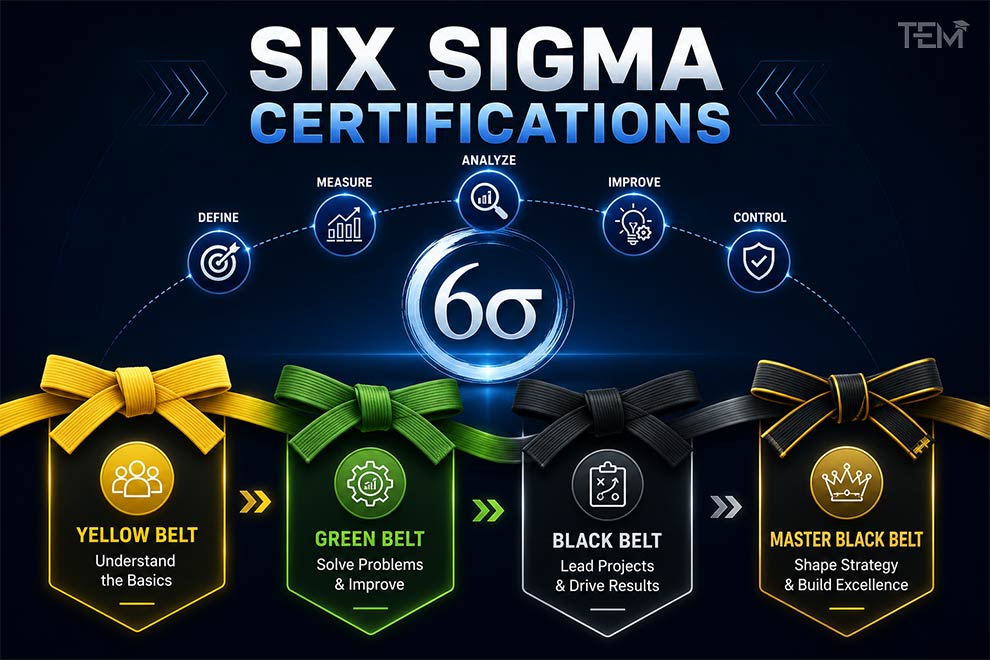
The best Six Sigma certification depends on your experience and career goals. The Yellow Belt is ideal for beginners, the Green Belt for project contributors, the Black Belt for process improvement leaders, and the Master Black Belt for senior quality specialists and organizational strategists.
Key Takeaways
- Skill Validation: These credentials validate your process improvement skills and data-driven problem-solving abilities.
- Choose Wisely: Select your belt level based on your current professional experience and daily job responsibilities.
- High Demand: Green Belt and Black Belt qualifications remain the most sought-after credentials by employers across industries.
- Real-World Value: Practical project experience is often just as valuable as the formal qualification itself.
What Is Six Sigma?
At its core, Six Sigma is a disciplined, data-driven approach aimed at eliminating defects, reducing workflow variation, and making operations run more smoothly.
Think of it as a structured toolkit to help organizations run as close to perfect as possible. Statistically, operating at a “Six Sigma” level means an operation produces fewer than 3.4 defects per million opportunities. It shifts a company’s culture from guessing to using objective data.
The DMAIC Methodology
Most business efficiency initiatives rely on the DMAIC framework, which serves as a step-by-step roadmap for solving problems:
- Define: Clearly state the problem, the project goals, and what the customer needs.
- Measure: Collect baseline data on how the current process is performing.
- Analyze: Look closely at the data to find the root cause of errors or inefficiencies.
- Improve: Develop, test, and implement practical solutions to fix the problem.
- Control: Put tracking tools in place to ensure the improvements last over time.
Industries Using These Tools
While it started on the manufacturing factory floor, this methodology has evolved into a flexible business strategy used across almost every sector:
- Healthcare: To lower patient wait times, reduce diagnostic errors, and streamline emergency room operations.
- Information Technology (IT): To eliminate software bugs, speed up deployment cycles, and improve server uptime.
- Finance & Banking: To accelerate loan approvals, minimize transaction errors, and make compliance audits smoother.
- Logistics & Retail: To optimize supply chains, reduce warehouse waste, and improve order accuracy.
Is Six Sigma Still Worth It in 2026?
As businesses navigate a highly digital workplace, many professionals wonder if classic quality tools are still relevant. The answer is a resounding yes. The rise of modern digital tools has actually made this toolkit more powerful because companies now have access to better data.
High-intent job postings across multiple fields consistently prioritize specialists holding a verified Project Management Certification or a process improvement credential:
- Manufacturing: Modern smart factories rely on Lean Manufacturing principles to sync digital tools with clean, human workflows.
- Healthcare: Hospital networks use quality management systems to balance strict regulations with patient care.
- Information Technology: Tech environments frequently blend continuous improvement tools with Agile frameworks to ensure high-quality software releases.
- Logistics: Companies facing global disruptions use these methods for supply chain optimization.
- Finance: Financial institutions apply data analysis to remove friction points from the customer onboarding journey.
Ultimately, any organization focusing on quality, business efficiency, and continuous improvement requires trained talent to interpret data and champion execution.
Comprehensive Guide to Every Certification Belt
Earning a qualification requires picking the level that matches your current career stage. Here is a detailed, realistic look at the four primary tiers.
1. Six Sigma Yellow Belt
The introductory tier is for individuals new to business efficiency concepts.
- Overview: A basic-level credential that provides an overview of the terminology, structure, and foundational tools of process improvement without complex math.
- Best For: Entry-level team members, students, and support staff who want to contribute effectively to project teams.
- Unique Insight: This belt is the perfect “testing ground.” It lets you see if you enjoy data-driven problem-solving before investing significant time and money into higher-level programs.
- Eligibility: No prior experience or prerequisites required.
- Skills Learned: Foundational DMAIC methodology, basic data collection, and process mapping.
- Typical Responsibilities: Helping higher-level belts gather data, mapping localized workflows, and participating as an active team member.
- Who Should Avoid This Belt: Avoid this level if you already have a few years of project management experience or an engineering background; you are likely ready to start directly with a Green Belt.
- Career Opportunities: Operations Coordinator, Quality Assurance Associate, Business Analyst.
- Salary Potential: Serves as a great resume builder to help entry-level candidates stand out during job hunts.
- Pros: Low cost and low time commitment; helps you speak the same language as company leadership.
- Challenges: Does not qualify you to lead large, independent projects.
2. Six Sigma Green Belt
The standard intermediate benchmark for project managers and hands-on problem solvers.
- Overview: A highly practical qualification that equips you to lead localized efficiency projects and manage data-driven team initiatives.
- Best For: Project managers, business analysts, engineers, and department heads looking to drive measurable improvements.
- Unique Insight: This certification is often the most popular choice because it offers an excellent balance between practical skills and career advancement without requiring senior leadership experience.
- Eligibility: Varies by provider, but typically requires 1 to 3 years of work experience. Some providers require a completed real-world project.
- Skills Learned: Root cause analysis, statistical process control, lean principles, and team leadership basics.
- Typical Responsibilities: Leading medium-sized improvement projects, analyzing departmental data, and supporting Black Belts on larger company-wide changes.
- Who Should Avoid This Belt: Avoid this if you have no professional work experience at all, as it can be difficult to grasp the operational concepts without a real-world context.
- Career Opportunities: Process Engineer, Continuous Improvement Specialist, Operations Management roles.
- Salary Potential: Strong mid-career salary structures with clear upward mobility.
- Pros: Highly valued by corporate recruiters; provides immediately usable skills that show visible workplace results.
- Challenges: Requires balancing demanding data analysis and project execution alongside your standard daily work duties.
3. Six Sigma Black Belt
The advanced leadership credential for full-time change agents.
- Overview: A prestigious credential designed for individuals who will oversee large, cross-functional organizational changes and manage dedicated improvement teams.
- Best For: Full-time quality specialists, change managers, and operational consultants.
- Unique Insight: A Black Belt changes your role from someone who helps fix problems to someone who designs the strategy to fix them. It positions you as an internal consultant within your organization.
- Eligibility: Requires a deep understanding of the course materials, typically 3+ years of experience, and proof of leading successful, high-impact projects.
- Skills Learned: Advanced statistical modeling, linear regression, change management, and operational planning.
- Who Should Avoid This Belt: Not ideal if you’re just beginning your career or have limited experience with data analysis and process improvement.
- Career Opportunities: Senior Process Excellence Manager, Director of Quality Management, Senior Operations Consultant.
- Salary Potential: Upper-tier professional compensation, frequently breaking into leadership brackets.
- Pros: High industry prestige, extensive leadership authority, and a direct path to executive positions.
- Challenges: Requires an intensive study dedication and the ability to handle corporate resistance to change.
4. Six Sigma Master Black Belt
The absolute peak of process improvement training and operational leadership.
- Overview: The highest tier of expertise, focusing heavily on business strategy, operational planning, and building a continuous improvement culture across the whole company.
- Best For: Elite quality leaders, senior directors, and internal training program directors.
- Unique Insight: At this level, you rarely run individual projects yourself. Instead, your primary job is teaching, mentoring, and ensuring that the company’s operational goals align with its financial targets.
- Eligibility: Must hold a valid Black Belt credential, possess 4 to 5+ years of active leadership experience, and clear a rigorous portfolio review showing documented financial savings.
- Skills Learned: Executive strategy design, resource planning, advanced training methods, and high-level business strategy.
- Typical Responsibilities: Advising executives on strategic direction, overseeing the corporate project office, and coaching Black Belts and Green Belts.
- Who Should Avoid This Belt: Avoid this unless you plan to make continuous improvement the primary focus of your entire career. It is overkill for general managers.
- Career Opportunities: VP of Operational Excellence, Chief Quality Officer, Enterprise Transformation Director.
- Salary Potential: Executive-level premium compensation with substantial performance bonuses.
- Pros: Elite professional recognition and deep influence over an organization’s future.
- Challenges: High barrier to entry and scarce, highly competitive certification paths.
Certification Comparison Table
| Belt Level | Best For | Experience Required | Material Difficulty | Typical Corporate Roles |
| Yellow Belt | Beginners & Project Support | None | Easy / Introductory | Operations Associate, Project Team Member |
| Green Belt | Departmental Leaders & Engineers | 1–3 Years | Moderate | Process Engineer, Quality Specialist, Project Manager |
| Black Belt | Full-Time Project Leaders | 3+ Years + Projects | Advanced / Rigorous | Senior Process Excellence Manager, Consultant |
| Master Black Belt | Executive Strategists | 5+ Years as Black Belt | Expert / Elite | VP of Operational Excellence, Chief Quality Officer |
Career Stage Guide: Which Belt Should You Choose?
Selecting your path can be simplified by identifying where you currently stand in your professional lifecycle:
[ Students & Recent Graduates ] ──> Choose: Yellow Belt
│
▼
[ Early Career & Project Staff ] ──> Choose: Green Belt
│
▼
[ Experienced Managers & Engineers ] ──> Choose: Black Belt
│
▼
[ Senior Directors & Executives ] ──> Choose: Master Black Belt
Cost Comparison, Durations, and Renewals
When evaluating a training program, pricing and time commitments are critical factors. Fees vary significantly depending on the certifying body you choose, such as the American Society for Quality (ASQ), the International Association for Six Sigma Certification (IASSC), or the Council for Six Sigma Certification (CSSC).
Note: Always verify final pricing, specific prerequisites, and exam criteria on the official provider’s website before enrolling.
- Yellow Belt: Costs typically range from $200 to $450. Training can generally be completed in 1 to 2 weeks of self-paced study. Most providers grant lifetime validity.
- Green Belt: Costs range between $400 to $800+ for the exam and basic preparation. Expect to dedicate 4 to 8 weeks of active preparation. Some providers require renewal every 3 years.
- Black Belt: Costs range from $600 to $2,000+, depending on whether instructor-led coaching is included. Preparation demands 2 to 4 months of deep study. Often requires regular recertification.
- Master Black Belt: The most expensive tier, ranging from $1,500 to $4,000+, due to the intensive portfolio review and specialized testing metrics. The timeline spans 3 to 6+ months.
Tips to Prepare for the Certification
- Choose the right belt level: Don’t skip ahead too fast. Ensure your current real-world experience matches the belt you choose.
- Study the DMAIC framework inside out: This five-step lifecycle is the backbone of almost every exam. Understand how the tools apply to each phase.
- Practice with sample questions: Testing formats can be heavy on situational analysis. Use practice tests to get used to the wording.
- Apply concepts to real projects: Try using process maps or root cause analysis tools at your current job. Practical application makes studying much easier.
- Use official learning resources: Stick to study guides provided directly by your chosen certification body (like ASQ or IASSC) to avoid outdated study materials.
Understanding the Real Salary Impact
While a professional credential can strengthen your qualifications for leadership roles, it is critical to maintain realistic expectations. Earning a credential does not automatically trigger an overnight promotion or an instant raise.
Salary varies depending on your industry, experience, location, employer, and job responsibilities. Instead of treating a belt as a golden ticket, view it as an accelerator that gives you the analytical capability to unlock higher-tier roles, such as specialized operations leadership or lucrative data-focused business tracks like Data Analytics Careers.
Skills You Learn Across the Journey
Investing your time into a structured process improvement program builds an extensive technical and soft skill profile:
- DMAIC Implementation: Master a repeatable framework to attack any corporate inefficiency systematically.
- Root Cause Analysis: Learn to look past superficial symptoms using tools like the 5 Whys and Fishbone diagrams.
- Statistical Process Control: Utilize control charts to monitor process stability and catch mistakes early.
- Lean Principles: Eliminate common forms of waste to speed up cycle times and save resources.
- Process Mapping: Visualize intricate workflows to rapidly locate bottlenecks and operational redundancies.
- Data-Driven Decision Making: Move away from emotional conclusions by leveraging core data analytics tools.
- Change Management: Develop the communication skills needed to rally diverse teams around process updates and overcome workplace friction.
How AI Is Changing Six Sigma
The intersection of Artificial Intelligence (AI) and operational excellence is rewriting how quality management occurs. Classic statistics are now being supercharged by machine learning models.
- Predictive Analytics: For example, manufacturers now use AI to predict equipment failures before they happen, allowing teams to prevent defects instead of reacting after problems occur.
- Automated Quality Monitoring: Vision-based AI tools and sensors continuously stream live metrics from production lines, automatically flagging errors without human intervention.
- AI-Assisted Root Cause Analysis: Advanced data parsing engines allow analysts to scan millions of rows of data, identifying deeply buried correlations in minutes.
- Intelligent Process Automation: Continuous improvement designs how a workflow should run cleanly, while AI-driven tools execute the repetitive components flawlessly. This is an exciting landscape for anyone exploring modern AI Careers.
Common Mistakes to Avoid When Getting Certified
- Choosing the Wrong Belt Level: Jumping straight into an advanced Black Belt program without any foundational business or data analysis experience often leads to academic burnout.
- Ignoring Project Experience: Memorizing a handbook to pass a multiple-choice test is not enough. True value comes from applying the tools to real workplace challenges.
- Selecting an Unrecognized Provider: Ensure your certifying body is universally recognized across global industries to preserve your resume value.
- Expecting the Certificate to Do All the Work: Assuming a credential alone guarantees a promotion without showing a proactive track record of leadership and teamwork.
- Letting Your Tools Go Cold: Failing to actively use software, process maps, or lean practices post-certification will quickly erode your technical sharpness.
Top 2026 Industry Trends in Process Improvement
- AI-Driven Quality Management: The blend of automated machine learning with classic DMAIC foundations is becoming a standard requirement for technical roles.
- Smart Manufacturing Mastery: Organizations are prioritizing specialists who can apply lean principles specifically to software-integrated, internet-connected workspaces.
- Lean Digital Transformation: Removing waste from virtual digital processes, cloud workflows, and software deployment pipelines rather than just physical factories.
- Resilient Supply Chain Optimization: Re-architecting logistics networks using data-driven risk models to protect against disruptions, making it an excellent focus area for those with Supply Chain Management Certifications.
“Six Sigma certification delivers the greatest value when professionals apply its tools to real workplace challenges. Employers increasingly look for measurable improvements and project experience alongside formal credentials.”
Final Thoughts
The right Six Sigma certification depends on your current experience and long-term goals. Focus on building practical skills alongside your certification to maximize your career growth and bring genuine, measurable efficiency to your organization.
FAQ
- Which Six Sigma certification is best?
The ideal option depends on your career stage. For general project managers, a Green Belt offers the best balance of depth, time commitment, and employer demand. For dedicated quality specialists, a Black Belt stands out as the premium industry standard.
- Is Six Sigma worth it in 2026?
Yes. As industries scale up their investments into automation and big data, the demand for structured thinkers who know how to parse data, eliminate waste, and optimize workflows remains incredibly high.
- Which Six Sigma belt pays the most?
The Master Black Belt yields the highest compensation potential, given its senior nature and focus on company-wide business strategy. Among non-executive tracks, the Black Belt commands a substantial premium.
- Can I learn Six Sigma without experience?
Yes. You can easily enter the field by pursuing a Yellow Belt program. These foundational paths do not require prior technical or statistical experience and serve as an excellent entry point.