Look, everyone’s using AI to write now. That’s just… the reality. But here’s the thing that most people don’t talk about enough: readers can tell. They actually can tell when something was written by a real person versus an algorithm.
So what if you didn’t? What if you just committed to writing everything yourself?
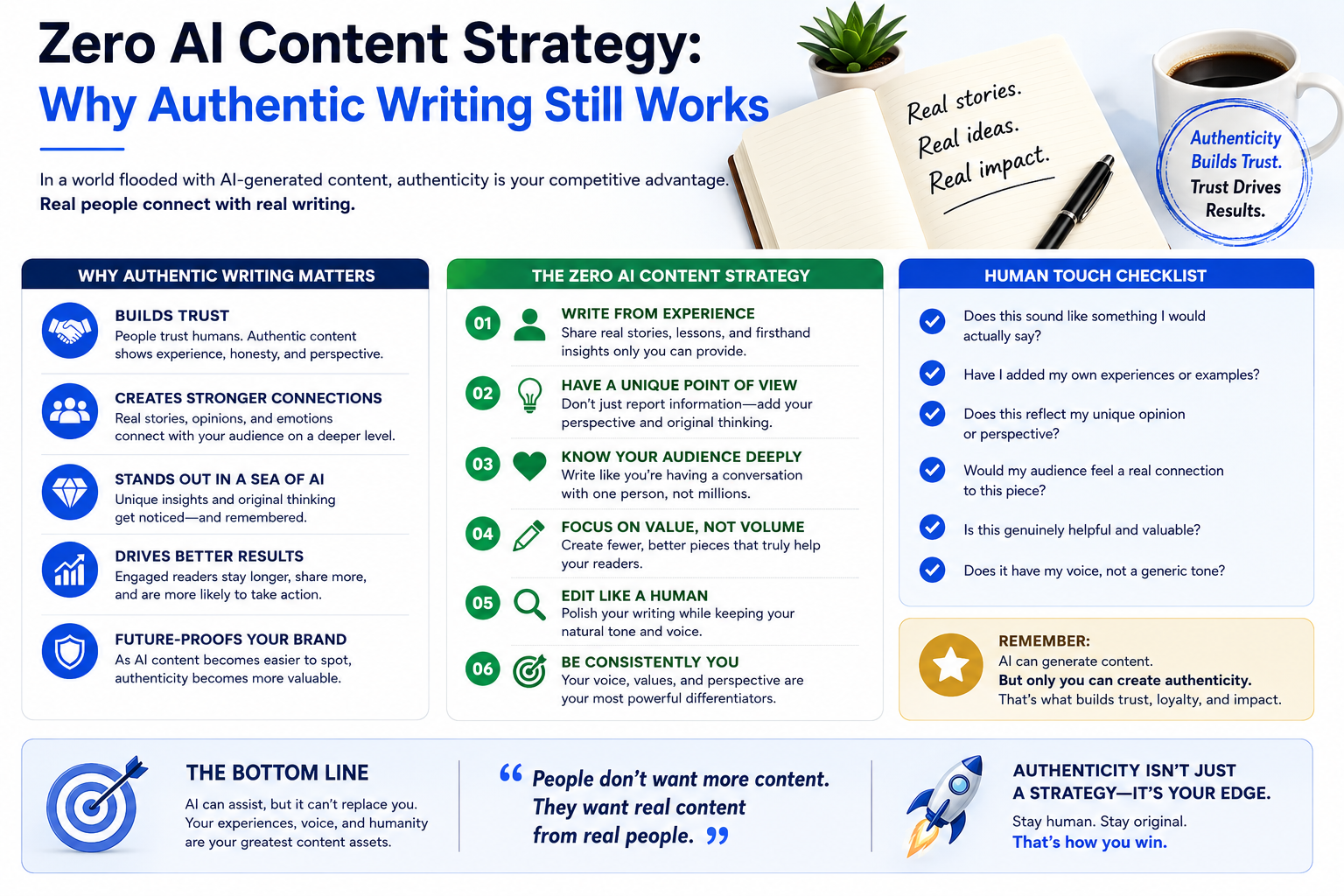
That’s basically what a zero AI content strategy is. It’s not revolutionary. It’s just… You write your own content. Nobody else, nothing else. Just you, your keyboard, and actual thinking.
How People Spot AI Writing
The stuff that AI generates? It has this weird consistency to it that human writing doesn’t naturally have. Like, sentence length. AI tends to keep things roughly the same length throughout. Short sentence, medium sentence, long sentence, repeat. Real writers don’t do that. We’ll write a four-word sentence. Then somehow the next one becomes this long wandering thing about something we’re trying to explain. Then back to short. We’re all over the place.
Also AI picks really safe words. Common words. Nothing weird or unexpected. Everything lands smoothly. But when people actually write, they stumble sometimes. They use odd phrasing. They repeat words by accident. They change their mind mid-paragraph and don’t bother editing it out.
Teachers see this constantly in student essays. You read five papers, four sound robotic, one actually sounds like a teenager’s voice. You know which one’s real.
Search engines are catching on to this too. Google literally cares about E-E-A-T now:
Experience. Expertise. Authority. Trust.
And AI can’t really deliver on the experience part. It can remix information. It can’t actually know something from doing it.
Why It Actually Ranks Better
Here’s what happens with zero AI content that doesn’t happen with AI-generated stuff:
Your article from two years ago? Still getting traffic. Still getting shared. Because it’s not just keyword-matched filler. You actually said something real.
AI-generated content ranks initially because the keyword targeting works. Then it fades. Fast. Because there’s nothing underneath it. No actual insight. No perspective that didn’t already exist online three times over.
But an article where you actually had something to say? Where you brought experience or a unique angle? That compounds. It gets better over time. Older content attracts backlinks. People cite it. It becomes part of the conversation.
Also you’re not competing on volume. Everyone’s drowning in AI content now. Publishers are flooding the internet with it. So when readers find something that was actually written by a human who thinks? They notice. They engage more. They come back.
The Real Problems (Because There Are Some)
Writing everything yourself takes forever. An article that AI pumps out in 15 minutes takes me 4-6 hours. That’s including research, actual writing, multiple edits, fact-checking. It’s a lot.
And if you’re trying to publish frequently? Weekly, even? You’ll burn out. I’ve seen it happen. Really good writers quit because they couldn’t sustain that pace while maintaining quality.
Most publishers who do this well publish maybe once, twice a week. Not daily. They’d rather have something actually good than something that just exists.
You also need to actually research. Not skim abstracts. Read the studies. Talk to people in your field. Verify your claims against multiple sources. It’s more work. But it’s the only way you end up with something credible.
How to Actually Do This
Start with what you know
This is foundational. Write about stuff you’ve actually experienced or figured out. A teacher writing about classroom management after 15 years in classrooms. A marketer writing about campaigns they actually ran with real data. That’s your advantage. AI doesn’t have that.
Do actual research
Find primary sources. Read them. Look for angles nobody’s covered yet. This part is where you actually create something new instead of recycling what’s already online everywhere.
Write the whole thing badly first
Don’t try to make it perfect on the first draft. Get everything down. Let it be messy. Then you can fix it.
Edit what you wrote
Read through it. Cut stuff that doesn’t matter. Make the weak arguments stronger. Add examples. Rearrange things if they’re in the wrong order. This is where the actual thinking happens.
Check your facts before publishing
Make sure everything you said is actually true. Verify your sources. If you’re citing data, confirm it’s current and accurate. You’re staking your credibility on this.
Why This Makes Business Sense
Okay so the obvious one: long-term SEO value. But also—no legal headaches. You wrote it, so there’s no copyright questions or weird plagiarism issues with random content you never even knew existed.
Reader loyalty. People who recognize that you actually write your own stuff come back. They trust you. And they’re more likely to actually convert or take whatever action you want them to take.
You’re also not competing the same way everyone else is. They’re all trying to out-volume each other with AI. You’re saying “I actually thought about this and wrote it myself.” That’s differentiating when everything else sounds the same.
When This Actually Makes Sense
Educational content? Absolutely. You want accuracy. Thought leadership? Yeah, definitely. Expert advice? Obviously. Brand voice stuff where personality actually matters?
You don’t need this for product descriptions or routine social media stuff. That’s fine with AI.
But anything meant to teach people something? Anything asking for their trust? That’s where you want real human writing.
The Simple Reality
Everyone’s drowning in AI content now. It’s everywhere. But readers are exhausted by it. They can feel the difference between something real and something generated.
A zero AI strategy isn’t about being a purist. It’s just recognizing: what actually works right now is writing that shows you’ve actually thought about something. That you have perspective. That you know what you’re talking about.
Also Read: How to Choose the Right Executive Resume Writer for Your Career Level