The Education Magazine
October 21, 2026
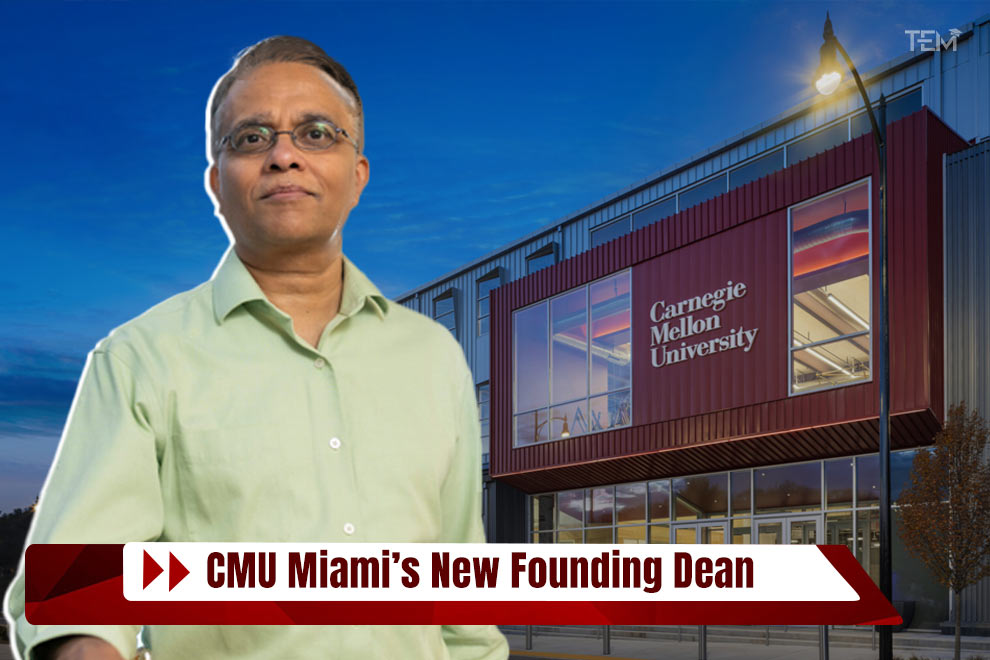
Carnegie Mellon University has appointed Computer Scientist and Entrepreneur Jignesh Patel as CMU Miami’s new Founding Dean and Vice President. Announced on October 20, 2026, the appointment tasks Patel with shaping CMU Miami’s academic direction, recruiting faculty and students, and forging public- and private-sector partnerships.
The CMU campus is planned for Miami’s Wynwood neighbourhood. Carnegie Mellon aims to pursue an academic model that connects diverse disciplines and focuses research on major societal challenges, not just traditional academic divisions.
Who Is CMU Miami’s new Founding Dean Jignesh Patel?
CMU Miami’s new Founding Dean and Vice President, Jignesh Patel, is a computer scientist, educator, and entrepreneur whose work spans data systems, computing education, and technology innovation. Jignesh is currently a faculty member in Carnegie Mellon’s Kenneth C. Griffin School of Computer Science, where he served as interim head of its Computer Science Department from 2025.
Jignesh joined Carnegie Mellon in 2023 following academic appointments at the University of Wisconsin-Madison and the University of Michigan. He received his bachelor’s degree from the Indian Institute of Technology (BHU), Varanasi, and master’s and doctoral degrees in computer science from the University of Wisconsin-Madison.
Jignesh Patel’s research includes developing scalable algorithms for data systems and natural-language interfaces that enable people to analyse data. Patel has an established record in entrepreneurship, co-founding four companies that were subsequently acquired. One of his companies, Locomatix, was acquired by Twitter in 2013.
At Carnegie Mellon, Jignesh Patel, the new Founding Dean and Vice President of CMU Miami, has contributed to undergraduate computing education, including advancing foundational problem-solving skills and responsible use of artificial intelligence. His extensive experience across research, teaching, and business will shape his leadership of the new campus.
What is the Role of Jignesh Patel as CMU Miami’s new Founding Dean and Vice President?
Jignesh Patel will shape CMU Miami’s academic mission, recruit faculty and students, and forge partnerships that connect research to practice as CMU Miami’s new Founding Dean.
Carnegie Mellon President Farnam Jahanian remarked on Patel’s role in shaping CMU Miami’s academic mission and research priorities as he oversaw the campus’s early planning. Jahanian highlighted his experience as a scholar, educator, and entrepreneur who understands how to translate research to practice.
Jignesh Patel, the new Founding Dean of CMU Miami, noted that the new campus presents an opportunity to begin with the problems facing society and identify ways to address them. He stressed the importance of connecting foundational research to its practical implementation.
Jignesh Patel’s appointment as Founding Dean is a boon to Carnegie Mellon University, which will have a leader with a proven record in both academic research and entrepreneurship as it seeks to build a new educational environment in Miami.
What Are CMU Miami’s Four Research Priorities?
Carnegie Mellon will pursue a set of four major societal challenges as a basis for CMU Miami’s initial research activities. The CMU university will assemble multidisciplinary teams to tackle problems that require more than one area of expertise.
The four CMU Miami research priorities are:
- Human health and biological discovery: Research into healthy ageing, personalised treatments, biological systems, and technologies that could enhance human function.
- National security and strategic capabilities: Work involving national defence, cybersecurity, robotics, autonomous systems, and emerging capabilities in space.
- Energy and climate resilience: Research into reliable energy, resilient electricity grids, climate forecasting, and responses to environmental challenges.
- Advanced manufacturing and industrial transformation: Work involving advanced materials, robotics, supply chains, and industrial innovation.
The interdisciplinary education model will build Carnegie Mellon’s strengths in computing, artificial intelligence, robotics, and machine learning, and science, engineering, business, policy, design, arts, and humanities.
Carnegie Mellon University aims to connect research findings to practice. However, the public information reviewed has not yet fully outlined detailed degree lists, course requirements, and admissions arrangements.
How Will Carnegie Mellon Fund Its Miami Campus?
The Carnegie Mellon Miami campus is backed by a philanthropic commitment of more than $3 billion from Ken Griffin, founder and CEO of Citadel and founder of Griffin Catalyst. The commitment includes $2 billion for CMU Miami and $1 billion for Carnegie Mellon’s Pittsburgh campus.
The funding from Ken Griffin supports Carnegie Mellon University’s pursuit to establish a campus focused on interdisciplinary education, research, and applied problem-solving. Its location in Wynwood places it within one of Miami’s noted arts and creative districts.
Carnegie Mellon plans to begin enrolling students at CMU Miami in 2028, contingent upon the required regulatory approvals being granted.
What Happens Next for CMU Miami?
The hiring of CMU Miami’s new Founding Dean and Vice President, Jignesh Patel, represents an important milestone in Carnegie Mellon’s plans for its Miami campus. Patel will help advance the university’s academic vision into research priorities, faculty recruitment, partnerships, and learning opportunities.
Carnegie Mellon has yet to reveal CMU Miami’s degree offerings, tuition fees, financial aid provisions, admission requirements, or application deadlines. These will be vital for prospective students evaluating the campus’s academic opportunities and preparing for its planned 2028 enrolment.
As CMU Miami’s opening planning progresses, the campus’s programme announcements and progress towards regulatory approval will provide greater insight into Carnegie Mellon’s intentions to connect education, research, and solving real-world problems in Miami.