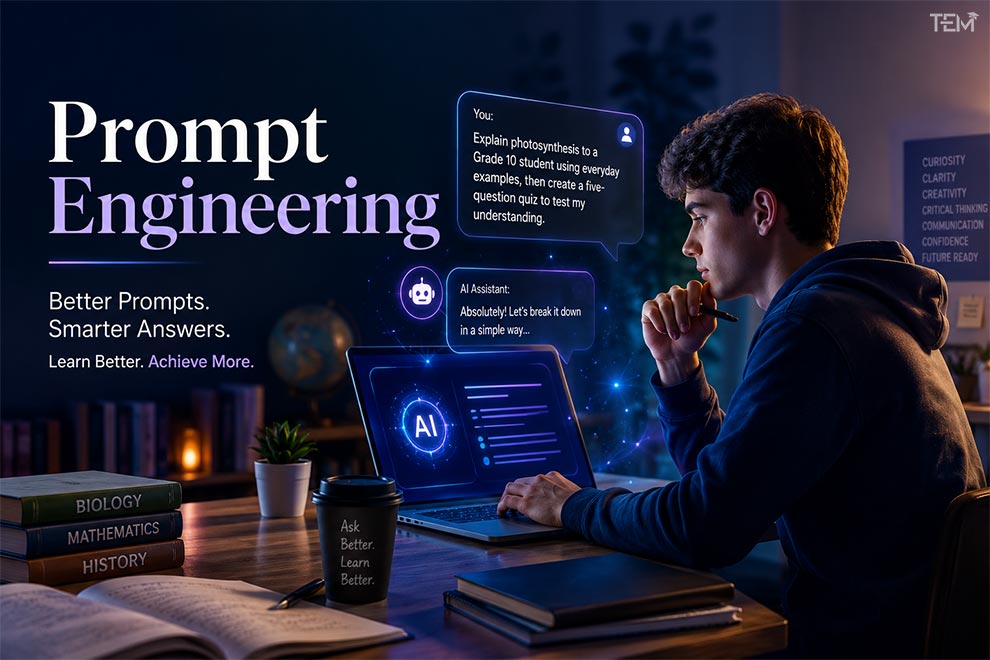
Sarah and Alex are preparing for the same biology exam. Sarah asks an AI chatbot, “Explain photosynthesis.” Alex asks, “Explain photosynthesis to a Grade 10 student using everyday examples, then create a five-question quiz to test my understanding.” Both students use the same AI tool, but Alex receives a far more useful answer. The difference isn’t intelligence; it is knowing how to ask better questions. AI is becoming a major part of education today. Better inputs produce higher-quality explanations.
This guide will teach students how to communicate effectively with AI by mastering prompt engineering to beat competitors in the classroom.
What Is Prompt Engineering?
Prompt engineering is the practice of writing clear, specific instructions to guide generative AI models in producing high-quality and relevant outputs. By structuring queries thoughtfully, you help the AI understand your intent, context, and required format. This skill turns a generic AI tool into a personalized learning assistant.
Key Takeaways
- Accurate Understanding: Prompt engineering helps AI understand your request more accurately.
- Better Answers: Precise inputs lead to more useful responses.
- Versatile Learning Support: It supports learning, research, writing, coding, and creativity.
- Essential Skill: It is quickly becoming an essential AI literacy skill for everyone.
Why Prompt Engineering Matters More Than Ever for Students
1. AI Is Changing How Students Learn
AI in education is transforming classrooms into adaptive learning hubs. Instead of relying on a single generic explanation, students can use generative AI in education to personalize complex topics instantly. Learning prompt engineering for students lets you convert an everyday chatbot into a tailored private tutor.
Prompt engineering isn’t about “tricking” AI. It’s about communicating clearly so the model can respond more effectively.
2. Why Asking Better Questions Leads to Better Answers
AI does not think like a human; it responds to patterns and instructions. If you give a vague prompt, you receive a vague response. When you understand how to write AI prompts, you reduce errors and hallucinations while maximizing the practical value of the output. This gives students a massive edge, allowing them to study faster and prepare for exams more efficiently than their peers.
3. Prompt Engineering as a Future-Ready Skill
Knowing how to act as your own AI prompt engineer is a major career benefit. Can prompt engineering improve grades? Absolutely, but it also prepares you for the future job market.
According to a report by Fortune Business Insights, the global prompt engineering market size is projected to grow from USD 673.6 million in 2026 to USD 6,703.84 million by 2034.
Learning AI prompt engineering early prepares you for modern workplaces that depend on automated systems and data analysis. Does prompt engineering require coding? No, it relies entirely on plain language and clear logical formatting rather than traditional programming code, making it worth learning for every student.
How AI Voices the Journey: From Input to Refinement
To build effective AI prompts, you need to understand how communication works with large language models. The process follows a clear path from input to refinement:
When you craft a prompt, the system relies on five main pillars:
- Context: The background scenario or situation.
- Intent: What you want to achieve.
- Specificity: Explicit and precise details rather than vague phrases.
- Constraints: Limits such as word counts or stylistic boundaries.
- Output Format: The final layout should be like bullet points, tables, or essays.
The Anatomy of an Effective AI Prompt
Instead of copying random templates from the internet, students can master the SMART Prompt Framework. Unlike one-size-fits-all prompt templates, the SMART framework is designed to help students build prompts that are clear, contextual, and adaptable across subjects.
| Element | Purpose | Example |
| S – Specify the role | Act as a specialized persona. | “Act as a biology teacher.” |
| M – Mention the objective | State the core directive clearly. | “Explain photosynthesis.” |
| A – Add context | Define the target audience or background. | “For Grade 9 students.” |
| R – Request the format | Outline how to organize information. | “Table, bullets, summary, quiz.” |
| T – Test and refine | Improve the query if needed. | Change the prompt based on the response. |
Poor Prompt vs Effective Prompt
Google AI Overviews love clean comparisons. Review these comparison examples to see how minor details drastically alter response clarity.
| Poor Prompt | Effective Prompt |
| Explain photosynthesis. | Explain photosynthesis to a Grade 10 student using real-world examples and finish with a five-question quiz. |
| Help with history. | Compare the causes of World War I using a table and explain them simply to a high school student. |
| Write an essay. | Create a detailed essay outline on the themes of Macbeth with supporting evidence and counterarguments. |
Practical Prompt Engineering Examples for Students
Let us look at how you can use prompt engineering techniques across different school subjects using varied engagement styles.
1. Mathematics: The Interactive Tutor Chat
The Goal: Struggling to solve a calculus equation and needing a step-by-step breakdown.
The Dialogue Method: Instead of just asking for the answer, try an interactive conversation style.
Student: “Act as a patient math tutor. Explain how to solve $f(x) = 3x^2 + 2x$ step-by-step without just giving the final answer right away. Ask me if I understand after each step.”
AI Bot: “I can help with that. First, we need to apply the power rule, which states that the derivative of $x^n$ is $n \cdot x^{n-1}$. Let us apply this to the first term, $3x^2$. Do you know what the derivative of $3x^2$ would be?”
2. Science: Visual and Analogy Transformation
The Goal: Visualizing cellular respiration.
The Before vs. After Style:
Before (Basic): “What is cellular respiration?”
After (Engineered): “Explain cellular respiration using an everyday analogy like a car engine or factory. List the main inputs and outputs in a clear bulleted list.”
Result: The AI avoids heavy textbook jargon and creates a relatable comparison to fuel and exhaust, making the concept instantly memorable for an exam.
3. English Literature: The Teacher’s Inside Tip
The Goal: Analyzing theme elements in literature.
Teacher Tip Strategy: When writing essays, do not let AI write the text. Use it to construct your structural skeleton.
The Prompt Layout: “Create a detailed essay outline analyzing the theme of ambition in Macbeth. Include suggested thesis statements and three separate sections for historical context, character breakdown, and tragic downfall.”
4. History: Side-by-Side Perspectives
The Goal: Understanding conflicting accounts of historical events.
The Matrix View: Requesting a matrix or table layout cuts down on text walls. Try prompting: “Act as a historian. Compare the perspectives of the monarchy and the working class during the French Revolution using a side-by-side table focusing on taxes, power, and food scarcity.”
5. Computer Science: Debugging Code Logic
- The Goal: Fixing a script that keeps crashing.
- The Mock Screen Setup: Paste your code block directly into the tool with explicit debugging parameters: “Find the logic error in this Python script and explain why it causes an infinite loop. Do not write the full correct script until you explain the exact mistake first.”
5 Prompt Templates Every Student Should Memorize
Bookmark these core frameworks to use during your daily study sessions.
1. The Learning Prompt (The Feynman Technique)
“Act as an expert teacher. Explain [Insert Complex Topic] to me using the simplest language possible, avoiding all jargon. Use a real-world analogy and conclude with a one-sentence summary.”
2. The Research Prompt (Deep Synthesis)
“I will provide a long text. Extract the top three core findings, the main methodology used, and any noted limitations into a scannable, bulleted summary suited for a research project.”
3. The Essay Blueprint Prompt
“Create a comprehensive essay outline for the topic: [Insert Topic]. Provide a strong thesis statement suggestion, three main arguments with placeholder spaces for evidence, and a counterargument section.”
4. The Coding & Debugging Prompt
“Analyze this [Insert Language] code snippet: [Paste Code]. Identify any syntax or logic errors, explain why the bug occurs, and show the corrected line with comments explaining the change.”
5. The Exam Revision Blueprint
“Imagine you are preparing for tomorrow’s biology exam. Act as a strict examiner. Generate a three-part study plan that includes a 20-minute revision breakdown, three difficult practice questions on [Insert Topic], and a marking rubric.”
Prompt Engineering Beyond ChatGPT
The skill of a prompt engineer is highly versatile and transfers seamlessly across multiple models. It is not limited to a single application.
- ChatGPT: Exceptional for brainstorming, creative writing outlines, and general study help. It requires strong prompt engineering best practices to avoid filler text.
- Gemini: Connects directly to live internet data, making it the best tool for current events, news verification, and fast web research.
- Claude: Known for advanced reasoning, nuanced logic flow, and analyzing long documents like full literature chapters.
- NotebookLM: A specialized research tool that creates a personalized study hub strictly from your uploaded PDFs and notes without looking outside your data.
- Perplexity: Acts as an answer engine that pulls direct citations from the web, showing you exactly where the facts came from.
Common Prompt Engineering Mistakes Students Make
Avoid these common traps to keep your AI study tools running efficiently.
- Being Too Vague: Writing short phrases like “tell me about math” instead of asking specific queries.
- Omitting Context: Failing to specify your grade level or prior knowledge.
- No Intended Audience: Leaving out who the response is for, which leads to overly complex explanations.
- Accepting Outputs Without Verification: Believing every word without checking textbooks.
- Ignoring Follow-Up Prompts: Treating the session like a single search instead of an interactive conversation.
Best AI Prompting Techniques
Depending on your study goals, choose the right prompting method to get optimal results.
- Role Prompting: Directing the model to act as a specific expert, like a prompt engineer or a professor.
- Step-by-Step Prompting: Instructing the AI to break its workflow down into explicit phases.
- Few-Shot Prompting: Giving the tool two or three examples of your ideal output style before it responds.
- Chain-of-Thought Prompting: Encouraging the model to process its logic sequentially to arrive at more accurate answers.
- Iterative Prompting: Tweaking your wording back and forth across several turns to narrow down the target information.
- Comparative Prompting: Requesting a side-by-side analysis of two opposing ideas or datasets.
Prompt Engineering Doesn’t Replace Critical Thinking
AI can be confidently wrong. Large language models operate on probability and pattern recognition, meaning they can experience hallucinations and present false data as an absolute fact. Students must always verify critical data points, historical dates, and mathematical equations against trusted textbooks or teacher resources. Automated tools are designed to support learning; they do not replace human reasoning, critical analysis, or independent thought.
How Teachers Can Encourage Responsible Prompt Engineering
While this guide is built for students, educators can also use these strategies to improve classroom learning. Teachers can introduce prompt engineering exercises to help students develop strong AI literacy skills:
- Classroom Brainstorming: Use AI to generate diverse project ideas, then have students critique them.
- Feedback on Writing: Teach students to ask AI for stylistic critiques and active voice suggestions rather than writing assistance.
- Research Planning: Guide students to use tools to structure their research steps before diving into online databases.
- Quiz Creation: Encourage students to build their own practice tests to reinforce active recall.
Prompt Engineering Best Practices Checklist
Use this quick review guide before hitting send on any query.
- [ ] Give relevant background context.
- [ ] Define your exact audience or grade level.
- [ ] Specify the exact output format you want.
- [ ] Ask follow-up questions to drill deeper.
- [ ] Verify critical facts against reliable textbooks.
- [ ] Experiment with different prompt engineering techniques.
Ethical AI Use for Students
Using AI prompts for students should enhance your knowledge, not replace your effort. Academic honesty is a cornerstone of digital literacy. Remember that generative models can contain bias or display hallucinations. Always check your institution’s specific teacher expectations regarding automated tools. Use AI for studying to support active critical thinking rather than using it to complete your homework entirely.
How Prompt Engineering Can Prepare Students for Future Careers
Learning how to converse with machines builds long-term problem-solving skills. Organizations rely on prompt engineers across countless fields:
- Marketing & Business: Automating content creation and personalizing ad copy.
- Healthcare & Education: Analyzing data and generating interactive study materials.
- Software Development & Cybersecurity: Simulating defensive strategies and debugging complex code lines.
- Engineering & Data Analysis: Uncovering deep patterns across massive corporate research datasets.
Conclusion
Prompt engineering is ultimately about communicating clearly with AI. Students who invest time into learning this skill can save time, improve their understanding of complex topics, and use tools more effectively. Is prompt engineering worth learning? Absolutely. The most valuable modern educational asset is combining generative AI in education with human critical thinking and responsible habits. Do not settle for simple one-shot questions.
Before you finish reading, open your favorite AI tool and rewrite one simple question using the SMART framework. Compare the response with your original prompt. You’ll quickly see that prompt engineering isn’t about knowing more; it is about asking better questions. Practice refining your prompts today and turn AI into your ultimate learning partner.
FAQ
- Which AI tool is best for students?
It depends on your goal; ChatGPT works well for general study help, while Gemini and Perplexity are ideal for research tasks.
- Can prompt engineering improve studying?
Yes, it allows you to generate personalized quizzes, build custom study guides, and translate complex concepts into simple analogies.
- Is prompt engineering difficult?
No, it simply requires practicing specific phrasing habits like assigning clear roles and setting precise output formats.
- What makes a good AI prompt?
A great prompt includes an explicit role, a clear primary objective, relevant context, and specific layout constraints.