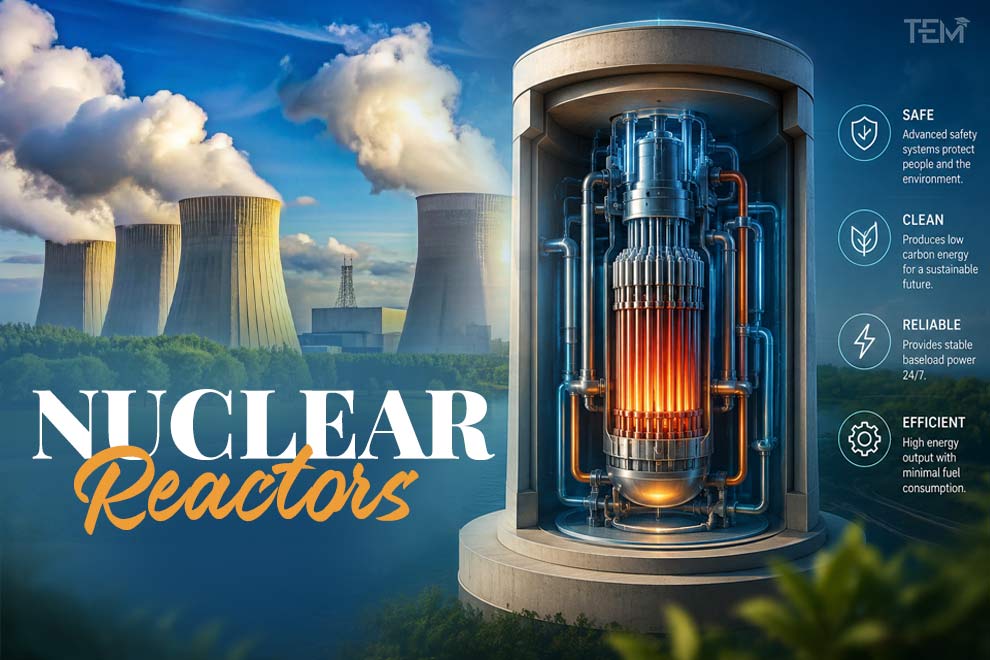
A nuclear reactor is the specialized apparatus where atomic fission takes place under controlled conditions. People often confuse a nuclear reactor with a complete nuclear power plant, but they perform distinct roles. The power plant represents the whole industrial facility, while the nuclear reactor acts as the thermal engine inside it, generating intense heat to produce steam and electricity.
Understanding how different nuclear reactor types operate gives valuable context as global energy demand increases the need for reliable, low-carbon electricity. Today’s energy landscape features time-tested designs like Pressurized Water Reactors (PWR), Boiling Water Reactors (BWR), and Pressurized Heavy Water Reactors (PHWR), along with emerging Small Modular Reactors (SMR) and fast reactors.
This guide explains how reactor technology works inside the core, compares major design architectures, and details key global developments unfolding in 2026.
What Is a Nuclear Reactor?
A nuclear reactor is an engineered system designed to initiate, sustain, and control a nuclear fission chain reaction to produce useful heat. In commercial power applications, a circulating coolant absorbs this heat and transfers it to steam generation equipment, which spins turbines to produce electricity.
What does a nuclear reactor do? A nuclear reactor converts the subatomic energy released when heavy atoms split into steady thermal energy. It provides continuous power that can run uninterrupted for 18 to 24 months before needing fuel replacement, making it a reliable pillar for electrical grids.
How Nuclear Reactors Work
Generating power inside a reactor core involves a precise five-stage sequence. While individual designs use different coolants and pressures, all thermal reactors rely on this fundamental process.
1. Nuclear fuel undergoes fission
The primary reaction begins when a free neutron collides with the nucleus of a fissile atom, such as uranium-235 or plutonium-239. The nucleus absorbs the neutron, splits into two lighter fragments, and releases thermal energy along with two or three fast neutrons. The kinetic energy of these flying fission fragments converts directly into heat as they collide with neighboring atoms inside the fuel pellets.
2. The chain reaction is controlled
Neutrons released during fission travel at high speeds. In thermal reactors, these fast neutrons collide with the light atoms of a moderator, such as water or graphite, which slows them down. Slower thermal neutrons have a higher probability of splitting additional uranium atoms. Operators adjust neutron-absorbing control rods made of boron or cadmium to keep the reactor at a steady state called criticality, where exactly one neutron from each fission event triggers another split.
3. Heat is transferred through the reactor system
Continuous fission produces high temperatures inside the metal fuel rods. Primary pumps force a coolant fluid through channels in the core to absorb this thermal energy and carry it away from the fuel assemblies. Depending on the design, this coolant can be light water, heavy water, helium gas, or liquid sodium.
4. Steam is produced directly or indirectly
The thermal energy carried by the coolant must create steam to produce mechanical energy. In direct-cycle systems, the primary coolant boils inside the reactor vessel itself to form steam. In indirect-cycle systems, the superheated primary coolant flows through a heat exchanger called a steam generator, boiling water in a completely separate secondary piping loop.
5. The resulting energy can be converted into electricity
The high-pressure steam leaves the reactor area and enters steam turbines, expanding through turbine blades to spin an electrical generator. After passing through the turbines, the steam flows into a condenser, where secondary cooling water cools it back into liquid form so pumps can send it back into the steam generation loop.
Key Components of a Nuclear Reactor
A nuclear reactor relies on several primary systems operating inside tight mechanical tolerances to extract heat safely.
| Component | Primary Function |
| Reactor Core | Holds the fuel assemblies and structural elements where nuclear fission occurs. |
| Nuclear Fuel | Supplies fissile isotopes, typically arranged as ceramic uranium dioxide pellets in metal tubes. |
| Control Rods | Absorb excess neutrons to regulate reaction speed or shut down the core. |
| Moderator | Slows fast neutrons down to thermal energies to maintain the chain reaction. |
| Coolant | Circulates through the core to extract heat and transfer it to steam systems. |
| Reactor Pressure Vessel | Encloses the core and primary coolant under high mechanical pressure. |
| Steam Generator | Transfers heat from primary coolant to an isolated secondary loop in indirect designs. |
Why Reactor Architecture Matters
Selecting a specific reactor design shapes the operational characteristics, fuel requirements, and construction complexity of an energy project. The internal technology dictates how heat moves out of the core, what type of fuel enrichment is necessary, and how operators manage safety.
For example, choosing a design that uses heavy water allows an electric utility to use natural, unenriched uranium, eliminating the need for expensive fuel enrichment services. Conversely, choosing a pressurized light-water design requires enriched fuel but allows for a more compact core layout. Understanding these technical trade-offs explains why energy planners select different options based on local resources.
What Are the Main Types of Nuclear Reactors?
Commercial power stations operate on a few established reactor designs, each using distinct cooling and moderation mechanisms.
1. Pressurized Water Reactor (PWR)
The Pressurized Water Reactor is the world’s most common commercial design. It uses light water under high pressure (around 155 atmospheres) to prevent boiling inside the core. Superheated primary water passes through steam generators to boil secondary water into clean steam for the turbine. Keeping primary coolant in a closed loop prevents radioactive water from leaving containment.
2. Boiling Water Reactor (BWR)
The Boiling Water Reactor is the second most common design. It operates at lower pressure (about 70 atmospheres), allowing water to boil directly inside the reactor vessel. Dry steam travels straight from the vessel to the turbine, eliminating separate steam generators. However, the turbine equipment requires radiation shielding because primary steam touches the blades directly.
3. Pressurized Heavy Water Reactor (PHWR)
Pressurized Heavy Water Reactors use heavy water (deuterium oxide) as both coolant and moderator. Because deuterium absorbs very few neutrons, PHWRs can run on natural, unenriched uranium. Instead of a single pressure vessel, hundreds of pressure tubes inside a calandria tank hold the fuel, allowing continuous online refueling without taking the plant offline. Canada and India rely heavily on this architecture.
4. High-Temperature Gas-Cooled Reactor (HTGR)
High-Temperature Gas-Cooled Reactors use inert helium gas as coolant and solid graphite blocks as moderators. Achieving outlet temperatures above 700 degrees Celsius, HTGRs can supply direct industrial process heat for hydrogen production and desalination alongside electricity generation.
PWR vs BWR
Comparing the two dominant light-water designs highlights the trade-offs between system pressure, steam loops, and component complexity.
| Feature | Pressurized Water Reactor (PWR) | Boiling Water Reactor (BWR) |
| Core Boiling | Prevented by high pressure | Allowed inside the reactor vessel |
| Operating Pressure | High, approximately 155 bar | Moderate, approximately 70 bar |
| Coolant Loops | Separate primary and secondary loops | Single direct steam loop |
| Steam Generator | Required | Not required |
| Turbine Shielding | Minimal required | Required due to direct steam path |
Thermal vs Fast Reactors
Nuclear reactors are categorized into two main families based on the speed of the neutrons driving the chain reaction.
Thermal reactors make up almost the entire global fleet today. They rely on a moderator to slow neutrons down to thermal energies around 0.025 electron volts. Slow neutrons interact readily with uranium-235, allowing thermal reactors to operate efficiently on fuel enriched to between 3 and 5 percent.
| Operating Metric | Thermal Reactor | Fast Reactor |
| Neutron Energy Spectrum | Slow thermal spectrum, under 0.025 eV | High-energy fast spectrum, above 0.1 MeV |
| Moderator Material | Light water, heavy water, or graphite | None |
| Primary Coolant | Water or gas | Liquid sodium, lead, or gas |
| Fuel Recycling Role | Consumes fissile isotopes | Burns heavy elements and breeds new fuel |
| Fleet Scale | Standard commercial power generation | Specialized commercial and demonstration fleet |
Advanced Reactor Technologies
Beyond traditional large-scale reactors, advanced reactor technologies offer alternative cooling media and flexible deployment models.
Small Modular Reactors (SMRs) represent a shift toward factory fabrication rather than field construction. SMRs produce up to 300 megawatts of electrical power per unit, roughly one-third the output of standard reactors. Rather than being a single reactor technology, SMR describes a size and manufacturing classification. SMR designs include miniaturized PWRs, BWRs, gas-cooled cores, and molten-salt units.
Standardized factory manufacturing allows SMR components to ship directly to sites by rail or truck, lowering financing costs and shortening project timelines. Many SMRs use passive safety systems that rely on gravity and natural convection, allowing the reactor to remain cool during complete power loss without human action. Highlighting this momentum, IAEA Director General Rafael Mariano Grossi noted:
“Small modular reactors are one of the most promising, exciting and necessary technological developments in recent times and are now becoming a reality.”
Real-World Example: 2026 Advanced SMR Deployment
In 2026, Ontario Power Generation began nuclear construction on Canada’s first commercial SMR at the Darlington site. The project uses GE Hitachi’s BWRX-300 design, a 300-megawatt boiling water reactor. By utilizing factory fabrication and passive cooling systems, the plant aims to reduce construction schedules and capital costs compared to traditional gigawatt-scale facilities.
Similarly, China operates its commercial Shidaowan high-temperature gas-cooled reactor while building the Linglong One land-based SMR, and Russia is expanding its floating SMR fleet. These deployments demonstrate how advanced reactor designs are moving from digital models into active power grid projects.
What Is the Difference Between a Nuclear Reactor and a Nuclear Power Plant?
Understanding the distinction between a nuclear reactor and a nuclear power plant helps clarify how nuclear energy fits into power infrastructure.
A nuclear reactor is the central thermal unit where atomic fission occurs. It includes the reactor vessel, fuel assemblies, control systems, moderator, and primary coolant loops. Its job is strictly thermal: converting subatomic binding energy into high-temperature heat while containing radiation.
A nuclear power plant is the entire industrial facility surrounding the reactor. It includes the power block, steam turbines, electric generators, cooling towers, electrical switchyards, backup power systems, and physical security barriers. The reactor provides the thermal energy, while the rest of the plant converts that energy into grid-ready electricity.
Reactor Control and Safety Mechanics
Controlling a nuclear reactor requires continuous balance between neutron generation and neutron absorption. Operators rely on defense-in-depth safety design, combining mechanical controls with passive physics.
Control rods made from neutron-absorbing materials like boron, cadmium, or silver-indium-cadmium drop into the core to slow or stop the reaction. In light-water reactors, operators also dissolve soluble boric acid into the primary coolant water. Adjusting boron concentrations provides smooth control over reactivity across multi-year fuel cycles.
What Happens During a Reactor Shutdown?
Dropping control rods fully into the core stops the fission chain reaction within seconds, an event called a reactor scram. However, stopping fission does not immediately eliminate core heat.
The core continues generating decay heat, caused by radioactive decay in the spent fuel rods. Right after shutdown, decay heat equals roughly 6.5 percent of the reactor’s full operating power. Pumps must keep circulating coolant through the vessel to remove this residual heat. Decay heat declines steadily over several days, allowing the system to reach safe cold shutdown conditions.
2026 Developments in Reactor Technology
The year 2026 marks a key turning point for nuclear energy, driven by soaring power demand from data centers, industrial electrification, and clean energy goals.
SMRs transition to active construction
Small Modular Reactors are moving rapidly from engineering designs into active construction. Beyond Canada’s Darlington SMR project, China is advancing construction on its Linglong One SMR, while Russia expands its floating SMR capacity.
Large reactor deployments accelerate
Large Generation III+ reactors remain the backbone of global capacity. Across the globe, around 416 to 441 commercial reactors generate roughly 9 percent of world electricity, providing over 376 gigawatts of baseline power. More than 60 reactors totaling over 66 gigawatts are under construction, led by China, Russia, India, Türkiye, and Egypt.
Recent grid connections include China’s Hualong One PWR units at Changjiang-3, Taipingling 1 and 2, and San’ao 1, alongside Russia’s VVER-TOI unit at Kursk 2-1. India is expanding its indigenous 700-megawatt PHWR program, connecting Rajasthan unit 7 to the grid while starting construction on Kaiga units 5 and 6.
Advanced reactor demonstration
Advanced reactor testing is expanding globally. High-temperature gas-cooled systems and liquid-metal fast reactors are securing investment for demonstration projects. Highlighting how persistent nuclear engineering capabilities are worldwide, IAEA Director General Rafael Mariano Grossi stated:
“Iran is a very sophisticated country in terms of nuclear technology, as is obvious. So you cannot disinvent this. You cannot undo the knowledge that you have or the capacities that you have.”
His observation highlights how technical expertise in reactor physics and fuel cycles continues to mature across multiple nations.
Operating license extensions
Extending operating licenses for existing commercial fleets offers a direct path to low-cost clean energy. Utilities in the United States, France, South Korea, and Japan are investing in equipment refurbishments to extend operational lifespans from 40 to 60 or 80 years.
Why Countries Select Specific Reactor Designs
National choices in reactor technology depend on domestic engineering skills, industrial supply chains, natural resource access, and historical partnerships.
Canada developed heavy-water reactors so it could burn domestic natural uranium without spending billions to build enrichment facilities. The United States scaled up pressurized and boiling light-water reactors derived from naval submarine programs. France standardized a fleet of pressurized water reactors to streamline manufacturing, speed up regulatory licensing, and simplify maintenance training. Modern choices continue to reflect local geography, available cooling water, grid capacity, and financing models.
Conclusion
Evaluating different nuclear reactor types provides essential context for understanding modern clean energy infrastructure. Established light-water designs like PWRs and BWRs, together with natural-uranium PHWR units, deliver reliable baseload electricity across the globe. As advanced fast spectrum designs and Small Modular Reactors advance through civil construction and commercial deployment throughout 2026, the continuing evolution of nuclear reactor types will play a pivotal role in strengthening grid resilience, powering industrial electrification, and supporting global net-zero goals.
FAQ
- What are the primary nuclear reactor types?
The main commercial types include Pressurized Water Reactors (PWR), Boiling Water Reactors (BWR), Pressurized Heavy Water Reactors (PHWR), High-Temperature Gas-Cooled Reactors (HTGR), Fast Reactors, and Small Modular Reactors (SMR).
- What is the difference between a PWR and a BWR?
PWRs keep primary coolant under high pressure to prevent boiling and use separate steam generators. BWRs allow water to boil directly inside the reactor vessel to produce steam for the turbine.
- What is a Pressurized Heavy Water Reactor (PHWR)?
A PHWR uses heavy water (deuterium oxide) as both moderator and coolant, allowing the core to operate on natural, unenriched uranium fuel.
- Is an SMR a distinct type of nuclear reactor?
An SMR is a size classification and modular deployment model producing up to 300 megawatts electrical per module, rather than a single specific cooling or nuclear technology.
- What is the difference between thermal and fast reactors?
Thermal reactors use a moderator to slow neutrons down for standard fission, while fast reactors operate without a moderator to burn heavy elements and breed new fuel.