The Education Magazine
October 26, 2026
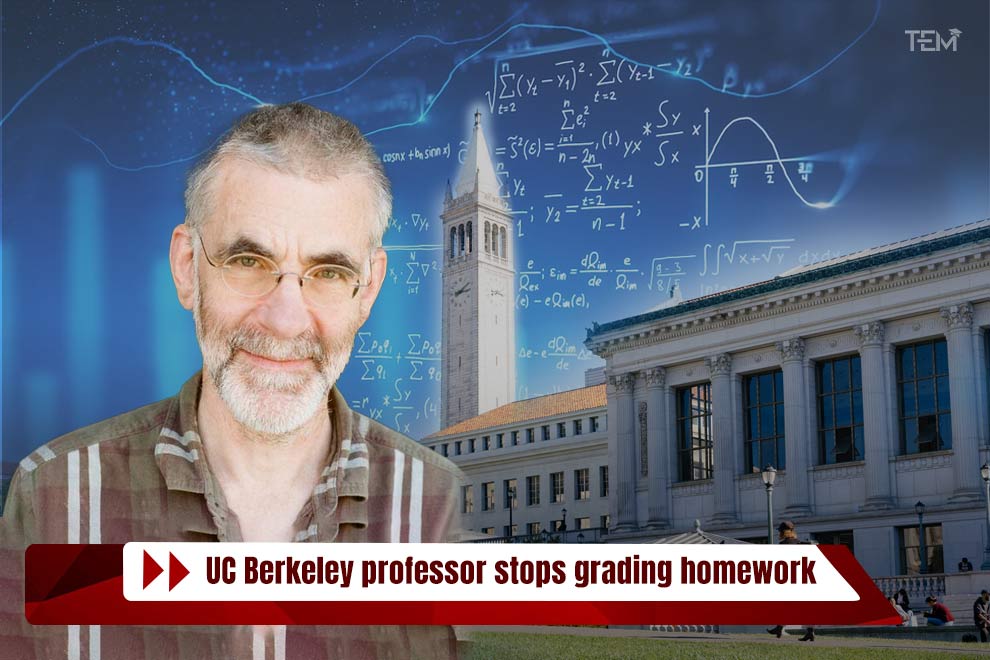
The UC Berkeley professor stops grading homework for correctness after students use artificial intelligence (AI) tools to obtain high scores. UC Berkeley Math professor Richard Borcherds now awards credit for completing homework rather than grading answers for correctness, raising questions about how universities can assess students’ understanding when AI can solve mathematical problems.
Borcherds said the growing use of AI had made correctness-based grading less worthwhile, although he acknowledged that completion-based grading was not an ideal solution. His change applies to his own teaching and does not represent a university-wide policy.
Why UC Berkeley Professor Stops Grading Homework?
The UC Berkeley professor stops grading homework for correctness because AI tools can help students produce accurate answers without necessarily demonstrating independent understanding.
Borcherds’ decision highlights a limitation of using homework scores to measure independent understanding. When AI can generate correct mathematical solutions, submitted answers may not show whether students understand the reasoning behind them.
Homework traditionally gives students opportunities to practise concepts, identify mistakes, and demonstrate what they have learned. Instructors also use submitted work to assess progress and identify areas where students need support. AI-generated answers can complicate this process when students submit solutions without working through the underlying mathematics themselves.
Borcherds has shifted to completion-based grading because he sees little value in paying graders to verify answers that students can obtain through AI. However, this approach has limitations. Completing homework does not necessarily demonstrate that students understand the concepts or can solve problems independently.
Borcherds’s decision raises a wider question for universities about how instructors can distinguish genuine understanding from correct answers generated with AI assistance.
How Is UC Berkeley Approaching AI-Writing Detection in Academic Work?
UC Berkeley provides general guidance on generative AI through its AI Hub, while course-level AI rules can vary depending on the instructor and subject.
UC Berkeley has also evaluated whether AI-detection software can help instructors identify AI-generated writing. After testing Turnitin’s AI-writing detection feature, the University of California, Berkeley decided not to enable it campuswide. Its official guidance cites inconsistent results and concerns about privacy, security, accessibility, and the reliability of detection findings.
Although UC Berkeley’s AI detection policy focuses on written assignments rather than mathematics homework, it highlights concerns about the reliability of AI detection tools. Students should check course-specific policies before using AI to solve problems or generate work for submission.
How Could AI Advances Affect the Careers of Mathematicians?
AI advances could affect mathematicians’ careers by automating mathematical tasks and changing the work that researchers can perform independently of AI systems. UC Berkeley mathematics professor Richard Borcherds has expressed concern that, if AI continues to improve at its current rate, it could eventually perform mathematical work better than human mathematicians. His concerns reflect the potential impact of AI on the profession, although they do not establish that human mathematicians will become unnecessary.
Borcherds’ concerns extend beyond homework grading to the future of mathematics itself. His comments followed OpenAI’s September 2026 announcement that an internal AI system had produced a proposed solution to the Navier-Stokes existence and smoothness problem, one of seven Millennium Prize Problems.
The Navier-Stokes existence and smoothness problem concerns whether mathematical equations describing fluid motion can develop singularities under specific conditions. OpenAI published a proof and a formalization in Lean, a proof-verification system, and said it believed the result resolved the problem. The announcement does not mean the $1 million Millennium Prize has been awarded. OpenAI stated that it did not intend to claim the prize.
Borcherds’ decision to stop grading homework for correctness has added to discussions about how increasingly capable AI systems could affect mathematical research. He warned that continued advances in AI could change what human mathematicians can accomplish compared with AI systems.
Borcherds also expressed concern about the future of mathematics as AI capabilities continue to advance. Borcherds said,
“If AI continues to improve at present rate, then, in a few years, there’ll be nothing human mathematicians can do that AI can’t do better.”
However, Borcherds’ comments reflect his concerns about AI’s future capabilities, not a confirmed outcome for the mathematics profession.
What Does the UC Berkeley Professor’s Grading Change Mean for University Math Courses?
The UC Berkeley professor stops grading homework for correctness, highlighting the challenges universities face in assessing student learning as AI tools become more capable. Although students can use AI to explore mathematical concepts and check solutions, correct answers do not necessarily demonstrate independent understanding.
Borcherds’ decision raises questions about how universities can assess students’ mathematical reasoning and problem-solving skills when AI can generate solutions. While alternative assessment methods may help address this challenge, Borcherds has not confirmed adopting a different approach. His decision highlights the need for universities to reconsider how they evaluate learning in mathematics courses as AI advances.