A student who wants to become a cybersecurity analyst and an IT professional who wants to move into cloud security both need cybersecurity training, but they rarely need the same courses. The student is usually starting from zero, with no networking background and no lab experience yet. The IT professional already understands operating systems and infrastructure and just needs to translate that into security-specific skills.
That difference is exactly why “what’s the best cybersecurity course” doesn’t have one answer. According to the NIST NICE Cybersecurity Workforce Framework, cybersecurity roles span several distinct work categories from Protection and Defense to Governance and Investigation. Choosing a course starts with knowing what each specialized learning path actually teaches.
This guide breaks down the main types of cybersecurity courses, the skills they build, how courses compare to certifications and degrees, and how to choose a learning path that matches where you’re starting from and where you want to go.
What Are Cybersecurity Courses?
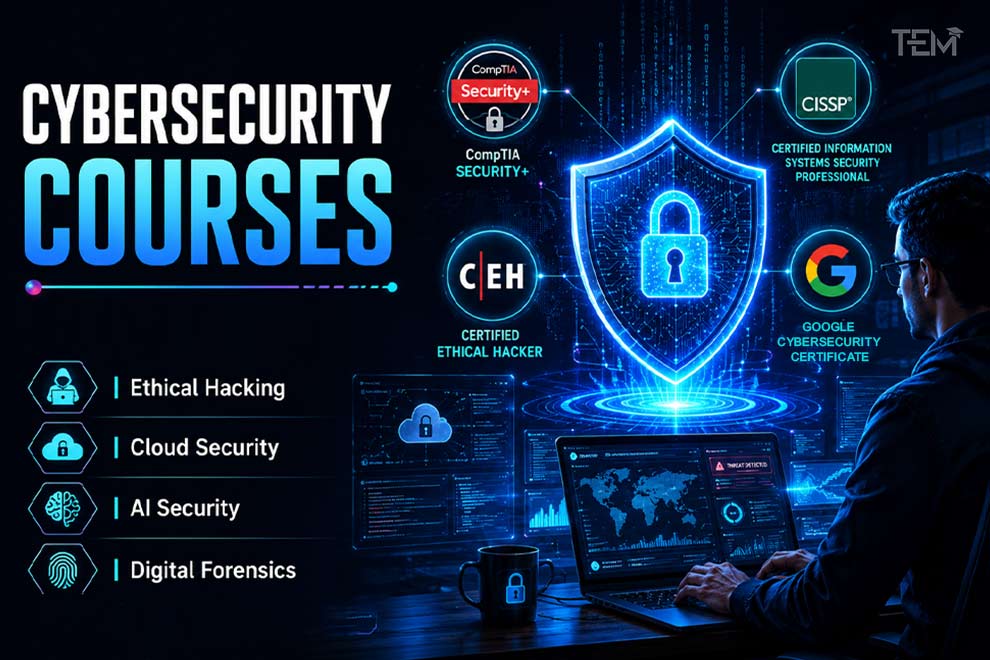
Cybersecurity courses are structured learning programs, delivered online or in a classroom, that teach people how to protect networks, systems, applications, cloud environments, and data from cyber threats. They range from beginner-friendly foundations in networking and cyber hygiene to advanced, specialized training in ethical hacking, cloud security, digital forensics, and AI security.
Key Takeaways
- Tailored Learning Paths: Cybersecurity courses exist for complete beginners as well as experienced IT professionals, and the right choice depends on your starting point, not just your end goal.
- Hands-on Labs Matter: Practicing in a simulated environment is what turns theory into a usable, job-ready skill.
- Career Goal Alignment: Course selection should match a specific career goal: analyst, ethical hacker, cloud security engineer, forensics investigator, or GRC specialist because each path builds a different sequence of skills.
- Emerging Areas: AI security and cloud security are emerging areas of growing interest as organizations expand their use of cloud platforms and AI systems.
- Certifications vs. Experience: A certification can support career development, but it works best alongside practical labs, projects, and real experience rather than as a replacement for them.
Who Should Take a Cybersecurity Course?
- Students exploring technology careers looking to enter a stable, high-growth field.
- Career changers seeking a transition into IT and security roles from non-technical backgrounds.
- IT professionals moving into security who want to build specialized defense or architectural skills.
- Developers who want to build secure applications by understanding secure coding practices and threat modeling.
- Professionals interested in GRC or compliance needing to manage risk frameworks and regulatory policies.
What Do Real Cybersecurity Pathways Actually Look Like?
It’s one thing to read about courses on paper, but how do real people actually use them to change their careers? Let’s take a look at a few inspiring, real-world examples from top universities and training institutes:
- From Software Engineer to Senior Security Analyst: When software developer Rahim Millious wanted to move into dedicated security, he enrolled in Georgia Tech’s OMS Cybersecurity program to master reverse-engineering and system defense. By putting his hands-on coursework right onto his resume, he landed a Security Assurance Analyst role at ATB Financial halfway through his studies, eventually becoming the program’s very first graduate and stepping up into a Senior Analyst role.
- From Industrial Engineering to NATO Cyber Security: Joyce Kinsey was already working in threat management at AIG, but she wanted to bridge the gap between technical defense and global security policy. She used Georgia Tech’s Master’s Curriculum to deepen her skills, ultimately becoming the first online master’s student selected for an international cyber defense internship at NATO.
- From Hands-On Student Labs to Big-Tech Engineering: Over at Carnegie Mellon University (CMU), students don’t just sit through lectures. Members of their famous student hacking team, the Plaid Parliament of Pwning, blend deep classroom theory with intense Capture-the-Flag (CTF) attack-and-defend competitions. That exact combination of coursework and lab battle-testing is how CMU graduates regularly land high-impact security engineering roles at tech giants like NVIDIA.
Types of Cybersecurity Courses
Cybersecurity is broad enough that “one course” rarely covers everything relevant to a given career goal. These are the main categories learners typically choose from:
Beginner Cybersecurity Courses
These cover core concepts of how networks work, basic operating system security, common Types of Cyber Attacks, and cyber hygiene without assuming prior technical background. They’re the right starting point for students, career changers, and anyone testing whether cybersecurity is a good fit before committing to a longer program.
Network Security Courses
Focused on protecting the infrastructure that connects systems together: firewalls, VPNs, network segmentation, and intrusion detection and prevention. This is foundational for almost every other specialization, since most attacks eventually touch the network layer.
Ethical Hacking Courses
Ethical Hacking courses teach the same reconnaissance, scanning, and exploitation techniques attackers use, but within a legal, authorized testing framework. Learners study penetration testing methodology, common vulnerability classes, and how to document findings for a client or employer.
Cloud Security Courses
These cover the shared-responsibility model across AWS, Azure, and Google Cloud, along with identity and access management (IAM), cloud configuration auditing, and container and workload security. Cloud security is an area of high demand as more organizations move infrastructure off-premises.
Cybersecurity Analyst Courses
Analyst-track courses teach how to monitor security alerts, use a Security Information and Event Management (SIEM) platform, triage incidents, and escalate confirmed threats. This is one of the most common entry points into a full-time security role.
Digital Forensics Courses
Digital forensics courses teach how to preserve, extract, and analyze evidence from compromised systems, covering both Windows and Linux artifact analysis, chain-of-custody practices, and reporting standards that hold up in legal proceedings.
Incident Response Courses
These focus on what happens during and after a breach: containment, eradication, recovery, and post-incident review. Incident response overlaps with digital forensics but is more focused on speed and coordination under pressure than long-form investigation.
AI Security Courses
AI security courses teach how to defend machine learning models and generative AI systems against risks like data poisoning, model manipulation, and prompt injection. Courses cover securing pipelines and models, including Small Language Models deployed in constrained environments, while helping security practitioners build foundational AI Literacy.
Vendor-neutral credentials and training tracks in this domain include ISACA’s AI credentials, IAPP’s AIGP (Artificial Intelligence Governance Professional), and QA/EC-Council’s Certified AI Security Engineer (CAISE) track.
Governance, Risk, and Compliance (GRC) Courses
GRC courses teach how organizations manage security policy, risk assessment, and regulatory compliance, working with frameworks like the NIST Cybersecurity Framework (NIST CSF) and ISO/IEC 27001. These courses suit learners aiming for audit, compliance, or security leadership roles rather than hands-on technical work.
Cybersecurity Courses by Skill Level
| Level | Best For | Topics |
| Beginner | Students and career changers | Networking, operating systems, cyber hygiene |
| Intermediate | IT professionals | SIEM, incident response, ethical hacking |
| Advanced | Security specialists | Cloud security, AI security, threat hunting |
A college student with no IT background could start with networking and operating-system fundamentals, practice in beginner labs, and then move toward a SOC analyst course.
Essential Skills You Learn
- Networking fundamentals: how data moves across a network and where common weak points sit.
- Linux and Windows security: hardening, permissions, and log analysis on both major operating systems.
- Security monitoring: reading SIEM dashboards and recognizing abnormal activity.
- Vulnerability assessment: finding and prioritizing weaknesses before they’re exploited.
- Incident response: containing and recovering from an active security event.
- Cloud security: IAM, configuration management, and shared-responsibility practices.
- Scripting and automation: using Python or Bash to speed up repetitive security tasks.
- Risk management: assessing and prioritizing security investments against business impact.
- Communication and reporting: translating technical findings into decisions non-technical stakeholders can act on, relying heavily on core Communication Skills.
Emerging Cybersecurity Specializations
Organizations are expanding their focus across several specialized security disciplines:
- AI and Generative AI Security: protecting machine learning models, training data, and GenAI applications from adversarial manipulation and data leakage.
- Cloud and Identity Security: securing multi-cloud environments and the identity systems that control access to them.
- IoT and Operational Technology (OT) Security: protecting connected devices and industrial control systems (ICS).
- Zero Trust Architecture: designing systems around continuous verification rather than a trusted internal network perimeter.
- Software Supply-Chain Security: securing the dependencies, build pipelines, and third-party code that make up modern software.
- Post-Quantum Cryptography: preparing encryption systems for a future where quantum computing can break current standards.
These areas are receiving increased attention as organizations strengthen security around cloud systems, connected devices, software supply chains, and AI applications.
How to Choose the Right Cybersecurity Course
- Identify your current skill level. Be honest about what you already know; a course that assumes networking knowledge you don’t have will slow you down.
- Choose a career goal. “Cybersecurity” is too broad a target; aiming for “cybersecurity analyst” or “cloud security engineer” gives you a clear course sequence to follow.
- Review course prerequisites. Note that while some certifications (such as CISSP or CISM) require verified professional experience for full certification, candidates can often sit for the exam prior to fulfilling those experience requirements.
- Check for hands-on labs. A course heavy on theory and light on labs will leave gaps when you try to apply the material in a job environment.
- Evaluate instructor expertise. Look for instructors with real-world practitioner backgrounds.
- Compare course duration and cost. Match the investment in time and tuition to what your target role actually requires.
- Review credential recognition. Check whether the course or aligned certification is recognized by employers in your industry.
- Look for project work and mentorship. Portfolio-worthy projects and mentor access significantly shorten the gap between completing a course and becoming job-ready.
Cybersecurity Courses by Career Goal
| Career Goal | Recommended Learning Path |
| Cybersecurity Analyst | Security fundamentals → SIEM → incident response |
| Ethical Hacker | Networking → Linux → penetration testing |
| Cloud Security Engineer | Cloud fundamentals → IAM → cloud security |
| Digital Forensics Analyst | Operating systems → evidence analysis → forensic tools |
| GRC Specialist | Risk management → compliance → security frameworks |
Online vs. Classroom Cybersecurity Courses
- Flexibility: Online courses let you learn around a job or school schedule; classroom courses run on a fixed timetable.
- Cost: Online self-paced courses are generally more affordable; instructor-led classroom and bootcamp formats cost more but offer structured guidance.
- Instructor access: Classroom and live cohort settings typically offer direct, real-time access to instructors.
- Lab experience: Both formats can include hands-on labs, but instructor-led programs often feature live lab troubleshooting support.
- Networking opportunities: Cohort-based and classroom programs make it easier to connect with peers and industry contacts.
Certifications vs. Cybersecurity Courses
A course provides learning: it teaches concepts, tools, and techniques over a structured curriculum. A certification validates knowledge or skills through a standardized assessment, typically a proctored exam.
It is important to note the distinction regarding prerequisites: while certifications like CISSP (ISC2) and CISM (ISACA) require several years of verified professional experience to obtain full certification status, both bodies allow candidates to take and pass the exam first. Candidates who pass can hold Associate status or maintain passing scores while completing their work experience requirements.
Neither courses nor certifications guarantee employment on their own. Employers evaluate a combination of credentials, practical lab work, personal projects, and demonstrated technical capability during hiring.
Common Mistakes When Choosing a Course
- Choosing a course based on marketing buzz rather than career fit.
- Skipping foundational networking and operating system skills to jump into advanced topics.
- Selecting material that is too advanced for your current knowledge level.
- Collecting completion certificates instead of building usable, hands-on skills.
- Relying strictly on video lectures without interactive lab environments.
- Learning specific software tools without understanding the underlying security principles behind them.
Next Steps After Completing a Course
- Build a home lab: Set up virtual environments to practice network configurations, threat detection, and system defense.
- Practice in legal platforms: Utilize structured lab platforms and sanctioned Capture the Flag (CTF) competitions.
- Document your work: Build a practical portfolio showcasing lab write-ups, security projects, or scripts.
- Engage with the community: Join local or online cybersecurity groups to network with practitioners and stay updated on emerging threats.
- Apply for entry-level roles: Look for positions such as SOC analyst, junior security analyst, or IT support roles with a security focus.
FAQs
- Which cybersecurity course is best for beginners?
The best beginner course depends on your background, but options built around foundational networking, operating systems, and cyber hygiene without assuming prior IT experience are generally the strongest entry point.
Yes. Many cybersecurity professionals build successful careers through certifications, structured courses, hands-on labs, and entry-level IT experience rather than a traditional degree.
- How long does a cybersecurity course take?
Short professional certificates typically take three to six months of part-time study, while complete certification tracks or degree programs can take anywhere from six months to a few years.
- Are online cybersecurity courses worth it?
Online courses are worth the investment when they include hands-on labs and align with a clear career path. They offer less value if pursued solely for a certificate of completion without practical exercises.
- Which cybersecurity skills are most in demand?
Cloud security, identity and access management, incident response, and AI/GenAI security are emerging areas of strong interest, alongside foundational skills in networking and threat monitoring.