Imagine arriving at work only to discover that every company file, customer record, and critical system has been locked. A message appears demanding millions of dollars in cryptocurrency to restore access. This is the reality organizations face during a ransomware attack.
Ransomware incidents continue to grow at an alarming rate globally. These malicious attacks cause devastating financial losses, massive operational downtime, and long-term reputational harm. Today, ransomware threats remain a top priority among all cybersecurity threats because attackers constantly update their tactics to breach modern defenses.
For many organizations, a ransomware attack is more than a technology problem. It can halt business operations, delay patient care, interrupt classroom learning, and damage customer trust overnight. The financial loss is often only part of the impact.
This article explains how these data encryption attacks work, analyzes real-world examples, and provides actionable ransomware protection strategies to secure your business network.
What Is a Ransomware Attack?
A ransomware attack is a type of cyberattack where malicious software encrypts a victim’s data or locks them out of their devices. The cybercriminals then demand a ransom payment, usually in cryptocurrency, in exchange for the decryption key.
Why Ransomware Attacks Are Increasing
Cybercriminals increasingly favor ransomware because it offers a direct path to profit. The rise of cryptocurrencies, ransomware-as-a-service platforms, and AI-powered attack tools has lowered the barrier to entry, allowing even less-skilled attackers to launch sophisticated campaigns.
How Ransomware Differs from Other Malware
While ransomware is technically a form of ransomware malware, its objectives are unique. Standard malware typically aims to silently steal sensitive information, spy on user activities, or damage operating systems over a long period. In contrast, ransomware does not hide its presence after execution. It openly disables operations and relies on public cyber extortion to force immediate financial payouts.
Why Cybercriminals Prefer Ransomware
For cybercriminals, ransomware is often faster and more profitable than selling stolen data. Instead of searching for buyers on underground forums, attackers can demand payment directly from the victim. Instead of selling stolen credentials on the dark web, attackers extract money directly from the victim. The rise of anonymous cryptocurrencies makes tracking these illicit transactions incredibly difficult for law enforcement.
How a Ransomware Attack Works
Understanding the mechanics of a ransomware cyber attack helps organizations deploy better security measures.
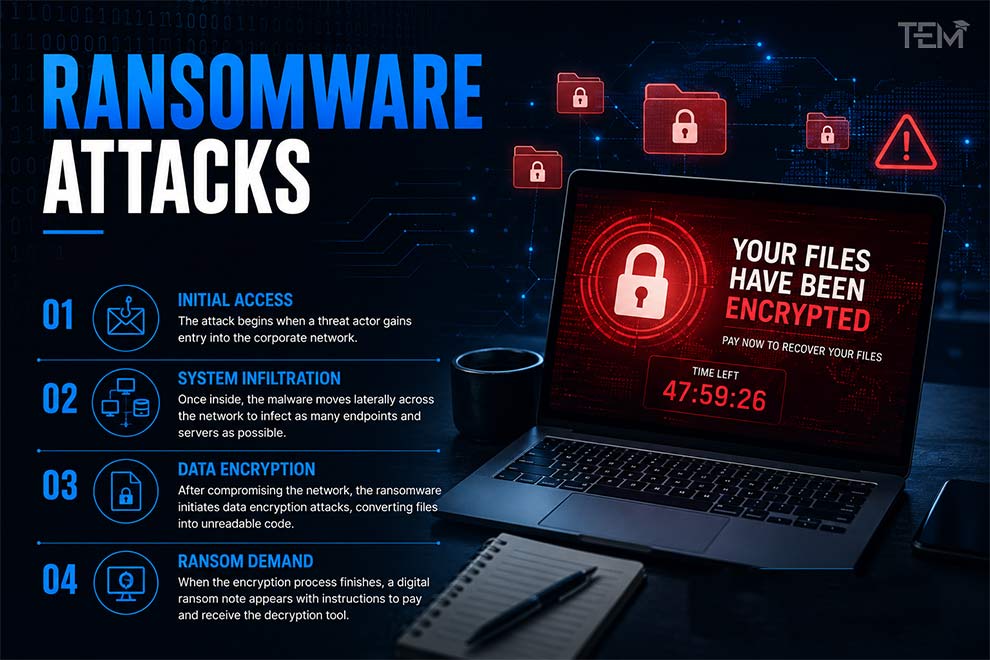
1. Initial Access
The attack begins when a threat actor gains entry into the corporate network. Attackers usually achieve initial access through phishing emails, compromised user credentials, or unpatched software vulnerabilities.
2. System Infiltration
Once inside, the malware moves laterally across the network to infect as many endpoints and servers as possible. Attackers often seek out and disable local automated backup systems to prevent easy recovery.
3. Data Encryption
After compromising the network, the ransomware initiates data encryption attacks. It uses complex mathematical algorithms to convert files into unreadable code.
4. Ransom Demand
When the encryption process finishes, a digital ransom note appears on the user’s screen. The note provides strict instructions on how to purchase cryptocurrency and submit the payment to receive the decryption tool.
5. Data Leak Threats
Modern attackers do not just encrypt files. They also extract sensitive corporate records before locking the systems. If the victim refuses to pay, the criminals threaten to leak confidential information to the public or sell it to competitors.
Common Types of Ransomware Attacks
1. Crypto Ransomware
This variant focuses specifically on encrypting valuable files and documents on a computer without blocking basic system functions. In January 2026, the AZ Monica hospital network in Belgium was hit by an aggressive crypto ransomware cyber attack.
2. Locker Ransomware
This type locks the user completely out of the device hardware or operating system interface, making the entire machine unusable. The most famous and widely documented examples of locker ransomware belong to the Reveton malware family, often referred to as the “Police Locker” or “FBI Trojan.”
3. Double Extortion Ransomware
Attackers steal sensitive data before they encrypt it. They demand payment for the decryption key and an additional fee to prevent a public data leak. A defining, high-profile example of a widespread double extortion campaign occurred throughout 2025, orchestrated by the notorious Clop ransomware gang.
4. Triple Extortion Ransomware
In this advanced method, the criminals demand payment from the primary victim, while also contacting the victim’s customers and partners to demand cash from them too. The most haunting and widely studied real-world example of a pure triple extortion tactic occurred when threat actors targeted the Finnish psychotherapy provider Vastaamo Psychotherapy Breach.
Real-World Ransomware Attack Examples
Analyzing historical and recent ransomware attack examples highlights how devastating these incidents are across various sectors.
1. Jaguar Land Rover Supply Chain Disruption
In late 2025, British automotive giant Jaguar Land Rover fell victim to a massive ransomware attack orchestrated by the Scattered Spider cybercrime group. The hackers bypassed perimeter security by exploiting unpatched vulnerabilities in third-party enterprise software.
2. Marks & Spencer Retail Outage
Major UK retailer Marks & Spencer suffered a severe ransomware attack in 2025 launched by a collaboration between the Scattered Spider and DragonForce ransomware-as-a-service operators. Attackers used basic social engineering and helpdesk impersonation to steal internal Active Directory credentials.
3. Instructure Canvas EdTech Breach
In May 2026, educational technology giant Instructure became the target of a massive ransomware attack by the notorious ShinyHunters criminal group. The hackers defaced the login portals of the Canvas learning platform at roughly 330 academic institutions, including Harvard and Princeton, knocking systems offline during critical final exam periods.
4. Stryker Global Device Resets
Medical device manufacturer Stryker faced an aggressive ransomware cyber attack in March 2026. An Iranian-linked hacking group named Handala gained unauthorized access to the company’s Active Directory services using compromised endpoint management tools. The attack triggered simultaneous factor resets on over 200,000 corporate devices across 79 countries, severely disrupting global order processing, production, and shipping.
5. Other Notable Industry Examples
Many businesses face these threats daily. For instance, companies often study historical events like the global WannaCry ransomware attack to understand massive automated propagation. In recent industry discussions, simulated threats like an Ingram Micro ransomware attack, a Davita Dialysis ransomware attack, or a Kettering Health ransomware attack show that no sector is immune.
Industries Most Vulnerable to Ransomware.
- Healthcare: hospitals cannot afford downtime.
- Education: schools hold large amounts of student and research data.
- Manufacturing: operational disruptions can stop production.
- Financial Services: sensitive customer data attracts attackers.
- Government Agencies: critical public services are high-value targets.
How Cybercriminals Deliver Ransomware
- Phishing Emails: Attackers send deceptive messages that trick employees into clicking malicious links or downloading dangerous attachments.
- Software Vulnerabilities: Hackers scan internet-connected systems for unpatched bugs to deploy malware. Can you have a ransomware attack with a zero-day vulnerability? Yes, cybercriminals frequently exploit previously unknown security flaws to bypass traditional firewalls.
- Remote Desktop Protocol (RDP) Exploits: Bad actors use stolen credentials or brute-force tools to log into corporate computers remotely.
- Supply Chain Attacks: Cybercriminals compromise a trusted third-party vendor or software supplier to distribute ransomware to all of their clients at once.
Warning Signs of a Ransomware Attack
Catching an intrusion early can stop full-scale encryption. Look out for these indicators:
- Unusual File Extensions: If standard documents suddenly change their extensions to randomized text strings like locked or crypto, an active encryption process is likely underway.
- Slow System Performance: Massive data encryption requires heavy CPU and disk utilization. Sudden, unexplained slowdowns across multiple servers often point to background malware execution.
- Suspicious Login Activity: Security tools flag multiple failed login attempts or successful remote connections during unusual hours as high-risk indicators.
How attackers use AI today
The cybersecurity landscape faces new pressures from AI-powered ransomware.
1. AI-Generated Phishing Emails
Attackers use Natural Language Processing to write highly convincing, error-free phishing messages. These personalized emails easily trick well-trained staff members. Three non-technical teenagers in Japan used ChatGPT to build automated scanning and highly tailored phishing tools.
2. Automated Vulnerability Discovery
Malicious AI tools scan vast corporate networks in seconds to identify unpatched software vulnerabilities, accelerating the initial access phase. In early 2026, a highly coordinated AI-assisted offensive campaign named CyberStrikeAI executed automated global reconnaissance.
3. Adaptive Malware
Modern ransomware threats use basic machine learning elements to modify their code structure on the fly. This adaptation allows the malware to evade traditional signature-based antivirus software.
How Organizations Can Prevent Ransomware Attacks
Implementing proactive ransomware prevention strategies significantly reduces organizational risk.
- Employee Security Training: Regularly educate employees on how to spot phishing tactics, malicious links, and social engineering tricks.
- Multi-Factor Authentication: Deploy multi-factor authentication across all corporate accounts, especially for remote access portals and email systems.
- Regular Software Updates: Keep all operating systems, applications, and firmware updated to eliminate vulnerabilities.
- Network Segmentation: Divide your corporate network into smaller, isolated segments. Network segmentation prevents ransomware malware from spreading easily to your critical servers.
- Endpoint Protection: Use Endpoint Detection and Response tools to monitor devices in real time for suspicious behavior.
- Zero Trust Security: Adopt a Zero Trust model. This framework ensures that every user and device must verify their identity continuously before accessing internal assets.
What to Do After a Ransomware Attack
If a ransomware attack breaches your perimeter today, follow these ransomware recovery steps immediately:
- Isolate Affected Systems: Disconnect infected computers from the local Wi-Fi and local area network to stop the malware from moving laterally.
- Notify Security Teams: Alert your internal IT department and external cybersecurity incident response professionals right away.
- Restore Backups: If you maintain clean, isolated offline backups, begin the system restoration process safely.
- Contact Law Enforcement: Report the cyber extortion to local authorities and federal agencies like the FBI.
Should Organizations Pay the Ransom?
The question of whether to pay cybercriminals is highly controversial.
- Arguments For Paying: Some organizations choose to pay because they face catastrophic operational downtime that threatens business survival, or they want to prevent sensitive customer data from leaking.
- Risks of Paying: Paying the ransom does not guarantee that you will receive a working decryption key. Furthermore, it marks your organization as a soft target for future extortion and directly funds criminal syndicates.
- Government Guidance: Law enforcement agencies strongly discourage paying ransoms. Official policies emphasize that compliance encourages the global ransomware industry to expand.
Conclusion
These file-encrypting cyber extortion campaigns remain among the most disruptive threats facing modern organizations. As AI-powered ransomware makes execution faster and detection harder, traditional security perimeters are no longer sufficient. Organizations must prioritize ransomware attack prevention by building layers of defense, training employees, and securing offline backups. By investing in comprehensive ransomware defense today, you can successfully shield your operations from the devastating consequences of cyber extortion.
FAQs
- Can ransomware spread across a network?
Yes. Many ransomware variants spread across a network move laterally through connected systems, allowing attackers to encrypt multiple devices and servers within a single organization.
- What is the most common way ransomware enters a network?
Phishing emails are the most common way ransomware enters a network, although attackers also exploit software vulnerabilities and stolen credentials.
- Can organizations recover without paying the ransom?
Yes. Organizations recover without paying the ransom by securing offline backups, and incident response plans can often restore operations without paying cybercriminals.