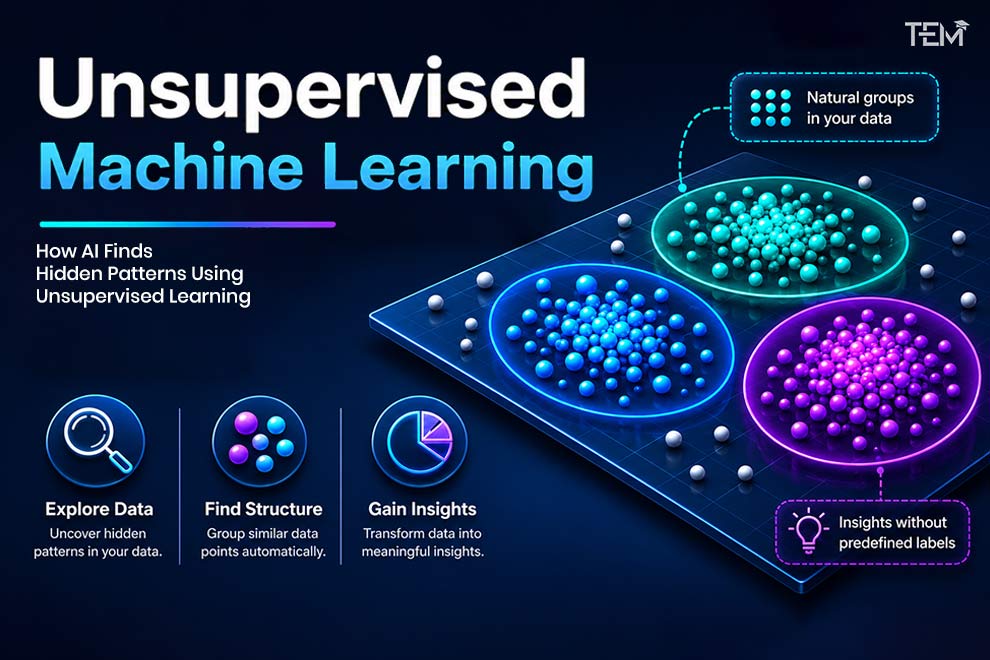
Artificial intelligence is becoming smarter at discovering insights from massive amounts of data. One of the most powerful techniques behind this transformation is unsupervised learning, a branch of machine learning that helps AI systems identify hidden patterns, relationships, and structures without relying on labeled datasets.
Unlike supervised learning, where algorithms learn from predefined answers, unsupervised machine learning allows AI models to explore raw data independently. This capability powers recommendation systems, fraud detection tools, customer segmentation platforms, and intelligent automation across industries.
In this guide, you’ll learn how AI finds hidden patterns using unsupervised learning, the most important algorithms, real-world applications, advantages, challenges, limitations, and future AI trends shaping intelligent systems in 2026.
Types of Unsupervised Learning Algorithms
There are two primary types of this technology: data clustering and dimensionality reduction. These methods allow machine learning models to process complex information quickly.
1. Clustering Algorithms
Clustering is the process of grouping data points so that objects in the same group are more similar to each other than to those in other groups. Common clustering algorithms include K- Means, Hierarchical Clustering, and DBSCAN.
- K-Means Clustering: This divides data into ‘K’ number of clusters based on distance to a central point.
- Hierarchical Clustering: This builds a tree-like structure of clusters, allowing for different levels of granularity.
- DBSCAN: This finds clusters based on the density of data points, which is great for identifying outliers.
2. Dimensionality Reduction
Modern data often contains too many variables, which can overwhelm AI pattern recognition systems. Dimensionality reduction simplifies this data without losing its essential characteristics.
Techniques like Principal Component Analysis (PCA) help reduce the “noise” so that the AI can focus on the most important signals.
Top Unsupervised Learning Algorithms Explained
1. K-Means Clustering
K-Means Clustering is one of the most widely used unsupervised machine learning algorithms for grouping similar data points into clusters. It helps AI systems identify hidden patterns and organize large datasets efficiently.
How It Works
The algorithm divides data into multiple clusters by assigning data points to the nearest central point called a centroid. The centroids are continuously updated until the clusters become stable. .
Real-World Uses
- Customer segmentation
- Recommendation systems
- Image compression
- Social media analytics
For example: Netflix uses clustering algorithms like K-Means to group users with similar viewing habits. If users watch similar genres, actors, or shows, Netflix places them into behavioral clusters and recommends content based on those patterns.
Advantages
- Simple implementation
- Fast processing
- Scalable for large datasets
Limitations
- Sensitive to outliers
- Requires predefined cluster count
2. Hierarchical Clustering
Hierarchical Clustering is an unsupervised learning algorithm that groups data into a tree-like hierarchy of clusters based on similarities between data points.
How It Works
The algorithm either merges smaller clusters into larger ones or splits large clusters into smaller groups to create a hierarchy called a dendrogram.
Real-World Uses
- Genetic analysis
- Document organization
- Customer behavior analysis
For example: During the COVID-19 pandemic, researchers used hierarchical clustering to group virus variants based on genetic similarities. This helped scientists understand how variants evolved and spread globally.
Advantages
- Easy visualization
- Useful for relationship analysis
Limitations
- Computationally expensive
- Slower for large datasets
3. DBSCAN
DBSCAN (Density-Based Spatial Clustering of Applications with Noise) is a clustering algorithm that identifies dense groups of data points while detecting outliers and anomalies.
How It Works
The algorithm groups closely packed data points into clusters and labels isolated points as noise or anomalies based on data density.
Real-World Uses
- Fraud detection
- Cybersecurity
- Geographic analysis
- Anomaly detection
For example: Banks use DBSCAN for anomaly detection to identify suspicious financial transactions.
Advantages
- Handles noise effectively
- Identifies irregular cluster shapes
Limitations
- Sensitive to parameter settings
- Less effective with varying data density
4. Mean Shift Clustering
Mean Shift Clustering is an unsupervised machine learning algorithm used to identify clusters in data by locating dense regions of data points. Unlike K-Means, it does not require a predefined number of clusters.
How It Works
The algorithm continuously shifts data points toward areas with the highest data density until stable clusters are formed.
Real-World Uses
- Image segmentation
- Object tracking
- Customer segmentation
- Traffic pattern analysis
- Computer vision systems
For example: self-driving cars identify pedestrians, vehicles, traffic signals, and road objects by tracking dense visual data regions in real time
Advantages
- Does not require predefined cluster count
- Handles irregular cluster shapes
- Effective for image processing
- Works well with complex datasets
Limitations
- Computationally expensive
- Slower with large datasets
- Sensitive to bandwidth parameter selection
- Difficult to scale for big data applications
5. Principal Component Analysis (PCA)
Principal Component Analysis is a dimensionality reduction algorithm used to simplify complex datasets.
How It Works
PCA transforms large datasets into smaller components while preserving important information.
Real-World Uses
- Image processing
- Data visualization
- Feature extraction
- AI optimization
For example: smartphones use facial recognition to unlock devices
Advantages
- Reduces computational complexity
- Improves model efficiency
Limitations
- Information loss may occur
- Difficult interpretation
6. t-Distributed Stochastic Neighbor Embedding (t-SNE)
t-Distributed Stochastic Neighbor Embedding (t-SNE) is a dimensionality reduction algorithm used to visualize high-dimensional datasets in lower-dimensional spaces, typically 2D or 3D.
How It Works
The algorithm converts similarities between data points into probabilities and maps similar points closer together while separating dissimilar points.
Real-World Uses
- Data visualization
- AI pattern analysis
- Genomics research
- Image recognition
- Deep learning feature visualization
For example: Scientists use t-SNE to visualize high-dimensional genetic data in cancer research.
Advantages
- Excellent data visualization
- Preserves local data relationships
- Useful for high-dimensional datasets
- Helps identify hidden patterns
Limitations
- Computationally intensive
- Slow for large datasets
- Difficult interpretation
- Not ideal for predictive modeling
7. Linear Discriminant Analysis (LDA)
Linear Discriminant Analysis (LDA) is a machine learning technique used for dimensionality reduction and pattern classification. It helps separate different data categories while preserving important information.
How It Works
LDA identifies linear combinations of features that maximize the separation between different groups or classes in a dataset.
Real-World Uses
- Facial recognition
- Fraud detection
- Medical diagnosis
- Customer classification
- Speech recognition
Advantages
- Reduces dimensionality efficiently
- Improves classification performance
- Works well with small datasets
- Computationally efficient
For example: Email providers use Linear Discriminant Analysis to classify emails as spam or legitimate messages.
Limitations
- Assumes linear relationships
- Sensitive to outliers
- Less effective with complex nonlinear data
- Requires normally distributed data
8. Autoencoders
Autoencoders are deep learning models designed to learn efficient data representations by compressing and reconstructing information. They are commonly used in unsupervised learning and neural network applications.
How They Work
Autoencoders use neural networks to encode input data into compressed representations and then decode it to reconstruct the original information while preserving important features.
Real-World Uses
- Anomaly detection
- Image denoising
- Generative AI
- Cybersecurity
For example: Manufacturing companies use autoencoders to detect defective products during production.
Advantages
- Powerful for deep learning
- Excellent feature extraction
Limitations
- Requires large datasets
- Computationally intensive
Real-World Applications of AI Pattern Recognition
1. E-Commerce Recommendation Systems
E-commerce giants like Amazon use unsupervised learning algorithms to analyze customer behavior and personalize experiences.
- Product Recommendations: Systems analyze how a user’s behavior clusters with millions of others to suggest products they are likely to enjoy.
- Customer Segmentation: Companies identify micro-segments of shoppers, such as those buying specific niche products at specific times.
- Personalized Marketing: Marketing is tailored to groups based on actual behavior rather than just demographics.
- Demand Forecasting: Predictive analytics and pattern recognition help companies see average increases of 15-20% in customer retention.
2. Fraud Detection in Banking
Financial institutions rely on anomaly detection to monitor millions of daily transactions.
- Transaction Monitoring: Systems learn the “normal” spending patterns of a user to identify outliers.
- Credit Card Fraud Detection: Large or unusual foreign purchases are flagged instantly to protect customers from theft.
- Risk Analysis: Intelligent systems automate the discovery of suspicious activities that human monitors might miss.
3. AI in Healthcare
Healthcare organizations leverage intelligent systems to process complex medical records and biological data.
- Disease Clustering: Scientists use these techniques to group genes with similar expression patterns, identifying new subtypes of diseases.
- Medical Pattern Analysis: AI scans thousands of records to find correlations between lifestyle and health outcomes.
- Patient Segmentation: AI automation groups patients based on similar health profiles for more targeted care.
4. Social Media Algorithms
Platforms like Spotify and Google use unsupervised machine learning to manage massive streams of data.
- Identifying Trending Topics: Algorithms detect shifts in global conversations by identifying new clusters of keywords.
- Content Recommendations: Systems suggest songs or videos by clustering user preferences with similar profiles.
- Analyze User Behavior: AI pattern recognition learns the underlying structure of how users interact with content.
- Personalizing Feeds: Deep learning models, such as autoencoders, are used to process unstructured formats like video or speech to refine user feeds.
5. AI in Education
Educational technology utilizes machine learning models to create more adaptive environments.
- Adaptive Learning Systems: Platforms adjust content delivery based on identified patterns in a student’s progress.
- Student Grouping: Clustering algorithms group students with similar learning styles or challenges for better peer-to-peer or teacher interaction.
- Learning Behavior Analysis: Systems explore raw student data independently to find hidden roadblocks in the learning process.
- Intelligent Tutoring Systems: These systems act as autonomous discovery tools to provide help where a student’s behavior deviates from a successful path
Common Challenges in Unsupervised Machine Learning
While powerful, this technology is not without its hurdles. One major issue is the evaluation of results. Since there is no “ground truth,” it can be difficult to know if a cluster is actually meaningful or just a mathematical coincidence.
- Scalability: Some clustering algorithms become very slow as the data set grows.
- Interpretability: Explaining why an AI grouped certain data points can be a challenge for non-technical stakeholders.
- Sensitivity to Initial Conditions: Algorithms like K-Means can give different results depending on where they start.
Future Trends in AI Algorithms
The future of AI lies in “Self-Supervised Learning.” This is a subset of unsupervised learning where the system generates its own labels from the data. This is how Large Language Models (LLMs) are trained.
They look at billions of sentences and hide words, then try to predict what the hidden word was. By doing this repeatedly, they learn the entire structure of human language.
Conclusion: Embracing the Power of Hidden Patterns
In a world drowning in data, the ability to find meaning without human intervention is the ultimate competitive edge. We have seen how AI finds hidden patterns using unsupervised learning to transform industries from finance to healthcare. By leveraging clustering algorithms and dimensionality reduction, businesses can move from being reactive to being truly proactive.
As AI automation continues to evolve, the gap between those who use intelligent systems and those who don’t will only widen. Start exploring your unlabeled data today and uncover the hidden insights that will drive your future growth. Understanding how AI finds hidden
FAQ
- What is the main difference between supervised and unsupervised learning?
Supervised learning uses labeled data (input-output pairs), while unsupervised learning finds patterns in unlabeled data without any prior guidance.
- Can unsupervised learning be used for predictive analytics?
Unsupervised learning can be used for predictive analytics. While it doesn’t predict a specific label, it creates the clusters and features that make supervised predictive models much more accurate.
- Why is data clustering important for marketing?
Data clustering is important for marketing, allowing marketers to segment their audience into specific groups based on actual behavior rather than just demographics like age or location.