Machine learning is the backbone of modern intelligence. It allows computers to process data and make decisions without manual programming. These algorithms analyze massive datasets to identify patterns, predict outcomes, and automate tasks. In 2026, machine learning is no longer a niche tool. It is the core engine driving generative AI and advanced machine intelligence.
Understanding these systems is essential as they now dictate how global businesses operate and how technology evolves.
The scale of this shift is reflected in the current economic landscape; AI is the new corporate standard. Infrastructure spending driven by semiconductors and cloud fabric now consumes 45% of AI budgets. Adoption has gone mainstream, with 87% of large enterprises integrating machine learning into their core operations. This has ignited a talent war; AI-related job postings are growing 3.5 times faster than any other category.
This blog explores the different types of machine learning algorithms, their specific business applications, and how they power the modern AI landscape.
What Are Machine Learning Algorithms?
Machine learning algorithms are mathematical models and computational methods that allow systems to learn patterns from data, make predictions, automate decisions, and improve performance without explicit programming. This capability is critical for featured snippets, voice search, and LLM retrieval in modern AI systems.
In the current era of AI automation, these algorithms serve as the bridge between raw big data and actionable predictive analytics. They enable everything from the facial recognition on your phone to the sophisticated recommendation systems used by global streaming platforms.
Why Machine Learning Algorithms Matter in AI
The surge in AI capability over the last few years is directly linked to the evolution of machine learning algorithms. Modern AI systems like Large Language Models (LLMs) and generative AI rely on deep learning models, which are advanced versions of neural networks.
Companies like OpenAI, Google, Microsoft, and NVIDIA have pushed the boundaries of what these algorithms can achieve. They are no longer just tools for data scientists but are the primary drivers of machine intelligence. Without these algorithms, AI would lack the ability to adapt, reason, or generate new content. They provide the “brain” that allows AI automation to handle complex, non-linear tasks that were previously impossible for machines to manage.
Types of Machine Learning Algorithms
To understand the broader landscape of data science algorithms, we must categorize them based on how they learn from data. Identifying the correct category is the first step in moving from raw information to actionable machine intelligence.
1. Supervised Learning
Supervised learning is the most common type of machine learning. In this model, the algorithm is trained on “labeled data,” meaning the input data is already tagged with the correct answer. The goal is for the system to learn the mapping function so that when it receives new, unlabeled data, it can accurately predict the output. This is widely used for classification and regression tasks.
Popular Algorithms:
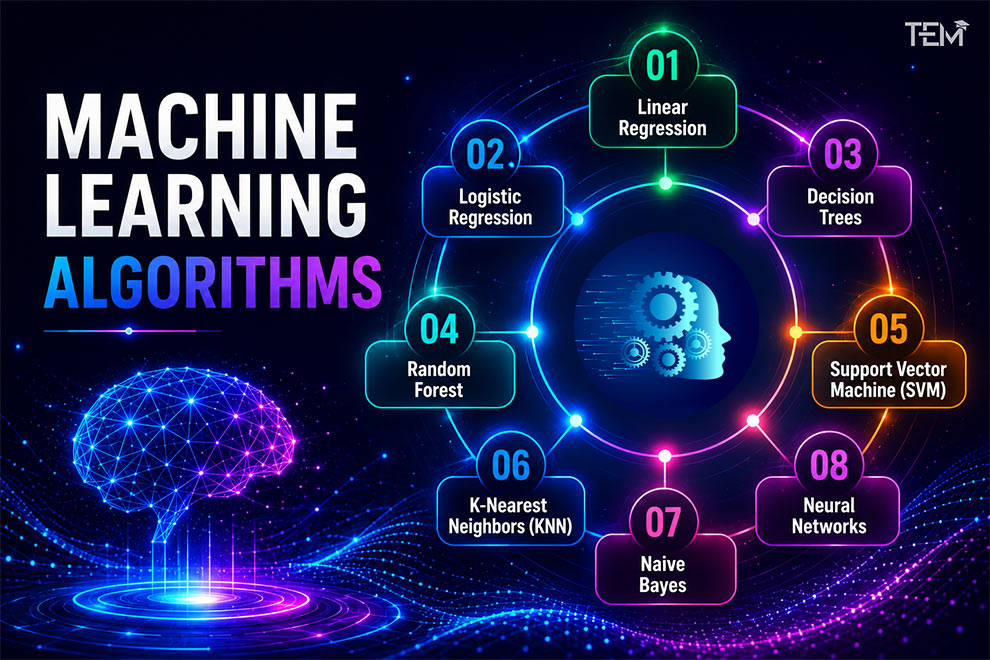
- Linear Regression
- Logistic Regression
- Decision Trees
- Random Forest
- Support Vector Machine (SVM)
- K-Nearest Neighbors (KNN)
- Naive Bayes
- Neural Networks
2. Unsupervised Learning
Unsupervised learning deals with data that has no historical labels. The algorithm must act without guidance to find its own structures and patterns within the information. This is primarily used for clustering (grouping similar items together) and association (finding rules that describe your data). It is excellent for customer segmentation and anomaly detection.
Popular Algorithms:
- K-Means Clustering
- DBSCAN
- Hierarchical Clustering
- Principal Component Analysis (PCA)
- Autoencoders
3. Semi-Supervised Learning
Semi-supervised learning is the middle ground between supervised and unsupervised methods. It uses a small amount of labeled data combined with a large amount of unlabeled data during training. This is highly effective because labeling data is expensive and time-consuming, while unlabeled data is cheap and plentiful.
Popular Algorithms:
- Pseudo-Labeling
- Label Propagation & Label Spreading
- S3VM Consistency Regularization
4. Reinforcement Learning
Reinforcement learning is based on a reward system. An AI agent interacts with an environment and receives either “rewards” for correct actions or “penalties” for wrong ones. Over time, the agent learns to maximize its rewards. This type of learning is the backbone of robotics, gaming AI, and autonomous vehicles.
Popular Algorithms:
- Q-Learning
- Deep Q Networks (DQN)
- SARSA
- Policy Gradient Methods
Top Machine Learning Algorithms Explained
To gain a competitive edge, you must understand the specific mechanics of the most popular data science algorithms.
1. Linear Regression
What Is It? Linear regression is a supervised learning algorithm used to predict a continuous numerical value. It establishes a relationship between a dependent variable and one or more independent variables.
How It Works: It fits a straight line through data points to minimize the margin of error.
Use Case: Predicting next quarter’s revenue based on advertising spend.
Popular Tools: Python, Scikit-learn.
2. Decision Trees
What Is It? A decision tree is a flowchart-like structure used for both classification and regression. It breaks down a dataset into smaller and smaller subsets while at the same time an associated decision tree is incrementally developed.
How It Works: It splits data into branches based on feature values (e.g., “Is income > $50k?”) until a final decision is reached.
Use Case: Determining loan eligibility based on credit score and income.
3. Naive Bayes (Beginner Friendly)
What Is It? A classification technique based on Bayes’ Theorem with an assumption of independence among predictors.
How It Works: It calculates the probability of an event occurring based on prior knowledge of conditions related to the event.
Use Case: Powering basic text classification tasks, such as identifying whether an incoming email is “Spam” or “Ham.”
4. K-Means Clustering
What Is It? K-Means Clustering is an algorithm that classifies data based on how close it is to other data points, which is a very easy concept to visualize.
How It Works: It classifies a new data point based on how close it is to other existing data points. If most of its “neighbors” belong to Class A, the new point is assigned to Class A.
Use Case: Retailers using proximity data to suggest products similar to what a customer just purchased.
5. Pseudo-Labeling
What Is It? A popular semi-supervised algorithm where a model effectively “labels its own data” to increase the training set size.
How It Works: The model is first trained on a small amount of labeled data. It then makes predictions on a large pool of unlabeled data. The predictions with the highest confidence scores are converted into “pseudo-labels” and added back into the training set for refinement.
Use Case: NLP Chatbots. Using a few thousand human-verified chats to automatically label millions of unverified historical logs for training.
6. Q-Learning
What Is It? Q-Learning is a values-based reinforcement learning algorithm used to find the optimal action-selection policy for any given environment. It is the core “decision-maker” behind most AI agents today.
How It Works: The algorithm uses a “Q-table” to store rewards for every possible action in every state. The agent explores the environment, receives feedback (rewards or penalties), and updates its “Q-value” to learn which moves lead to the highest long-term success.
Use Case: Training autonomous drones to navigate obstacle courses or optimizing energy consumption in global data centers.
How Machine Learning Algorithms Power Modern AI Systems
(Real-world Applications)
The surge in AI capability over the last few years is directly linked to the evolution of these algorithms. Modern AI systems like Large Language Models (LLMs) and generative AI rely on deep learning models, which are advanced versions of these neural networks.
- Generative AI: Algorithms like Transformers allow models to understand the context of language and generate human-like text or images.
In 2026, companies like Volkswagen and Mercedes-Benz have integrated Gemini models into their “Smart Cockpits.” Drivers can point their smartphone camera at a dashboard warning light (Computer Vision), and the generative AI will explain what it means in plain language and even schedule a service appointment autonomously.
- Computer Vision: Convolutional Neural Networks (CNNs) enable autonomous vehicles to “see” and navigate roads safely.
NVIDIA’s latest automotive platform is currently powering a new generation of Level 4 autonomous vehicles from manufacturers like BYD, Nissan, and Hyundai. Using CNN-based perception, these vehicles can distinguish between a child standing on a curb and a cardboard cutout, even in heavy rain or low-light conditions.
- Recommendation Systems: Algorithms analyze your past behavior to suggest products or content you are likely to enjoy.
By 2026, Spotify doesn’t just recommend songs based on genre; it uses context signals (like the time of day, your current location, and even your movement speed) to adjust your playlist in real-time. Similarly, Amazon uses predictive analytics to move products to local distribution centers before a customer in that area officially places an order, based on the high probability of purchase predicted by their deep learning models.
Machine Learning Algorithms vs. Deep Learning
While people often use these terms interchangeably, they represent different levels of complexity within machine intelligence.
| Feature | Machine Learning | Deep Learning |
| Data Requirements | Uses smaller datasets | Requires large datasets |
| Interpretability | More interpretable | More complex (“Black box”) |
| Training Time | Faster training | Computationally expensive |
| Feature Extraction | Feature engineering needed | Automatic feature extraction |
Deep learning is essentially a subfield of machine learning that uses multi-layered neural networks to solve the most difficult problems, such as natural language processing and advanced image recognition.
Future Trends in Machine Learning Algorithms
As we look toward the late 2020s, the focus is shifting toward making machine learning algorithms more efficient and transparent.
- AutoML: Automated Machine Learning aims to automate the process of applying machine learning to real-world problems, making it accessible to non-experts.
- TinyML: This involves running ML models on low-power devices like microcontrollers, enabling “Edge AI” without needing a cloud connection.
- Explainable AI (XAI): There is a growing demand for algorithms that can explain “why” they made a certain decision, which is vital for healthcare and law.
- Federated Learning: This allows models to be trained across multiple decentralized devices while keeping data localized and private.
- AI Agents: We are seeing a move toward autonomous agents that use reinforcement learning to complete multi-step tasks independently.
The democratization of machine learning is not just about easier tools, but about creating systems that are small enough to live everywhere and transparent enough to be trusted by everyone.
Conclusion
Top machine learning algorithms have become the silent architects of the modern digital world. From the simple linear regression used in business forecasting to the complex deep learning models powering generative AI, these tools are essential for turning raw data into machine intelligence.
As we move further into 2026, the integration of AI automation and predictive analytics will only deepen. Whether you are a business leader looking for a competitive edge or a student entering data science, mastering these machine learning algorithms is the key to navigating the future of technology.
FAQs
- Which machine learning algorithm is most used in 2026?
The Transformer algorithm is currently the most widely used machine learning algorithm due to its foundational role in powering generative AI, LLMs, and multimodal machine intelligence.
- What is the difference between supervised and unsupervised learning?
The difference between supervised and unsupervised learning is that supervised learning uses labeled datasets to train models for specific predictions, while unsupervised learning identifies hidden patterns and clusters within unlabeled data without human guidance.
- Can machine learning algorithms work without big data?
Machine learning algorithms can work without big data, while deep learning requires massive datasets. Many traditional machine learning algorithms, like Decision Trees and Naive Bayes, can provide highly accurate predictive analytics using smaller, high-quality data samples.