Artificial intelligence (AI) has moved from a futuristic concept to the primary engine of global industry in 2026. Current data shows that 84% of organizations have increased their AI investments this year, with nearly 30% of enterprises fully redesigning their core business processes around agentic AI and multimodal systems. While the adoption rate in leading economies now exceeds 70%, the technology remains a subject of intense debate due to its impact on the global workforce and data privacy.
This blog provides a balanced analysis of the advantages and disadvantages of artificial intelligence in 2026 to help you keep up with how quickly technology is moving.
What Is Artificial Intelligence?
Artificial intelligence (AI) is the ability of a computer system to perform tasks that typically require human intelligence, such as reasoning, learning from experience, and complex decision-making. In 2026, AI is no longer just a tool for answering questions; it has become a sophisticated system capable of processing massive datasets to find patterns invisible to the human eye.
By mimicking cognitive functions, AI can adapt to new inputs and perform human-like tasks with incredible speed. It combines advanced mathematics, computer science, and linguistics to understand our world, solve intricate problems, and automate logical processes, making digital interactions feel more natural and responsive than ever before.
How Artificial Intelligence Works
Modern AI relies on several core technologies to process information and generate results:
- Machine Learning: Algorithms that improve automatically through experience and data.
- Generative AI: Systems that create new content, including text, images, and code.
- Neural Networks: Computational models inspired by the human brain that identify complex patterns.
- NLP (Natural Language Processing): The tech that allows machines to understand and respond to human speech and text.
- Automation: The use of AI to perform repetitive tasks without human intervention.
Types of Artificial Intelligence
- Narrow AI: Specialized systems designed for a single task, like facial recognition or spam filters.
- General AI: A theoretical form of AI with human-like cognitive abilities across all domains.
- Generative AI: AI focused on creating original outputs based on training data.
- Predictive AI: Systems that analyze historical data to forecast future outcomes, such as market trends or inventory needs.
- Agentic AI: It refers to systems that can plan and execute multi-step workflows with minimal human supervision.
Why Artificial Intelligence Is Growing Rapidly in 2026
The surge in AI adoption is driven by the maturation of generative AI tools from companies like OpenAI, Google, and Microsoft. These tools have become deeply embedded in professional workflows, leading to a 78% year-over-year increase in software code production globally.
Industry adoption is also fueled by the increasing demand for automation and hyper-personalization. Executives report higher confidence in these systems, with 84% of organizations increasing their AI investments in 2026 to stay ahead of the competition.
Advantages of Artificial Intelligence
The Advantages of artificial intelligence are transformative for both businesses and individuals. By automating routine work, AI allows humans to focus on high-level strategy and creativity.
1. Automation of Repetitive Tasks
AI excels at handling mundane, high-volume work that often leads to human error.
- Chatbots: Handle 70% of customer interactions in some companies, resolving common queries instantly.
- Data Entry: AI verifies and matches records with higher accuracy than manual processing.
- Customer Service: Automation tags tickets and answers FAQs 24/7.
2. Improved Productivity and Efficiency
In 2026, the competitive advantage lies in agentic AI, which functions as an “action layer” across platforms like Slack and Microsoft Teams. Rather than just answering queries, these agents execute multi-step workflows from pulling Salesforce records to provisioning IT accounts directly within chat interfaces.
- Faster Workflows: AI thinking across the entire tech stack replaces manual execution.
- Reduced Costs: Automation fills labor gaps, lowering operational expenses.
- Smart Business Tools: Real-time identification of inventory needs and sales anomalies.
Companies leveraging these tools report a 20% boost in productivity and up to 7x higher lead conversion rates, fundamentally transforming operational efficiency.
3. Personalized Learning and Education
AI is revolutionizing the classroom by providing tailored support for students and teachers.
- AI Tutors: Platforms like Khan Academy and Duolingo use AI to provide 1-on-1 adaptive learning experiences.
- Classroom Tools: 57% of teachers use AI to improve lesson plans and simplify complex topics.
- Immersive Learning: Immersive and in-flow training models are helping students stay engaged and motivated.
4. Better Healthcare and Medical Support
- AI Diagnostics: Specialized systems analyze medical images to support faster and more accurate diagnoses.
- Robotic Surgeries: AI-enhanced tools assist surgeons in performing high-precision procedures.
- Research: AI speeds up drug discovery and medical research by processing vast datasets.
5. Accessibility and Inclusion
AI tools are making the world more accessible for people with disabilities by moving beyond “one-size-fits-all” interfaces to Natively Adaptive Interfaces (NAI) that adjust in real-time to a user’s unique needs.
- Multi-Agent Solvers: Tools like Meta Muse Spark orchestrate sub-agents to manage complex tasks.
- Real-World Navigation: StreetReaderAI uses dual subsystems to provide precise, conversational guidance.
- Multimodal Learning: Adaptive AI provides simultaneous ASL, captions, and narration.
- Assistive Features: Voice Assistants enable hands-free navigation, Live Captions facilitate real-time participation, and Translation bridges global communication gaps.
Disadvantages of Artificial Intelligence
While the pros are significant, the disadvantages of AI must be carefully managed to ensure ethical and safe deployment.
1. Job Displacement and Automation Concerns
The World Economic Forum projects that while AI could create 170 million new roles by 2030, it may also displace 92 million jobs.
- Significant 2026 Layoffs: According to Mirror Review, major tech firms are executing “structural resets” to prioritize AI development. Notable examples include Oracle cutting 30,000 roles (18% of its staff) to pivot toward AI data centers, and Block laying off 4,000 employees to become an AI-native organization. Additionally, Meta is redirecting $115 billion into AI infrastructure, leading to further team restructuring.
- Workforce Transformation: 36% of enterprises expect at least 10% of jobs to be fully automated in the coming years.
- At-Risk Roles: Entry-level positions in data entry, basic bookkeeping, and Tier 1 customer service are facing rapid declines.
- Reskilling Needs: Up to 14% of the global workforce may need to change careers by 2030 due to AI and digitization.
2. Privacy and Data Security Risks
AI systems require massive amounts of data, which creates significant privacy concerns.
- Data Leaks: Sensitive information can be exposed if AI models are not properly secured. According to some reports, leading firms like Scale AI have faced scrutiny over data leaks that inadvertently exposed private training sets, highlighting the vulnerability of centralized AI databases.
- Surveillance: High-risk use cases like mass surveillance raise serious human rights questions.
- Unauthorized Data Usage: A growing concern in 2026 is the use of personal intellectual property and private communications to train commercial LLMs without the explicit consent of the original creators.
3. AI Bias and Ethical Issues
AI is only as good as the data it is trained on. If the data is skewed, the AI will produce unfair outcomes.
- Algorithmic Bias: Hiring or lending models can quietly reject certain groups if they are trained on biased historical data. To counter this, California’s Executive Order N-5-26 (March 2026) now mandates that state-contracted vendors certify their systems against algorithmic bias and civil rights impacts.
- Lack of Transparency: Many AI systems operate as “black boxes,” making it difficult to understand how they reach specific decisions.
4. Misinformation and Deepfakes
The rise of generative AI has made it easier to create and spread misleading information.
- Manipulated Media: Deepfake technology can replace a person’s likeness or voice to create deceptive videos and audio.
- Political Risks: Deepfakes are being weaponized to harass individuals and influence elections globally.
5. AI Hallucinations and Incorrect Information
AI models sometimes generate “hallucinations”, confidently stated but entirely false information.
- Academic Integrity: 72% of teachers believe AI can harm integrity by allowing students to pass off AI-generated work as their own.
- Trust Issues: Over-reliance on AI outputs without human verification can lead to costly mistakes in business and law.
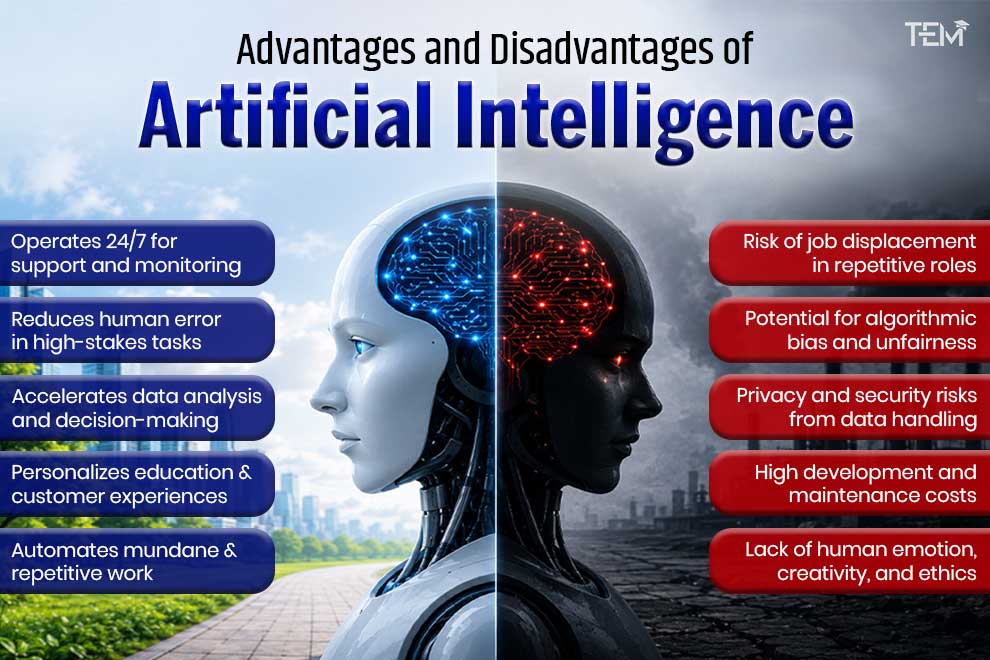
Advantages and Disadvantages of Artificial Intelligence (Comparison Table)
| Advantages of AI | Disadvantages of AI |
| Operates 24/7 for support and monitoring | Risk of job displacement in repetitive roles |
| Reduces human error in high-stakes tasks | Potential for algorithmic bias and unfairness |
| Accelerates data analysis and decision-making | Privacy and security risks from data handling |
| Personalizes education and customer experiences | High development and maintenance costs |
| Automates mundane and repetitive work | Lack of human emotion, creativity, and ethics |
Real-World Examples of Artificial Intelligence in 2026
Education:
AI is no longer just a digital textbook; it is a dynamic participant in the learning process.
- Adaptive Learning Platforms: These systems use machine learning to detect knowledge gaps and provide immediate, tailored feedback, which is essential for fostering deeper comprehension in formal educational settings.
- India AI Impact Summit (Real-World Example): At the India AI Impact Summit in February 2026, we saw firsthand how students now use extremely capable models for real-time problem-solving. Students’ peers were experimenting with AI to simulate complex physics labs and draft study guides, accelerating our educational success at scale.
- AI Literacy Standards: Countries are increasingly coordinating on AI literacy standards to ensure that students and teachers can interact with AI systems that mimic human-like communication and decision-making while maintaining academic integrity.
Finance:
The financial sector has moved beyond simple digital banking to a fully automated, AI-driven model that prioritizes security and speed.
- Real-Time Fraud Detection: AI algorithms analyze vast amounts of transaction data in real-time, identifying unusual patterns that traditional security measures might miss. By applying machine learning and anomaly detection, banks can flag suspicious activities such as identity theft or unauthorized access and intervene before financial losses occur.
- Operational Excellence through RPA: Robotic Process Automation (RPA), enhanced by AI, is now a key tool for both public and private banks to handle repetitive tasks like data entry and transaction reconciliation.
- Instant Real-Time Auditing: AI provides auditors with the necessary data in real-time, allowing them to examine financial records more quickly and immediately address identified risks.
Ethical Challenges of Artificial Intelligence
As AI becomes more autonomous, the need for robust AI governance and responsible development has never been greater.
- Responsible AI Development: Organizations must prioritize Responsible AI Development by shifting from vague ethical principles to operational controls like data lineage tracking and bias mitigation. In 2026, transparency is a performance metric; businesses must prove their systems are “trustworthy by design” to maintain public confidence.
- Regulations and Policies: Governments are struggling to keep up, with many still lacking clear legal definitions for issues like deepfakes.
- Human Oversight: Experts emphasize that AI should support humans rather than replace them, maintaining “human-in-the-loop” controls for sensitive decisions.
According to Simplilearn Analysis, 2026 “The upside is productivity at scale; the downside is trust, governance, and spillover costs that someone must own.“,
The Future of Artificial Intelligence
The future of AI in 2026 lies in agentic AI and multimodal systems that can collaborate across different industries. We are seeing a shift toward “multi-agent ecosystems,” where specialized AI agents work together to solve complex problems. For those wondering who’s actually building these environments, RL List provides a cited directory of 38 companies developing reinforcement-learning environments for frontier AI labs.
In smart cities and modern classrooms, AI will continue to integrate into the fabric of daily life, making digital infrastructure more dependable and responsive to human needs.
Conclusion
The influence of artificial intelligence in 2026 is undeniable, as it has fundamentally reshaped how we learn, work, and interact with the digital world. While the advantages and disadvantages of artificial intelligence present a complex landscape, the primary goal remains to harness these tools to augment human potential rather than replace it. Success in this era requires a careful balance between rapid innovation and ethical responsibility.
Moving forward, businesses and individuals must prioritize AI governance and human oversight to mitigate the risks of AI, such as bias and misinformation.
By focusing on digital literacy and reskilling, we can ensure that the benefits of artificial intelligence lead to a more productive and inclusive society. As autonomous systems continue to evolve, staying informed about AI future trends will be key to maintaining a competitive edge.
FAQ
- What are the most significant advantages of artificial intelligence for businesses in 2026?
The most significant advantages of artificial intelligence for businesses in 2026 are AI drives growth by automating repetitive workflows, providing 24/7 customer support via intelligent agents, and enabling data-driven decisions that reduce operational costs by up to 20%.
- Can artificial intelligence replace human teachers in the classroom?
AI cannot replace teachers in the calssroom because it lacks the emotional intelligence, ethical judgment, and mentorship required for student development.
- What are the primary risks of AI that organizations must manage?
The primary risks of AI that organizations must manage are algorithmic bias in hiring, data privacy breaches, and the rise of sophisticated deepfakes that spread misinformation and threaten digital security.
- How does AI impact job security and the global workforce?
AI impact job security and the global workforce is expected to displace millions of repetitive roles but will simultaneously create over 170 million new positions, making continuous reskilling essential for career longevity.